
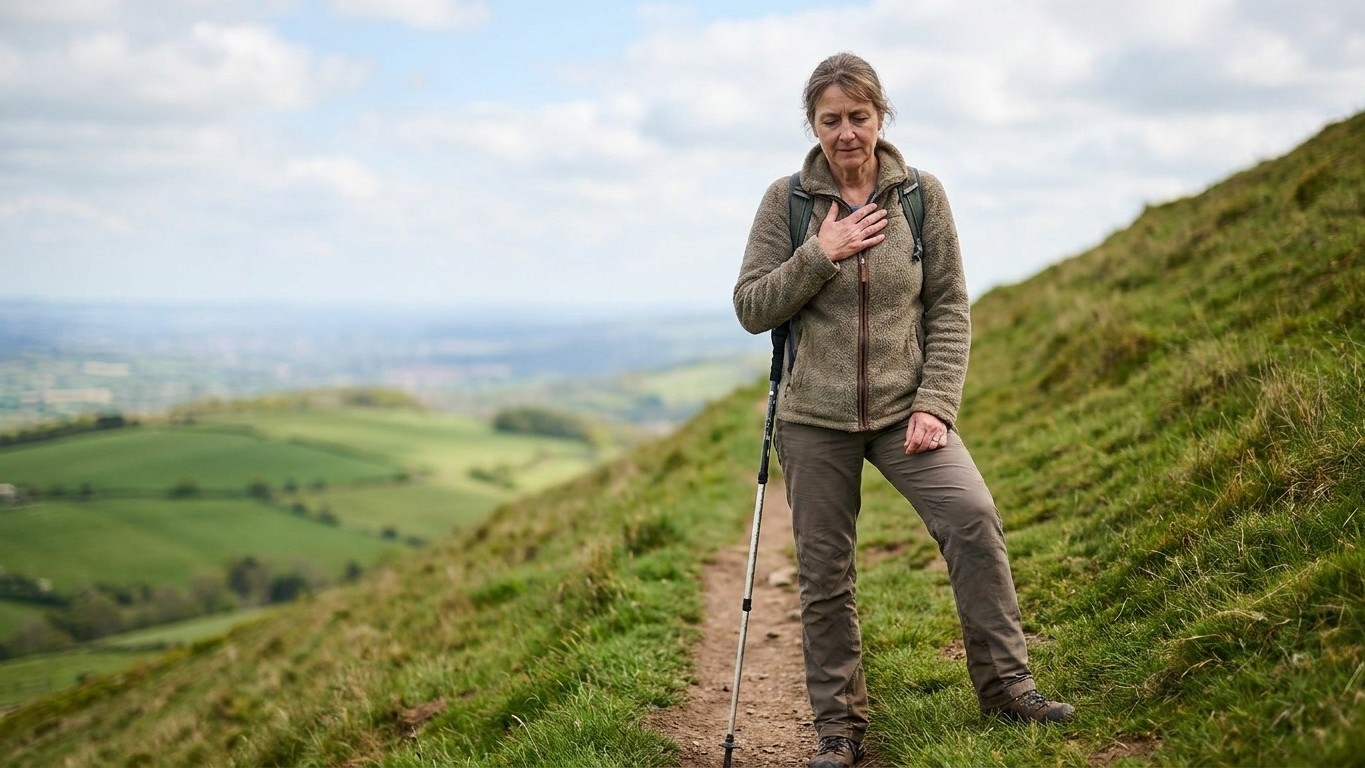
Chest tightness that shows up two minutes after you’ve stopped walking, always on the same hill, always at the same pace, is not what most people think it is. Walkers tend to write it off as “getting unfit”, but a symptom that appears at exactly the same point every single time is actually the opposite of what deconditioning looks like. Fitness drifts with sleep, hydration, stress and the weather. A fixed trigger doesn’t drift. It’s worth understanding what’s really going on before assuming you’ve simply let yourself go.
Key takeaways
- Why exercise-induced symptoms that appear precisely after stopping are rarely about fitness loss
- The surprising timing trick your airways (and your heart) use to signal trouble—and why it fools most walkers
- Two reproducible patterns that deserve a doctor’s attention, and the simple log that tells your GP everything
A moving target versus a fixed one
Genuine loss of fitness is inconsistent by nature. Some days you’d manage the hill without noticing, other days your legs would feel heavier halfway up, depending on how you slept or what you ate. What doesn’t usually happen with plain deconditioning is a symptom that clicks on like clockwork, on the same gradient, at the same effort, two minutes after you stop. That kind of precision points to a physiological threshold being crossed, not a gradual slide in general condition.
There’s also a detail people overlook: your heart rate and blood pressure don’t switch off the moment your feet stop moving. Oxygen demand stays elevated for a short window while the body downshifts, which is one reason symptoms can peak just after exertion ends rather than during the climb itself.
The airways explanation most people miss
Exercise-induced bronchoconstriction, still commonly called exercise-induced asthma, has a very specific timing pattern that matches this exact description. The symptoms of EIB are coughing, wheezing, a feeling of tightness in your chest, or shortness of breath, and most times, these symptoms start soon after you stop exercising. Research measuring lung function around exercise sessions found that symptoms may appear immediately after cessation of as little as 6 to 8 minutes of intense exercise activity, and may require 30 to 60 minutes to resolve. That delay, and the fact that discomfort worsens after stopping rather than during the effort, is the opposite of what most people expect from breathlessness.
There’s a strange twist to this condition too. Lung function may actually improve during the first 10 minutes of exercise, with symptoms followed by a refractory period of 1 to 2 hours in about half the patients, during which asthma symptoms cannot be induced again. So the same hill climbed twice in one outing might tighten your chest the first time and leave you fine the second, a pattern that confuses plenty of walkers into thinking it’s random.
Cold, dry air is a well-known aggravator. Asthma + Lung UK draws a useful line between the two possible explanations walkers face: if you have asthma symptoms like wheezing or feeling short of breath during exercise, it could be due to general lack of fitness or being overweight, but they also note that some people get tight airways and asthma-like symptoms when they exercise, even when they don’t have asthma, which is called exercise-induced bronchoconstriction. Worth remembering: this affects far more people than just those with a formal asthma diagnosis.
When it’s the heart doing the talking
The other reproducible pattern worth knowing about is angina, and it deserves a mention here because the “same hill, same pace” detail is almost textbook. The British Heart Foundation explains the mechanism plainly: when you exercise, your heart beats faster to get blood to your muscles, and so it needs more oxygen-rich blood itself, and if it does not receive enough blood, this can trigger angina pain, as well as other symptoms such as breathlessness and fatigue. Clinicians even grade the severity of angina by exactly this kind of consistency. Cleveland Clinic’s scale notes that at one level, fast walking or climbing stairs can trigger angina, while at a more advanced stage, walking a shorter distance at a normal pace can trigger angina. The narrowed artery has, in effect, a fixed ceiling, and every walk that pushes past it produces the same result.
Classic stable angina usually announces itself during the climb and eases quickly once you rest, rather than waiting two minutes to appear. That timing difference matters when you’re trying to work out which explanation fits your own pattern, but it isn’t something to diagnose from an article. Radiating discomfort into the jaw, arm or back, breathlessness out of proportion to the hill, sweating, or nausea alongside the tightness are the details that shift this from “monitor it” to “get it checked properly and promptly”.
What’s actually worth doing about it
Start a simple log for a couple of weeks: the hill, the pace, the weather, how many minutes after stopping the tightness arrived, and how long it took to fade. That pattern is exactly what a GP or practice nurse needs to hear, far more useful than “I think I’m unfit”. Risk factors change how urgently it should be looked at, and family history, smoking, high blood pressure, high cholesterol and age all raise the odds that a heart-related cause deserves priority over an airways one. If the pattern includes wheeze, a persistent cough, or symptoms easing gradually over half an hour rather than snapping off within a couple of minutes, that leans towards the airways explanation and a breathing test could settle it quickly.
None of this is a substitute for a proper assessment, and if the tightness ever changes character, lasts longer than usual, or comes with dizziness or chest pain at rest, that’s a same-day call to your GP or 999, not a wait-and-see. Do speak to your GP about any reproducible chest symptom during exercise; simple tests like an exercise ECG or spirometry can usually tell the two apart within a single appointment.
One detail that surprises most walkers: even without any asthma diagnosis at all, up to 20% of people in the general population have exercise-induced asthma symptoms. That fixed hill you’ve been quietly dreading might have far less to do with your fitness and far more to do with a narrow airway you never knew you had.
Sources : internationalheartspasmsalliance.org | uchealth.org