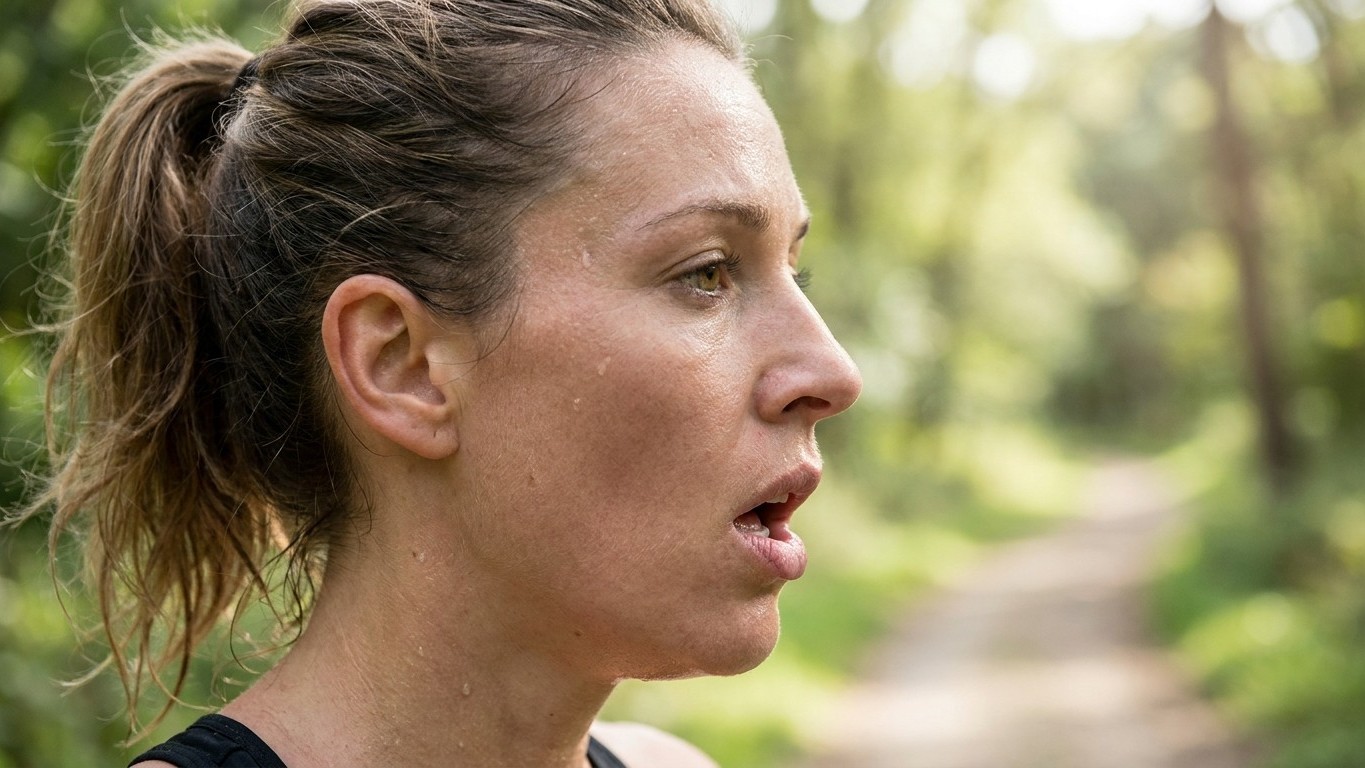
Cold air gets blamed for a lot of things on long runs: chapped lips, that raw feeling at the back of the throat, the occasional coughing fit at the finish line. But the gum bleeding that turns up somewhere around mile ten and never seems to happen on shorter, easier sessions has a different, more specific cause: what’s happening inside your mouth as you breathe hard for ninety minutes or more. It’s not the temperature. It’s the mechanics of endurance exercise itself.
Researchers at UCL looked closely at this in a study of elite athletes and found something that should reassure anyone who’s noticed the same pattern. In sports where there is a lot of airflow, such as cycling and running, breathing hard can make the mouth dry so teeth lose the protective benefits of saliva, and there is existing evidence of lower quality of saliva with intensive training. That word “quality” Matters More Than most runners realise, because the story isn’t simply “less spit, more problems.”
Key takeaways
- Your saliva doesn’t dry up during long runs—it actually changes texture, becoming thick and sticky instead of protective
- Mouth breathing combined with thickened saliva creates a surface moisture loss that gum tissue can’t withstand
- Carbohydrate gels and sports drinks sit against exposed gums for ninety minutes, raising acidity levels that brushing immediately after makes worse
Saliva doesn’t just disappear, it changes shape
Here’s the counterintuitive bit. Several studies measuring saliva during and after running have actually found flow rate increases rather than collapses during exertion. One study tracking runners through moderate and high-intensity exercise found salivary flow rate, protein and lysozyme secretion increased after exercise with moderate intensity and increased further after exercise with high intensity. So the glands aren’t switching off. What changes is the texture of what they’re producing.
The same research tracked a mucin protein called MUC5B, which is responsible for making saliva viscous and slippery. Exercise triggers an increase in the viscosity of saliva, determined by the concentration of the high molecular weight mucin MUC5B during exertion. Thicker, stickier saliva doesn’t spread across the teeth and gum line the way thin, watery saliva does. It pools instead of coating. That’s a problem, because saliva’s protective job depends on even coverage, not volume. A separate trial confirmed this pattern directly, finding immediately after exercise, the salivary viscosity and carbohydrate concentration were significantly higher than at baseline, concluding that thick saliva after exercise is at least partially due to increased secretion of MUC5B.
Add mouth breathing to that thickened saliva and you get the sensation runners describe: a mouth that feels bone dry even though, biochemically, it hasn’t run out of fluid. The constant airflow evaporates moisture off the surface faster than the thicker saliva can replace the protective film, leaving gum tissue exposed and more prone to irritation, which shows up as bleeding when you brush that evening or the next morning.
Why endurance sessions hit harder than a gym class
Duration is doing a lot of the damage here, not intensity alone. A quick five-kilometre effort doesn’t give this process time to build. Ninety minutes of open-mouthed breathing does. The UCL research team, led by Professor Ian Needleman, also flagged a nutritional angle specific to endurance training: nutrition in sports is heavily reliant on frequent carbohydrate intakes, which are known to increase inflammation in the body and gum tissues. Gels, chews, sports drinks, all sipped or chewed at regular intervals over a long run, sit against already-drying gum tissue with far less saliva available to buffer them or wash them away.
There’s a knock-on effect worth knowing about too. Beetroot juice research examining endurance athletes noted that the capacity of saliva to normalise oral pH and resist oral disease development may be limited in this population due to exercise-associated bouts of dehydration and reduced salivary flow-rates induced by mouth breathing during exercise. When pH drops and stays low because saliva isn’t neutralising it fast enough, the risk isn’t limited to gum irritation. The same research notes the risk of enamel erosion rises if pH falls below 5.5, so what starts as bleeding gums at mile ten can, over months of repeated exposure, become a broader dental erosion problem. A separate study of physically active young adults backed this up, reporting a high proportion of physically active young adults have erosive lesions, indicating that hard exercise and decreased stimulated salivary flow rate may be associated with such wear.
What actually helps, beyond blaming the weather
None of this means you should fear long runs or treat every bleed as a red flag. It does mean the fix isn’t a scarf over your mouth in January. Saliva management during endurance training is closer to pacing strategy than dental luck, and small adjustments seem to make a measurable difference.
- Sip water at regular intervals rather than gulping occasionally, since consistent hydration supports steadier saliva production through the session rather than a post-run rebound.
- Practise nasal breathing during easy warm-up kilometres and lower-intensity blocks, saving mouth breathing for when effort genuinely demands it.
- Rinse with plain water after gels or sports drinks rather than brushing immediately, since brushing straight after an acidic exposure can work enamel that’s already been softened.
- Chew xylitol-based sugar-free gum in the hour after a long session to stimulate flow back to normal while the mouth recovers.
Interestingly, one trial comparing fluids during exercise found that post-exercise saliva flow rate was not different when consuming a sports drink compared to before exercise, but decreased when water was ingested instead. That doesn’t mean sports drinks are better for your teeth, their sugar and acid content usually cancels out any saliva benefit, but it does show fluid choice genuinely changes what’s happening in your mouth mid-run, not just how thirsty you feel.
If the bleeding persists well beyond your longest sessions, turns up after short easy runs too, or comes with soreness rather than just a pink tinge on the toothbrush, that’s worth mentioning to a dentist rather than filing under “just an endurance thing.” Gum inflammation that’s allowed to sit unaddressed doesn’t stay confined to training days, and your GP or dental practice can check whether something beyond exercise physiology is contributing. For most runners, though, the pattern described here, dry mouth building through a long session, thickened saliva losing its protective spread, gums left exposed to acidic fuel, explains the mile-ten bleed far better than the temperature ever did.
Sources : ncbi.nlm.nih.gov | ucl.ac.uk