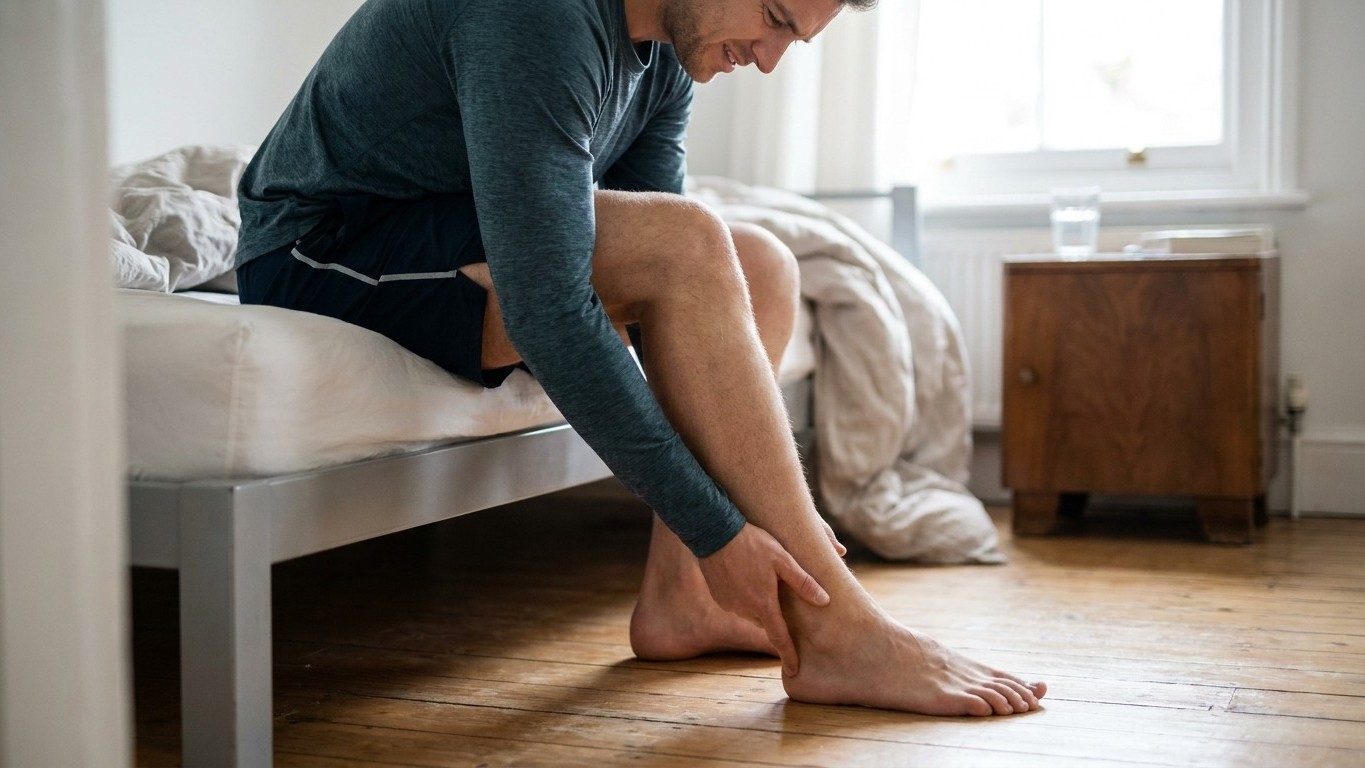
Six weeks. No running, no jumping, barely any walking beyond what daily life demanded. By the time I laced up for that first tentative run back, I expected relief, maybe even a spring in my step after all that recovery time. Instead, the tendon felt tight, oddly disconnected from the calf, and weaker than before the injury started. That first kilometre taught me something the rest period never could: time off doesn’t rebuild a tendon, it just pauses the clock while strength quietly drains away.
Achilles tendinopathy is one of the most common overuse injuries among runners, and the instinct to simply stop until the pain disappears feels logical. But the current clinical consensus tells a different story. Clinical practice guidelines for Achilles tendinopathy do not recommend complete rest, and patients should continue with recreational activities within pain tolerance while participating in rehabilitation, with the only Level A evidence for intervention found being exercise rehabilitation. Rest lowers pain in the short term, yes, but it doesn’t address why the tendon became irritated in the first place.
Key takeaways
- What happens to your Achilles during six weeks of complete rest might surprise you
- The moment your pain disappears isn’t when your tendon is actually ready
- A simple morning stiffness test reveals what your tendon is truly telling you
What six weeks of rest actually does to the tendon
The Achilles doesn’t behave like a bruise that simply fades with time. It’s a load-bearing structure that adapts, or deconditions, based on what you ask of it. A controlled clinical trial published in the journal Sports Medicine – Open found that it was exclusively a high-loading exercise intervention that induced significant mechanical and morphological adaptations of the plantar flexor muscle-tendon unit, which might contribute to protecting the tendon from strain-induced injury. Take the loading away entirely, and you take away the stimulus the tendon needs to stay resilient.
There’s also a more immediate, almost mechanical explanation for why a rested tendon can feel so stiff on that first run. Research examining the acute response of tendon tissue to exercise found that heavy resistive ankle exercises induced an immediate and significant decrease in Achilles tendon thickness of around 15 percent, with thickness returning to pre-exercise levels within 24 hours through an exponential recovery process. This fluid movement in and out of the tendon appears tied to its health and nutrition. Six weeks without that rhythmic loading and unloading is six weeks the tendon spends essentially stagnant, and mine felt exactly like that on the first attempt back: dry, tight, unresponsive.
Calf strength takes a hit too, and not just on the injured side. Clinicians who treat this injury regularly point out that even without pain, people with Achilles tendinopathy have reduced plantar flexor strength on the opposite side. So while I’d been protecting one leg, both had quietly lost capacity. That mismatch between how ready you feel psychologically and how ready your tissue actually is happens to be exactly where most comeback runs go wrong.
Why the pain-free window is deceptive
Pain and tissue readiness are not the same thing, and this is the part that caught me out. Feeling no discomfort while walking around the house tells you very little about whether the tendon can cope with running, where forces are dramatically higher. The ground reaction forces the Achilles has to tolerate during running can be up to three times more than walking. Some sources put that multiplier even higher depending on pace and terrain. Either way, the jump from “comfortable at rest” to “ready for repeated high-force loading” is far bigger than it feels.
This helps explain a statistic that genuinely surprised me when I first came across it: up to 44% of people returning to sport after Achilles tendonitis end up with a recurrence of the injury. Almost half. That’s not a failure of willpower, it’s usually a failure of pacing, going from zero activity straight back to normal training volume because the pain had gone and patience had run out.
Physiotherapists tend to use a simple, practical marker instead of pain during exercise: how the tendon feels the next morning. One rehabilitation clinic describes watching how the tendon settles by the next morning, not how it feels mid-exercise, using that morning stiffness as the dial for progressing or holding. If you wake up hobbling on those first few steps, that’s the tendon telling you the previous day’s load was too much, regardless of how comfortable the run itself felt.
Rebuilding without repeating the mistake
The return needs to be built around strength benchmarks, not just time elapsed or symptom relief. One clinic guideline suggests soleus strength should be a priority, noting that a seated calf raise should aim for 1.5 times body weight prior to resuming pre-injury running levels. That’s a considerably higher bar than most runners think to test before heading back out.
Spacing matters just as much as strength. A sensible approach recommends allowing roughly two days between runs to gauge tendon pain, allow recovery and avoid flare ups when fitness is building, alongside a straightforward pain scale: mild discomfort during activity that settles within a day is generally tolerable, but anything that lingers at a higher intensity signals the load was too much. Full recovery, researchers note, isn’t quick either. Recovery from Achilles tendinopathy can take up to a year, and there is a high propensity for recurrence, especially during the return-to-sport phase. That timeline felt discouraging when I first read it, but it reframed my six-week rest for what it really was: a pause, not a cure.
What I’d tell any runner facing the same tightrope walk is this: the tendon doesn’t remember how long you rested, it only responds to what you load it with next, and how consistently. Progress in small, monitored increments, let the calf raise numbers guide you rather than the calendar, and treat that first pain-free run as the start of rehabilitation rather than proof it’s finished. If pain persists beyond a few days of sensible loading, or you notice swelling, marked weakness, or a sudden sharp pain suggesting something more serious, it’s worth getting it assessed properly by your GP or a physiotherapist rather than guessing your way through it.
Sources : ncbi.nlm.nih.gov | jospt.org