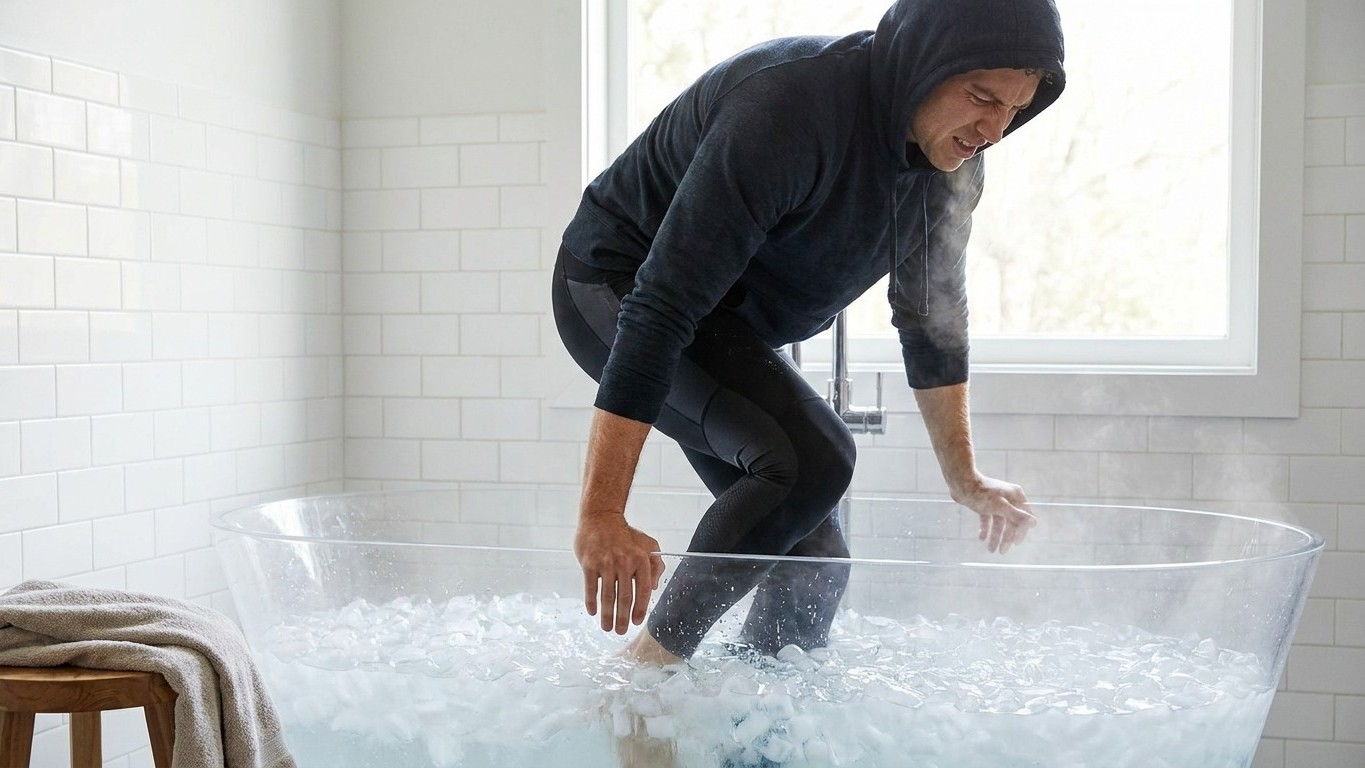
Ten minutes in water barely above freezing, done religiously after every single strength session for twelve weeks. That was the routine, and by the end of it the soreness had genuinely faded faster than usual. What hadn’t faded, though, was the nagging suspicion that something else was going on beneath the skin, something the ice wasn’t telling me about until I went looking for the research behind it.
The answer turned out to be uncomfortably specific. A widely cited study from the University of Queensland put 21 men through eight weeks of strength training, splitting them into two groups: one took a 10-minute ice bath at 10°C after every session, the other pedalled gently on an exercise bike instead. In the study, 21 men did strength training two days a week for 12 weeks, and about half took a 10-minute ice bath in water that was about 50 degrees Fahrenheit (10 degrees Celsius), while the other half cooled down actively by riding exercise bikes after each workout. The result wasn’t subtle. The researchers found that, at the end of the study, muscle strength and mass increased more in the men who cooled down on exercise bikes than in those who took ice baths.
A follow-up using MRI scanning (the gold standard for measuring actual muscle size rather than estimating it) made the gap even starker. Post-exercise application of cold water immersion at roughly 10°C for 10 minutes attenuated the increase in quadriceps muscle mass, with around a 15% gain for the control group compared to just 2% for the cold water group after 12 weeks of resistance training in young resistance-trained men. That’s not a rounding error. That’s the difference between visible progress and barely anything to show for three months of graft.
Key takeaways
- One athlete’s 12-week ice bath experiment revealed an uncomfortable truth backed by University of Queensland research
- Cold water immersion blocks nutrient delivery to muscles during a critical growth window—sometimes for hours after training
- Muscle size gains dropped dramatically in ice bath users compared to active recovery, but the mechanism behind it might surprise you
What the cold is actually doing to your muscles
Muscle growth after a hard lifting session isn’t instant. It’s a slow-burn biological cascade that unfolds over hours and days, and cold water seems to interrupt it at several points at once. Straight after training, blood flow to worked muscles normally surges, a response researchers call hyperaemia, and this rush of blood brings important nutrients like amino acids, oxygen and insulin, all of which help to trigger the muscle-building process. Plunge into cold water, though, and the blood vessels tighten in a reaction called vasoconstriction, which limits how much of those nutrients get through, meaning your muscles may miss out during an important window for growth and recovery. One analysis found the effect was still measurable hours later: even three hours after the workout, blood flow to the muscle that had been cooled was still noticeably lower, meaning the muscles were getting less of the amino acids and oxygen they needed to grow, with about 30% less of the building blocks of protein being used by the muscle.
It doesn’t stop at blood flow. A 2019 study from Victoria University tracked the actual molecular signalling inside muscle tissue and found that cold water immersion attenuates post-exercise anabolic responses both before and after seven weeks of resistance training and increases basal levels of protein degradation markers post-training, with the blunting of anabolic responses persisting after a period of training, which has implications for muscle growth over longer training periods. Interestingly, the same research found that blunted muscle fibre growth with cold water immersion does not necessarily translate to impaired strength development, which is a curious wrinkle worth remembering. Size and strength don’t always move in lockstep.
The bigger picture from the pooled evidence
Individual studies are useful, but the pattern really solidifies when you look across all of them together. A 2024 meta-analysis pulling together eight separate trials on cold water immersion and hypertrophy found that preliminary analyses showed strong evidence of hypertrophic adaptations with resistance training alone, likely at least small in magnitude, while hypertrophic adaptations with cold water immersion plus resistance training were likely small to negligible in magnitude. Translated out of statistics-speak: lifting weights works, as you’d expect, but bolting an ice bath onto the end of every session quietly shaves away a meaningful chunk of that benefit.
The mechanism isn’t just about blood flow or hormones either. Inflammation, the thing we’re all conditioned to fear and try to switch off as fast as possible, appears to be doing real work in the muscle-building process. Recovery is not just about feeling better, it’s about adaptation: resistance training creates microtears in muscle fibres, and the body responds by repairing and reinforcing those fibres through a process driven by muscle protein synthesis, which is the foundation of hypertrophy and strength gains. Dulling that inflammatory signal with cold, night after night, appears to tell the body there’s less repair work to do than there actually is.
So is the ice bath a waste of time?
Not entirely, and this is where nuance matters more than headlines. Cold water immersion has a genuine, well-documented job to do: it eases delayed-onset muscle soreness and speeds up how you feel between back-to-back training days, which is exactly why endurance athletes and those training multiple times a day still swear by it. The problem is timing and intent. If the goal twelve weeks from now is bigger, stronger muscles rather than simply feeling less battered tomorrow morning, dunking into 10°C water straight after every strength session is working against the very adaptation you’re chasing.
My own twelve weeks weren’t wasted, not completely, but they weren’t optimised either. These days I save the cold plunge for the days I genuinely need to feel human again quickly (before a second session, or ahead of a busy work week) and let the soreness run its course on the days when growth, not comfort, is the actual target. A warm shower, some gentle movement and a decent protein intake do the job just as well without switching off the very signals I was training so hard to switch on. As ever, if you’re managing an injury or have a specific medical reason for using cold therapy, it’s worth having a chat with your GP or a physiotherapist before building a routine around it.
Sources : researchgate.net | sportrxiv.org