
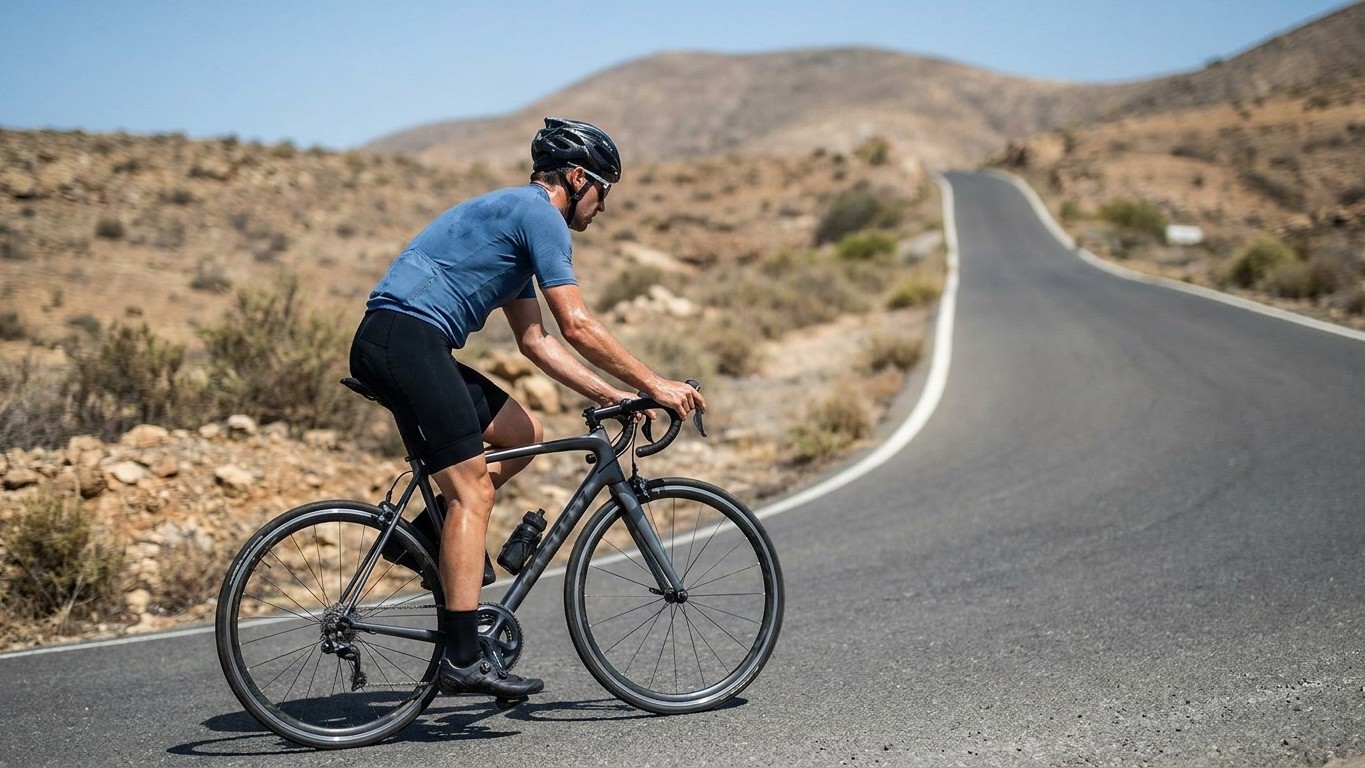
Drop below roughly 15 km/h on a climb and the airflow that normally carries heat away from your skin all but disappears, even though your legs are working harder than ever. The single change that stops this heat from piling up is deliberately backing off your power output the moment your speed dips under that threshold, rather than pushing to match your mates’ pace up the hill. It looks like slacking on Strava. It isn’t.
Key takeaways
- At 15 km/h and slower, the airflow cooling advantage of cycling nearly disappears—even when it’s cool outside
- Your muscles produce the same furnace-like heat uphill as on the flat, but without the speed-generated breeze to dissipate it
- Easing power output early prevents your core temperature from triggering involuntary muscle shutdown mid-climb
Why the hill turns into an oven
Cycling has a built-in cooling advantage that running and hiking don’t: your own forward motion creates wind. Cycling has one useful advantage over many other forms of outdoor exercise: speed creates airflow, and as the bicycle moves, air passes across the rider’s skin and clothing, supporting convective cooling and improving sweat evaporation. The trouble starts the moment gravity gets involved. The cooling effect decreases rapidly when speed falls, and on a long climb, the rider may produce very high metabolic heat while moving at only 7–12 km/h, while the surrounding terrain may block natural wind.
The numbers behind this are more striking than most riders realise. Riding at 14 mph (22.5 km/h) generates enough airflow to dissipate the heat, but climbing at 6 mph (10 km/h) means you could overheat even if it’s cool outside. Your muscles don’t know or care that you’ve slowed down. During exercise, around 75-80% of the energy produced by working muscles is released as heat, with only 20-25% converted into mechanical output. On the flat, that heat gets swept away by the breeze you’re generating. Grind up a 12% ramp at walking pace and the same furnace is burning, minus the fan.
This is precisely why a cyclist riding slowly uphill in hot, still air may accumulate heat quickly, sometimes faster than someone jogging in the shade. It’s a genuinely counterintuitive quirk of physiology, and it catches out fit, experienced riders as often as beginners.
The one change: pace by effort, not by your mates’ wheel
Once you understand that airflow, not ambient temperature, is doing most of the cooling work, the fix becomes obvious: when your speed drops under about 15 km/h, deliberately dial your power down rather than trying to hold the group’s pace. Coaches working with riders in hot events already build this into their pacing strategy for the opening efforts of a ride. Starting 5-8% below your target power for the first 30-60 minutes is not conservative, it’s optimal, because a rider who starts at 95% of threshold in 35°C will produce more total work over four hours than a rider who starts at 100% and blows. The same logic applies to any individual climb, not just the start of a ride.
The reason this matters so much on slow climbs specifically comes down to what heat does to your muscles once it builds up. Exercising increases metabolic heat production, and if the external environment makes losing that heat harder, the cyclist begins to ‘store’ heat, with core temperature rises resulting in reduced intensity because of a decrease in muscle recruitment, regulated by the brain. In practical terms, your legs get switched off from the top down before you’ve consciously decided to slow. Backing off the power slightly, early, keeps you ahead of that brake rather than fighting it halfway up the climb.
There’s also a perception trap worth naming. Rating of perceived exertion becomes unreliable in the heat, and it lies in one direction, with a pace that felt comfortable at 20°C feeling like threshold effort at 35°C. Your mates chatting away at the front might genuinely be working less hard than you, or they might simply not have hit their own thermal ceiling yet. Either way, matching their speed on a slow, exposed climb is a poor proxy for matching their effort.
What this actually looks like on the road
In practice, the change is small and slightly unglamorous. Drop a gear before your speed falls under 15 km/h rather than after, keep cadence up rather than mashing a bigger ring to hold position, and let the gap open if it has to. A few habits reinforce the effect:
- Check your speed, not just your heart rate, as the early warning sign that airflow cooling is failing you
- Pour water over your head and forearms on the climb itself, since Tour de France riders often grab bottles from fans not to drink, but to pour water over themselves, and applying water to your head and clothing can provide instant relief from the heat
- Treat any unusually fast heart-rate drift on a slow section as data, not a mood
- Save the harder push for the descent or the flat that follows, where your own speed will do the cooling for you
There’s a sting in the tail worth knowing about if your route includes a descent between climbs. On courses like the Maratona dles Dolomites, exposed climbs can reach 30°C+, and the deceptive part is that the descents feel cool, so riders stop cooling efforts, then suffer on the next climb. The relief of a fast, breezy descent can undo any good pacing discipline you showed on the way up, simply because it feels like the heat problem has gone away. It hasn’t. It’s just waiting for the next ramp under 15 km/h to start stacking up again, and the rider who kept sipping, kept the cap wet, and didn’t fully relax on the way down will be the one still riding strongly an hour later.
If you experience dizziness, confusion, nausea or stop sweating during hot-weather rides, these can be signs of heat exhaustion or heatstroke. Stop riding, cool down and seek medical attention, and speak to your GP before undertaking strenuous exercise in high temperatures if you have any underlying health concerns.
Sources : roadbikerider.com | hdroptech.com