
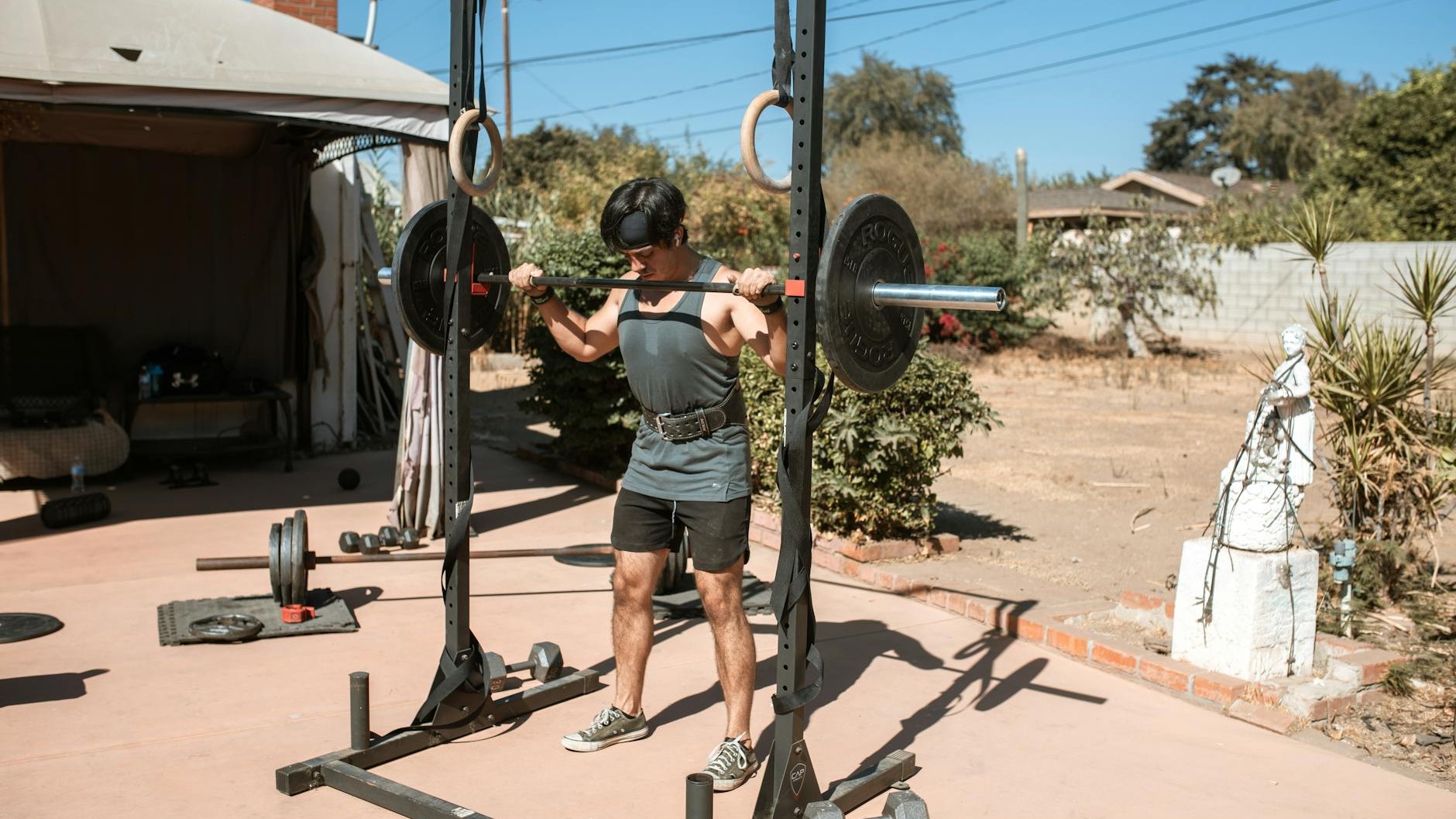
Lifting belts are everywhere in gyms right now, and for good reason, they do work. Under genuinely heavy loads, a well-fitted belt increases intra-abdominal pressure, gives the spine a more stable environment, and can meaningfully reduce injury risk during maximal efforts. The science on this is solid. The problem is not the belt itself. The problem is what happens when you wear it for your warm-up sets, your moderate lifts, your Romanian deadlifts, and basically every time you walk near a barbell.
Key takeaways
- Your transverse abdominis is being outsourced to plastic and Velcro—and it’s forgetting how to do its job
- Research from occupational health found prolonged belt use actually reduces trunk muscle strength over time
- The real danger isn’t in the gym; it’s when you reach for something off a shelf without the belt to save you
The muscle that does the job your belt is doing
Your transverse abdominis, often called the TVA, wraps around your trunk like a corset. It is the deepest layer of your abdominal muscles, sitting beneath the rectus abdominis (the “six-pack” muscle) and the obliques. Its primary job is to pre-emptively brace your spine a fraction of a second before any load or movement arrives, a reflex your nervous system runs automatically when it is functioning well. Researchers studying spinal stabilisation have consistently identified this anticipatory muscle activation as one of the key mechanisms protecting against lower back injury.
Here is where belts become a double-edged tool. When you strap one on, it provides the external hoop tension your TVA would normally generate itself. The spine gets its stability, the lift gets done, and your brain registers: job handled, no need for the TVA to fire hard. Over time, with repeated reliance on the belt across most of your training, that automatic anticipatory bracing response can weaken. The TVA, like any muscle, responds to demand. Give it less to do, and it does less.
What the research actually shows
Studies using electromyography (EMG) to measure muscle activation during loaded exercises have found that lumbar belts do reduce the muscular effort required from the stabilising muscles of the trunk during sub-maximal lifts. A frequently cited body of work in occupational health, examining workers who wore back support belts continuously during manual labour, found that prolonged belt use was associated with measurable reductions in trunk muscle strength over time, not increases. The belt was doing the work instead of the muscles.
This matters enormously when you consider what happens outside the gym. You do not wear a lifting belt when you pick up a child, haul luggage into an overhead compartment, or twist awkwardly reaching for something on a shelf. Those are the moments when a chronically underworked TVA leaves you exposed. Lower back pain in the general population is not usually caused by heavy deadlifts; it is caused by mundane movements the body was not prepared to stabilise.
There is also a proprioceptive element worth understanding. The belt gives you a constant pressure signal around your trunk, which actually helps with bracing awareness, that is partly why it feels useful. But that same signal can train your body to rely on external feedback rather than developing its own internal sensing of core tension. Remove the belt, and some lifters genuinely cannot replicate the same bracing quality they had with it on.
How to use a belt without undermining your foundation
The conventional wisdom among strength coaches, and this is a position with good physiological grounding, is that belts belong at roughly 85 to 90 percent of your one-rep maximum and above. Below that threshold, the goal should be developing your own bracing capacity. This means your warm-up sets, your technique work, your moderate accessory lifts, all done without the belt, with deliberate attention to generating that internal tension through your breath and your deep core.
Breathing mechanics are central to this. The Valsalva manoeuvre, where you take a deep breath into your belly, hold it, and brace your entire trunk before initiating a lift, creates genuine intra-abdominal pressure without any external aid. Practising this consistently on sub-maximal loads is the single most effective way to train your TVA to do its job reliably. Many recreational lifters skip this step because the belt compensates, and that is precisely where the slow erosion begins.
Direct TVA training is also worth including in your programme. Dead bugs, pallof presses, and slow bird-dog variations are not glamorous, but they specifically target the deep stabilising musculature that heavy compound lifts in a belt tend to bypass. A ten-minute core stability block twice a week can meaningfully close the gap if you have been belt-dependent for a long time.
A practical guide to belt use that actually protects you
If you want to keep your belt as a Performance tool rather than a crutch, a few adjustments are all it takes. Reserve it strictly for your heaviest working sets. Warm up beltless, every time, regardless of how heavy the session will eventually get. Spend at least one training cycle per year doing all your work without it, to audit and rebuild your unassisted bracing. And if you find that removing the belt makes your technique noticeably collapse even on moderate weights, that is diagnostic information, your TVA is telling you something.
One thing that surprises many lifters is that spending six to eight weeks training without a belt, while temporarily reducing their working weights, often results in a new beltless personal best by the end of that period, because the foundation has actually been rebuilt. The belt then adds to a solid structure rather than papering over a weak one. That is the distinction between using it intelligently and using it habitually, and for the long-term health of your spine, that distinction is everything.
Always consult your GP or a qualified physiotherapist before making significant changes to your training, especially if you have an existing back condition.