
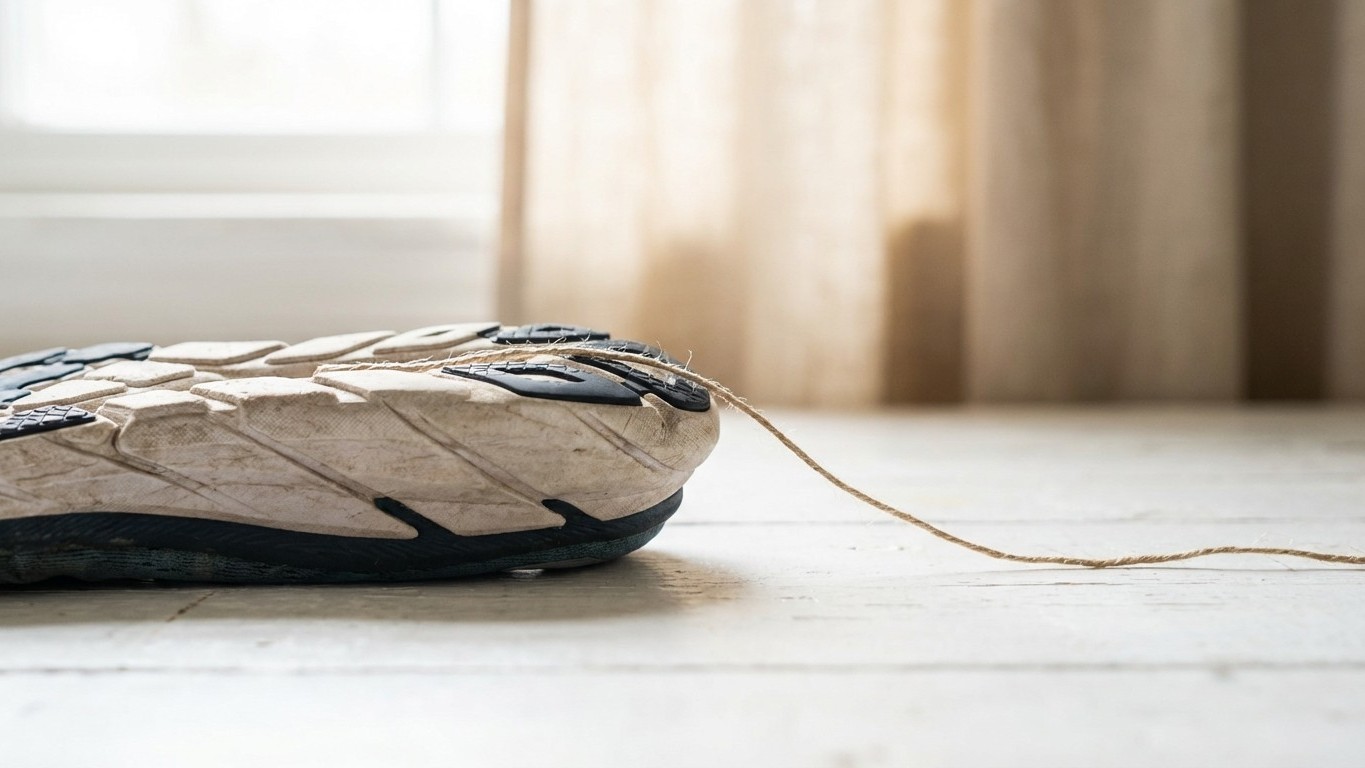
The drop number. It sits quietly on the box, sometimes on the tongue of the shoe, occasionally buried in the spec sheet, and most runners walk straight past it. Then, around week five or six of a new training block, the Achilles starts to complain. Or the calf seizes up on a Tuesday morning run. Or there’s that nagging pull behind the knee that wasn’t there before. The culprit is often not mileage, not pace, not even your running form. It’s that small figure, measured in millimetres, that describes how much higher your heel sits than your forefoot.
Key takeaways
- A number measured in millimetres on your shoe holds the key to a painful injury pattern that appears with suspicious regularity
- Your tendons operate on a biological timeline that’s completely disconnected from how quickly your legs feel ready for new demands
- There’s a specific window where prevention is possible, but most runners miss it by weeks
What the drop number actually means
Heel-to-toe drop (sometimes called “offset”) is the difference in stack height between the heel and the forefoot of a running shoe. A traditional trainer might sit at 10–12mm of drop, meaning the heel is significantly elevated compared to the toe. A “zero drop” shoe, as the name suggests, keeps both ends at the same level, mimicking barefoot movement. Most everyday running shoes fall somewhere between 4mm and 12mm, and that range matters far more than most runners appreciate.
The mechanics behind this are worth understanding. When your heel is elevated, your calf and Achilles tendon are effectively in a shortened, slightly relaxed position with every step. Over years of wearing shoes with significant drop (and this includes most standard trainers, dress shoes, and heels), the posterior chain adapts. The calf complex shortens. The Achilles becomes accustomed to operating within a reduced range of motion. Switch suddenly to a lower-drop shoe and you’re asking those same tissues to stretch further, absorb more load, and work through a range they haven’t used in years. That’s a recipe for tendinopathy.
Why week six is the danger zone
This timing is not a coincidence, and it’s one of the more instructive patterns in sports medicine. Tendons adapt more slowly than muscles, cardiovascular fitness, or even bone. A runner transitioning to lower-drop shoes might feel perfectly comfortable through the first few weeks, their muscles handling the new demand without obvious complaint. But tendons work on a longer biological clock. The collagen remodelling process that allows a tendon to adapt to new mechanical stress takes weeks, and when the cumulative load exceeds what the tissue can absorb before it’s had time to strengthen, that’s when symptoms appear.
Research into tendon biology consistently shows that this lag between load and adaptation is where most overuse injuries originate. It’s not that the shoe is inherently bad. A zero-drop or minimal shoe worn by someone who has transitioned carefully over months can be perfectly fine. The problem is the mismatch between the change in mechanical demand and the speed at which the body is given to catch up.
A useful analogy: imagine spending a decade never stretching your hamstrings, then signing up for a weekly yoga class and attending every day from day one. The enthusiasm isn’t the problem. The timeline is.
How to change shoes without injuring yourself
The good news is that this is almost entirely preventable with a structured transition. If you’re moving from a 10–12mm drop shoe to something lower (say, 4–6mm), give yourself a minimum of eight to twelve weeks before that lower-drop shoe becomes your primary trainer. Start by wearing it for one shorter run per week, keeping your other sessions in your usual shoes. Gradually increase the proportion over time.
Specific exercises can accelerate safe adaptation. Eccentric calf raises (slowly lowering the heel below the level of a step) have a solid body of evidence behind them for building tendon resilience. Single-leg calf raises, done with control rather than speed, are worth incorporating two to three times a week during any shoe transition. Stretching alone is less effective than loading the tissue progressively.
Pay attention to where you’re running, too. Hard tarmac demands more from a lower-drop shoe than trail surfaces or a track, because there’s less natural give in the ground to absorb impact. Some runners find it helpful to do their initial low-drop miles on softer ground before bringing them onto road routes.
One thing worth knowing: going in the other direction (from low-drop to high-drop) can also cause issues, though these tend to show up differently, often as knee or hip complaints rather than Achilles problems. The body is always adapting to whatever footwear geometry you present it with, which is both reassuring and a reminder that there are no neutral choices in running shoes.
The bigger question about what your feet actually need
There’s a broader conversation happening in sports science about what constitutes an “optimal” running shoe, and it remains genuinely unsettled. The minimal shoe movement of the early 2010s generated both passionate converts and a wave of stress fractures among runners who transitioned too fast. The current swing back toward maximal cushioning (with drops that vary considerably across brands) has its own set of implications for load distribution and lower limb mechanics.
My honest view? The drop number isn’t inherently good or bad at any point on the scale. What matters is consistency, gradual change when change is needed, and listening to the signals your body sends before week six turns into a month on the physio table. If you’re buying new shoes and the drop is more than 3–4mm different from your current pair, that’s worth a conversation with a running specialist or a physiotherapist before you log your first mile in them.
And if your tendons are already talking to you, please do see your GP or a musculoskeletal physiotherapist. Self-diagnosis has its limits, and what feels like an Achilles problem isn’t always straightforward. The shoe might be where it started, but the solution rarely ends there.