
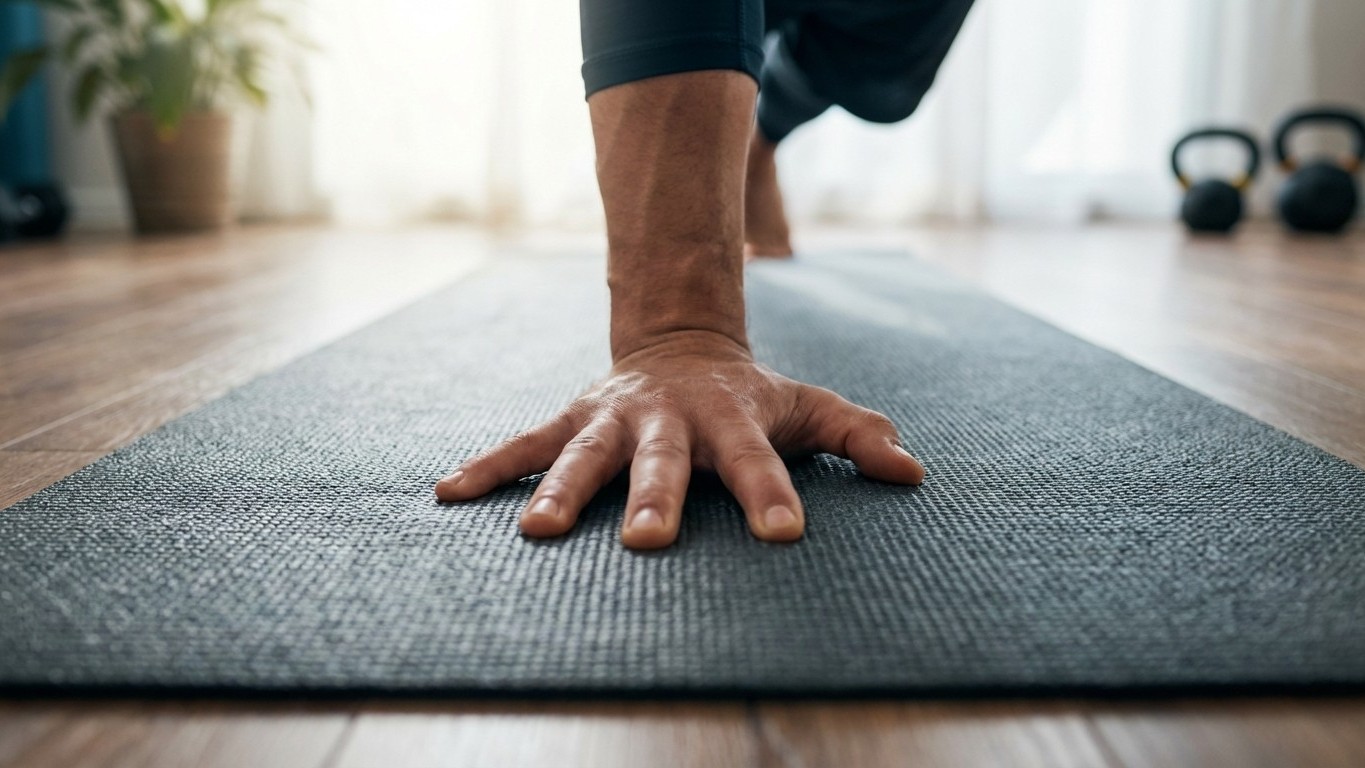
Wrist pain during push-ups is one of the most common complaints physiotherapists hear from people who exercise regularly at home. The joint is simply not designed to bear full bodyweight in a fully extended, flat-palm position, and for many people, that’s exactly what they’re doing every single session. A small adjustment to hand positioning, specifically how the fingers engage with the floor, can shift the load distribution enough to make a genuine difference.
Key takeaways
- Most push-up wrist pain comes from a single biomechanical issue that’s rarely addressed by beginners
- A five-second hand adjustment triggers a chain reaction of stability through your entire upper body
- The technique works so consistently that the real question becomes why no one teaches this from day one
Why your wrists hurt during push-ups in the first place
The wrist joint has a limited range of comfortable extension. When you place a flat palm on the floor and lower your Bodyweight through it, you’re pushing that joint to around 90 degrees of extension, which is at or near its anatomical limit for most people. Add compression and repetition, and it’s no surprise that discomfort follows.
There’s also a muscle imbalance issue that rarely gets discussed. The forearm flexors, the muscles running along the inside of your arm, tend to be tighter and stronger than the extensors in most people who spend hours typing or using a phone. This imbalance pulls the wrist into a slightly awkward position under load, concentrating stress on the lateral and dorsal structures of the joint. It’s not dramatic, but over time it accumulates.
A flat palm also offers minimal feedback to the nervous system. Without active engagement in the hand, the wrist bears the brunt of stabilisation work it was never meant to do alone.
The finger trick: what it actually involves
The technique a physiotherapist might show you is deceptively simple. Rather than placing your hands completely flat with fingers relaxed, you actively press your fingertips, the pads just below the nails, into the floor throughout the movement. Think of it as gripping the ground, almost as if you were trying to claw the surface slightly. The heel of the hand stays down, but the emphasis shifts forward into the fingers.
This does several things at once. Spreading the fingers wide (index finger pointing roughly forward, thumb at 45 degrees) increases your base of contact, which distributes force across a larger surface area. The active fingertip engagement triggers what’s known as co-contraction in the forearm, where flexors and extensors fire together, creating a natural splinting effect around the wrist joint. The joint becomes more stable without any equipment required.
There’s a secondary benefit that often goes unnoticed. When you grip the floor through your fingertips, it tends to trigger a chain reaction of engagement up the arm: forearms tighten, elbows track slightly inward, shoulders pack into the socket more effectively. The whole kinetic chain organises itself better from that single point of contact. Some physiotherapists describe this as “feeding tension through the system from the ground up,” and it’s a principle borrowed from strength training that applies just as well to bodyweight exercise.
Getting it right: the practical details
Hand position matters as much as finger engagement. A common error is placing the hands too far forward, which increases wrist extension even further. Your hands should sit roughly beneath your shoulders, perhaps very slightly wider. Fingers spread, fingertips pressing, thumb at a comfortable angle away from the index finger.
When you first try this, your forearms may fatigue faster than usual. That’s expected, and it’s actually a sign the technique is working. Muscles that previously weren’t contributing much are now being recruited. Give it a few sessions before drawing conclusions. Most people who adopt this approach notice that the familiar ache in the outer wrist begins to fade within a fortnight, though timelines vary depending on the underlying cause of the pain.
If you find even this adjustment insufficient, rotating your hands outward, so the fingers point at 10 and 2 on a clock face rather than straight ahead, reduces the degree of wrist extension required. This is a common modification used in rehabilitation settings. It’s slightly less demanding for the wrist while still allowing effective upper body work.
A note on fists and parallettes
Two other options exist for people with more significant wrist issues. Doing push-ups on closed fists keeps the wrist in a neutral, non-extended position entirely, eliminating the extension stress almost completely. The floor surface needs to be forgiving (a mat or carpet works better than wood), and the technique requires stable, firm fists. Parallettes, the small parallel bars used in gymnastics training, offer a similar neutral wrist position with more stability and are worth considering if flat-palm work remains consistently uncomfortable despite technique adjustments.
When to see a professional rather than self-correct
Technique adjustments are useful for the kind of diffuse, aching wrist discomfort that comes on during or after exercise and settles within an hour or two. Sharp, localised pain, swelling, pain that persists well beyond your session, or any tingling or numbness in the fingers are different matters entirely. These symptoms can indicate structural issues, including stress reactions in the carpal bones, that need proper assessment. Please consult your GP or a chartered physiotherapist before continuing to train through that kind of pain.
One detail worth knowing: research published in journals examining grip and wrist biomechanics consistently shows that wrist injuries in gym settings are underreported because people dismiss them as “just a niggle.” That dismissal is where minor, correctable discomfort occasionally becomes a longer-term problem. The finger trick works well precisely because it addresses a mechanical cause rather than masking symptoms, but it’s a technique adjustment, not a diagnostic tool.
Something that surprises many people: the same fingertip-pressing principle applies to yoga poses like downward dog and plank, where identical wrist extension loads are present. If you’ve been managing low-grade wrist discomfort across multiple exercises without connecting the dots, the hands-on-floor mechanics may be the single common thread worth examining first.