
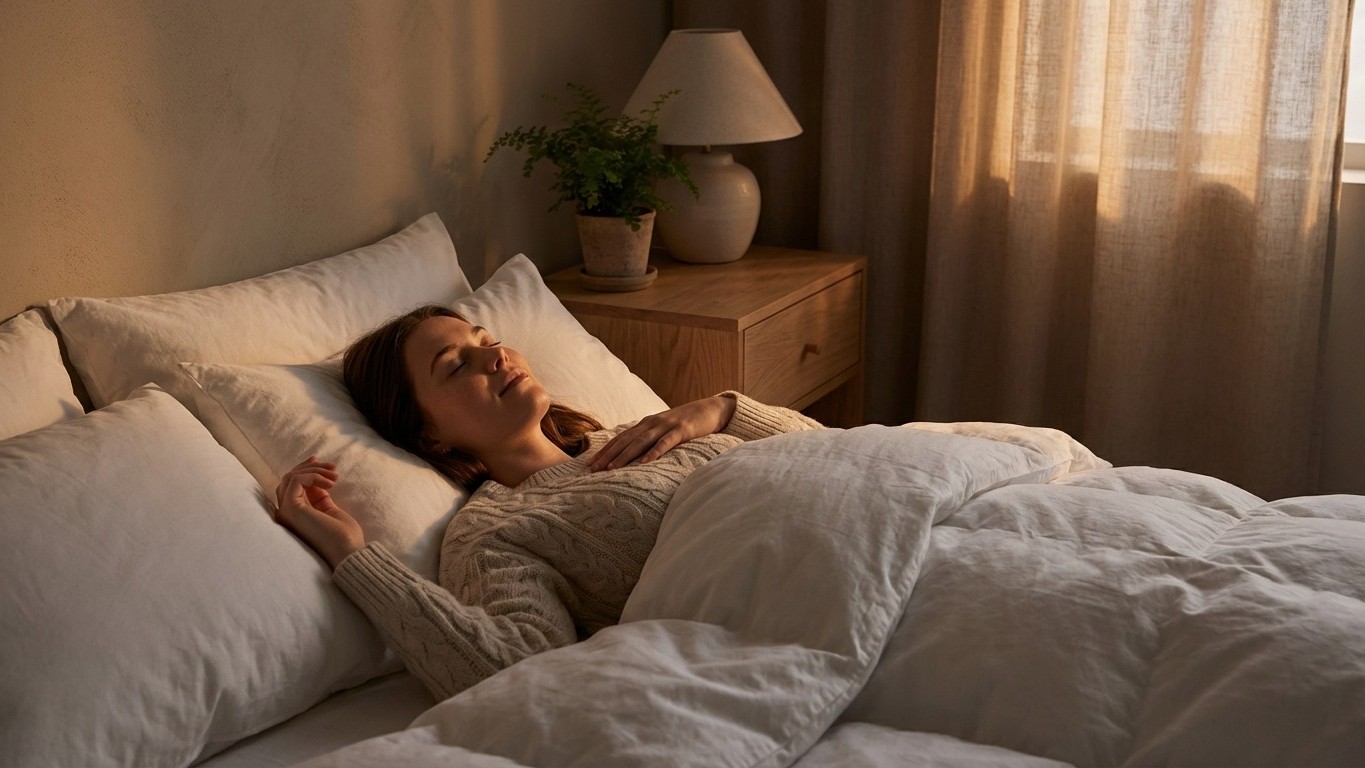
Lying awake at 2am, mind spinning, body tense and utterly uncooperative, most of us know this feeling far too well. The good news is that your nervous system is not broken. It simply needs the right signal to shift gears, and that signal can be sent deliberately, through relaxation techniques for sleep that work with your body’s own biology rather than against it. For those dealing with anxiety alongside sleeplessness, breathing exercises for sleep anxiety can be particularly effective at addressing both issues simultaneously.
This guide focuses exclusively on three proven families of technique: breathing exercises, meditation, and progressive muscle relaxation for sleep. No supplements, no sleep trackers, no expensive gadgets. Just you, your breath, and a handful of evidence-backed methods you can start using tonight. Each section includes concrete protocols you can follow step by step, and where the science actually supports a claim, you’ll find it noted, without the invented statistics that clutter so much wellness content.
Why Relaxation Is the Missing Piece of Your Sleep Puzzle
What stress actually does to your body at bedtime
Sleep doesn’t happen on demand. Your brain needs to register safety before it will allow the transition from wakefulness into rest, and modern life is extraordinarily good at convincing your nervous system that safety has not yet arrived. When you’re stressed or anxious, your body maintains elevated levels of cortisol and adrenaline, hormones that keep you alert and reactive. These are the same hormones designed to help you outrun a predator. They are deeply unhelpful at 10:30pm. If you’re struggling with an overactive mind at bedtime, learning how to calm racing thoughts at night naturally becomes essential for breaking this cycle.
The physiological result is a body that cannot lower its core temperature properly (essential for sleep onset), a heart rate that stays just slightly too high, and a brain that keeps scanning for threats even when none exist. Chronic stress compounds this: research consistently shows that people with persistent anxiety take longer to fall asleep, wake more frequently during the night, and spend less time in restorative deep sleep. The cruel irony is that poor sleep then raises cortisol the following day, creating a cycle that’s genuinely hard to break without intervention.
The role of deliberate relaxation in breaking that cycle
Relaxation techniques work because they activate the parasympathetic nervous system, the branch responsible for rest, digestion, and recovery. Think of it as the biological counterweight to your stress response. When you breathe slowly and deliberately, or systematically release tension from your Muscles, you’re not just “calming down” in a vague emotional sense. You’re sending measurable physiological signals: heart rate variability improves, blood pressure drops slightly, cortisol begins to fall.
This is why these techniques have genuine staying power in sleep medicine. They aren’t placebos dressed up in wellness language. They engage real mechanisms, and with consistent practice, the body learns to associate these cues with sleep, making the transition faster and more reliable over time. For those seeking a structured approach, techniques like a body scan meditation for sleep script can provide the framework needed to develop this association consistently.d approach to meditation specifically, guided meditation for sleep natural methods can provide a helpful framework. If you’re looking for a broader picture of drug-free sleep support, including lifestyle factors and natural sleep remedies, there’s a fuller context worth exploring, but here, we stay laser-focused on the techniques themselves.
Breathing Techniques: The Fastest Route to a Calmer Nervous System
Why conscious breathing works so quickly
Breathing is the only autonomic function you can control voluntarily, which makes it a uniquely powerful lever. When you extend your exhale beyond your inhale, you directly stimulate the vagus nerve, a key component of the parasympathetic nervous system. This isn’t folk wisdom; it’s established physiology. The practical implication is that you can shift your nervous system state within two to three minutes using breath alone, which is why breathing exercises are often the best place to start if you’re new to sleep relaxation practice.
Three protocols worth knowing
The 4-7-8 technique, developed from pranayama traditions, involves inhaling for 4 counts, holding for 7, and exhaling slowly for 8. The extended hold and long exhale are thought to increase carbon dioxide tolerance and promote a strong parasympathetic response. Some people find the breath-hold uncomfortable at first, if that’s you, shorten all counts proportionally (2-3.5-4) until the pattern feels natural.
Cardiac coherence is a French clinical approach that’s gained considerable traction in Europe. The protocol is simpler than it sounds: breathe in for 5 seconds, out for 5 seconds, creating a rhythm of approximately 6 breath cycles per minute. This specific rate has been shown in multiple studies to maximise heart rate variability, which is associated with better stress regulation and improved sleep quality. Five minutes of cardiac coherence before bed is genuinely one of the most accessible things you can do for your nervous system.
Abdominal breathing (sometimes called diaphragmatic breathing) is less a specific protocol and more a foundational skill. Most adults, particularly those under chronic stress, are habitual chest breathers, shallow, fast, and inefficient. Placing one hand on your belly and consciously directing each inhale downward so the abdomen rises before the chest activates the diaphragm fully and slows the breath naturally. Practised consistently, it can retrain your default breathing pattern, with benefits that extend well beyond bedtime.
For anyone whose sleep difficulties are tied to evening anxiety, there’s a dedicated deep-dive into breathing exercises for sleep anxiety with three specific protocols laid out in full detail.
Timing and practical considerations
These exercises work best when done lying down in bed, or seated in a dim, quiet space during a wind-down routine. Aim for a minimum of five minutes, less than that and you’re unlikely to shift your nervous system state meaningfully. The most common Mistake is rushing the exhale; it’s the long, slow out-breath that carries most of the benefit. Also worth noting: if you feel lightheaded during any breathing exercise, simply return to your normal rhythm. This is usually a sign of hyperventilation, which means you’re moving too much air too quickly rather than breathing too slowly.
Meditation for Sleep: Calming the Mind That Won’t Quieten
Mindfulness meditation and sleep onset
The word “meditation” carries a lot of unhelpful baggage, images of incense, perfectly still postures, and a serenely empty mind. In practice, mindfulness meditation for sleep is far more mundane and far more achievable. The core skill is simply noticing what’s happening in your experience (thoughts, sensations, sounds) without getting swept along by it. You’re not trying to stop your thoughts. You’re learning to observe them with a little more distance.
Clinical trials examining mindfulness-based approaches to insomnia have shown reductions in sleep onset time and improvements in sleep quality, with effects that appear to persist over months rather than fading quickly. The proposed mechanism is straightforward: rumination and racing thoughts are among the most common reported causes of difficulty falling asleep, and mindfulness practice directly targets the habit of mental over-engagement that fuels rumination. For a detailed, practical guide on how to calm racing thoughts at night naturally, there’s a full resource available.
Guided meditations: a practical shortcut
One of the persistent myths about meditation is that you need to practise in silence and know exactly what you’re doing. Guided sessions, whether via app, audio file, or a therapist’s recording, remove the cognitive burden of having to remember what comes next, which makes them particularly useful at bedtime when your brain is already stretched. A good guided sleep meditation will typically incorporate slow breathing prompts, body awareness cues, and gentle visualisation, all of which compound the relaxation response.
The quality of guidance matters more than the platform. A calm, unhurried voice matters. Music that doesn’t compete with the words matters. And critically, the content should be non-stimulating, no inspiring life lessons, no energising affirmations. You want something that asks very little of your cognitive attention. There’s more on choosing wisely in this guide to guided meditation for sleep natural.
The body scan: a practical script
The body scan is one of the most widely used sleep meditations, and one of the most misunderstood. It isn’t a relaxation technique in the direct sense, it’s a practice of noticing. You move your attention systematically through different regions of the body, simply observing whatever is there without trying to change it. Paradoxically, this noticing tends to produce relaxation as a side effect.
A basic sequence might run like this: begin with three slow abdominal breaths. Then bring your attention to the soles of your feet. Notice any sensations, warmth, pressure, tingling, or simply the absence of sensation. Without judging or trying to relax the area, simply observe it for 10-15 seconds before moving to the tops of your feet, your ankles, your calves, and so on, working gradually upward to your scalp. The entire sequence can take 10-20 minutes. If your mind wanders (and it will), gently return attention to the body region you were observing. No frustration required.
Progressive Muscle Relaxation: Teaching Your Body to Let Go
The method, step by step
Progressive muscle relaxation (PMR) was developed in the early 20th century by a physician who observed that anxiety and physical tension are inseparable, and that if you could interrupt one, you could interrupt the other. The technique works by deliberately tensing specific muscle groups for a few seconds, then releasing them. The contrast between tension and release trains the body to recognise and deepen its own relaxation response.
A full PMR sequence typically takes 15-20 minutes and moves through the major muscle groups: feet and calves, thighs, abdomen, hands and forearms, shoulders, neck, and face. For each group, tense firmly (but not to the point of cramping) for about five seconds, then release completely and notice the sensation of letting go for 20-30 seconds before moving on. The key instruction that most people miss: after you release, do nothing. Don’t try to relax further. Just observe what happens naturally.
For a complete, step-by-step tutorial, the dedicated page on progressive muscle relaxation for sleep walks through the full method with additional guidance on common mistakes.
Who benefits most from PMR
PMR is particularly well-suited to people who carry tension physically, the jaw-clenchers, the shoulder-shrugers, those who notice they’ve been bracing their abdomen without realising it. Research into PMR’s effectiveness against insomnia is encouraging, with studies showing measurable improvements in sleep quality when the technique is practised consistently over several weeks. It’s also one of the most accessible techniques for people who find breathing exercises frustrating or meditation too cognitively demanding — there’s something satisfying about the concreteness of squeezing and releasing.
People with chronic pain, muscle injuries, or high blood pressure should check with their GP before practising PMR, as the tension component may not be appropriate in all cases.
Building a Practical Evening Relaxation Routine
Setting the scene
Environment matters more than most people give it credit for. A cool room (around 16-18°C is often cited as optimal), dim or absent artificial lighting in the hour before bed, and minimal screen exposure all support the transition into sleep. These aren’t rigid rules, they’re conditions that make your relaxation practice easier to sustain, because you’re working with your body’s natural rhythms rather than against them.
Consistency of time matters too. Doing your relaxation practice at the same point each evening creates a learned association, so that the routine itself begins to signal sleep to your brain, a form of behavioural conditioning that builds over weeks.
Combining techniques for better results
There’s no rule that says you must pick one approach and stick to it. Many people find that techniques layer naturally: a few minutes of cardiac coherence breathing to lower arousal, followed by a body scan or guided meditation to occupy the mind gently, is a combination that addresses both the physiological and cognitive dimensions of pre-sleep tension. PMR can precede either of these if physical tension is the primary barrier.
The honest caveat: combining multiple techniques requires slightly more time and commitment. If you’re new to this, start with one. Master it. Then add.
A 12-minute sequence to try tonight
Here’s a practical starting point that requires nothing except a comfortable place to lie down:
- Minutes 1-3: Cardiac coherence breathing (5 seconds in, 5 seconds out), lying on your back with eyes closed.
- Minutes 4-7: Abbreviated PMR, feet, thighs, hands, shoulders, face. Five seconds of tension, then full release.
- Minutes 8-12: Body scan from feet to head, observing without changing, with slow natural breathing throughout.
If you fall asleep during this sequence, that is not failure. That is the point.
Frequently Asked Questions
Which breathing techniques are most effective for falling asleep naturally? Cardiac coherence (6 breath cycles per minute) and the 4-7-8 pattern both have good support in the literature. Cardiac coherence tends to be more accessible for beginners because there’s no breath-hold involved. The “best” technique is always the one you’ll actually use consistently.
Is progressive muscle relaxation proven to help with insomnia? Clinical evidence is positive, though most studies show benefits that accumulate over two to four weeks of regular practice rather than appearing after a single session. It’s recognised as a component of Cognitive Behavioural Therapy for Insomnia (CBT-I), which is currently the recommended first-line treatment for chronic insomnia in UK clinical guidelines.
How do you combine meditation and relaxation for better sleep quality? A layered approach works well: use a physical technique like PMR or breathing first to lower physiological arousal, then move to a cognitive technique like a body scan or guided meditation to settle the mind. Think of it as calming the body, then calming the thoughts, in that order.
Do you need to practise every night to see results? Regularity matters more than perfection. Daily practice is ideal, but three to four sessions per week is likely sufficient to build the conditioned association between routine and sleep. Missing a night isn’t a setback; treating it as one is.
Going Further: Resources and Next Steps
If you want to deepen any of the approaches covered here, there are well-researched apps worth considering. Insight Timer offers a large library of free guided meditations, including many designed specifically for sleep. Calm and Headspace both have structured sleep programmes with reasonable evidence bases behind their design. None of these are paid endorsements, they simply appear consistently in independent reviews as reliable options. Look for programmes built around CBT-I principles or mindfulness-based stress reduction (MBSR) rather than vague “wellness” content.
Each technique covered in this guide has its own extended tutorial linked throughout: detailed breathing exercises for sleep anxiety, the full progressive muscle relaxation for sleep method, and guidance on choosing and using guided meditation for sleep natural. If racing thoughts are your primary obstacle, the dedicated piece on how to calm racing thoughts at night naturally addresses the cognitive dimension in depth. And if you want to situate these techniques within a broader picture of drug-free sleep support, the comprehensive guide to natural sleep remedies covers the wider landscape.
One final thought worth sitting with: these techniques are skills, not treatments. Like learning to swim, the early sessions may feel effortful and slightly awkward. That doesn’t mean they’re not working. The nervous system learns slowly and consolidates quietly, often surprising you one evening when you notice, almost with disbelief, that you simply drifted off.
As always, if sleep difficulties are severe, persistent, or accompanied by other symptoms, please consult your GP. This article is for informational purposes only and does not constitute medical advice.