
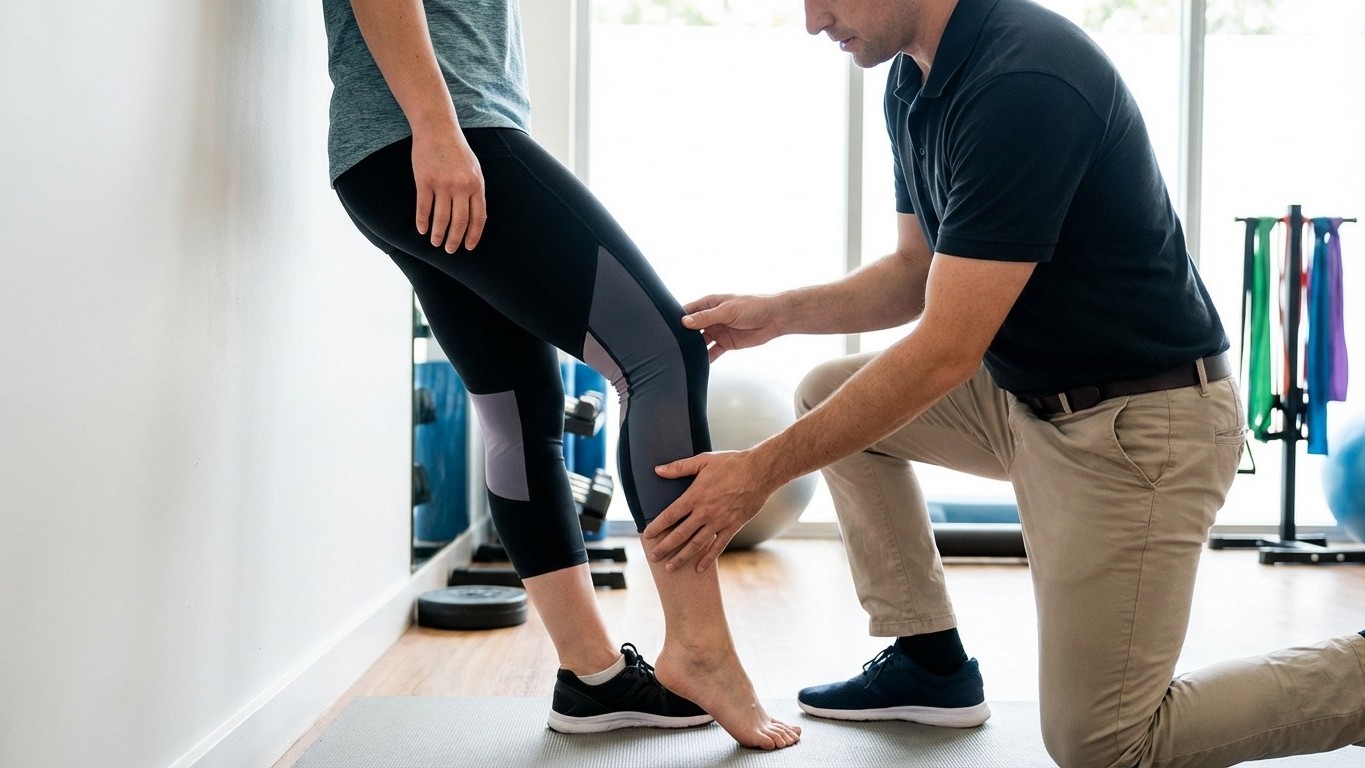
One appointment, one tight muscle, and suddenly a squat that had been stuck at parallel for months dropped into a full, comfortable depth. If you’ve ever been told your squat is “good enough” while Secretly knowing something feels blocked, this story will resonate. Ankle Mobility, particularly the restriction caused by a chronically tight soleus or a stiff ankle joint capsule, is quietly one of the most underdiagnosed reasons why squats plateau, knees cave, or heels peel off the floor the moment you try to go deeper.
Key takeaways
- Your heels rise and depth stalls—but the real culprit might be invisible to you
- One assessment distinguishes joint restriction from soft-tissue tightness; they require completely different fixes
- The fix isn’t hours of stretching—it’s targeted mobilisation followed by loaded strength work that rewires the pattern
Why the ankle is the squat’s secret gatekeeper
The squat is a full-body movement, but it starts from the ground up. Dorsiflexion, the movement that brings your shin forwards over your foot, needs to be generous enough to allow your centre of mass to travel down without compensation. When that range is restricted, the body is surprisingly creative in how it cheats: heels rise, the torso tips excessively forward, knees track inward, or the lower back rounds under load. None of these are technique failures in isolation. They’re often the body solving a mobility problem in real time.
Physiotherapists who work with lifters and recreational gym-goers frequently identify two main culprits. The first is soft-tissue restriction, typically in the soleus (the deeper of the two calf muscles) or the Achilles tendon complex. The second is a joint mobility issue, where the talus (the ankle bone that sits between your shin bones and heel) doesn’t glide backwards as it should during dorsiflexion. Both produce the same squat problem, but they respond to different interventions. This distinction matters enormously, and it’s Exactly why a five-minute assessment with a physio can unlock what months of calf stretching couldn’t.
What actually happens during that assessment
A Physiotherapist will typically use the weight-bearing lunge test to measure ankle dorsiflexion range. You stand facing a wall, place the ball of your foot a set distance away, and attempt to touch your knee to the wall without your heel leaving the floor. Research suggests that achieving roughly 10 to 12 centimetres of distance from the wall is associated with normal function, though this varies by individual. Failing the test on one or both sides points clearly to restriction, but the physio then needs to identify whether it’s coming from the joint or the soft tissue.
Distinguishing these two requires skilled hands. A joint restriction often responds well to mobilisation techniques where the therapist applies a gentle posterior glide to the talus, coaxing it back into its correct movement arc. Soft-tissue restriction, conversely, tends to respond better to targeted massage, dry needling, or specific loading of the soleus through exercises like seated calf raises with added weight. The interesting wrinkle is that many people have both simultaneously, which is why a single stretch band around the ankle, however popular on social media, sometimes produces underwhelming results on its own.
One physiotherapist described the experience of treating a client whose squat depth transformed after two sessions of talocrural joint mobilisation. The client had spent over a year working on calf flexibility with no meaningful change. The joint itself simply wasn’t moving freely, no amount of soft-tissue work was going to change that. Once the restriction was addressed manually, the nervous system stopped bracing against the movement, and the squat dropped naturally. There was no dramatic rehab programme. Just one tight joint, released.
The exercises that actually carry the change forward
Manual therapy tends to create a window of improved mobility rather than a permanent fix. What keeps that window open is loading the new range. The soleus, in particular, responds well to strength work rather than passive stretching alone. A weighted seated calf raise, performed with a full range of motion and a slow, controlled lowering phase, places the soleus under load in the position it needs to work in during a squat. This isn’t just anecdotal: research on tendon and muscle adaptation consistently shows that progressive loading produces more durable changes than passive stretching over time.
Alongside this, the banded ankle mobilisation (often called a “Mulligan” technique when performed with movement) is genuinely useful as a warm-up drill before squatting, provided the restriction is joint-based. You loop a resistance band around the front of the ankle, step forward into a lunge, and allow the band to pull the ankle posteriorly while you drive the knee over the toe. Done correctly, many people feel an immediate improvement in range that primes the joint before loading. Think of it as reminding the joint what it’s capable of, before asking it to do the work.
Hip flexor mobility, thoracic spine rotation, and foot arch strength all play supporting roles too, but they rarely produce the dramatic, immediate squat transformation that ankle work does. This is what makes ankle restriction so satisfying to address, the feedback is almost instant. You mobilise, you squat, you feel the difference before you leave the session.
When to stop guessing and get assessed
If your heels rise, your depth stalls, or your knees dive inward despite consistent technique work, it’s worth having your ankles properly assessed rather than continuing to troubleshoot alone. A physiotherapist with experience in movement assessment can distinguish joint restriction from soft-tissue tightness from a motor control issue in a single session, and point you towards the specific intervention that will actually move the needle.
The broader question this raises is how many training plateaus are quietly structural rather than motivational or technical. A tight ankle doesn’t announce itself with pain. It just limits range, subtly and consistently, until you accept that “nearly parallel” is simply how your body squats. Sometimes the body just needs someone to ask why.
Always consult your GP or a qualified physiotherapist before beginning any new exercise or treatment programme, particularly if you experience pain during movement.