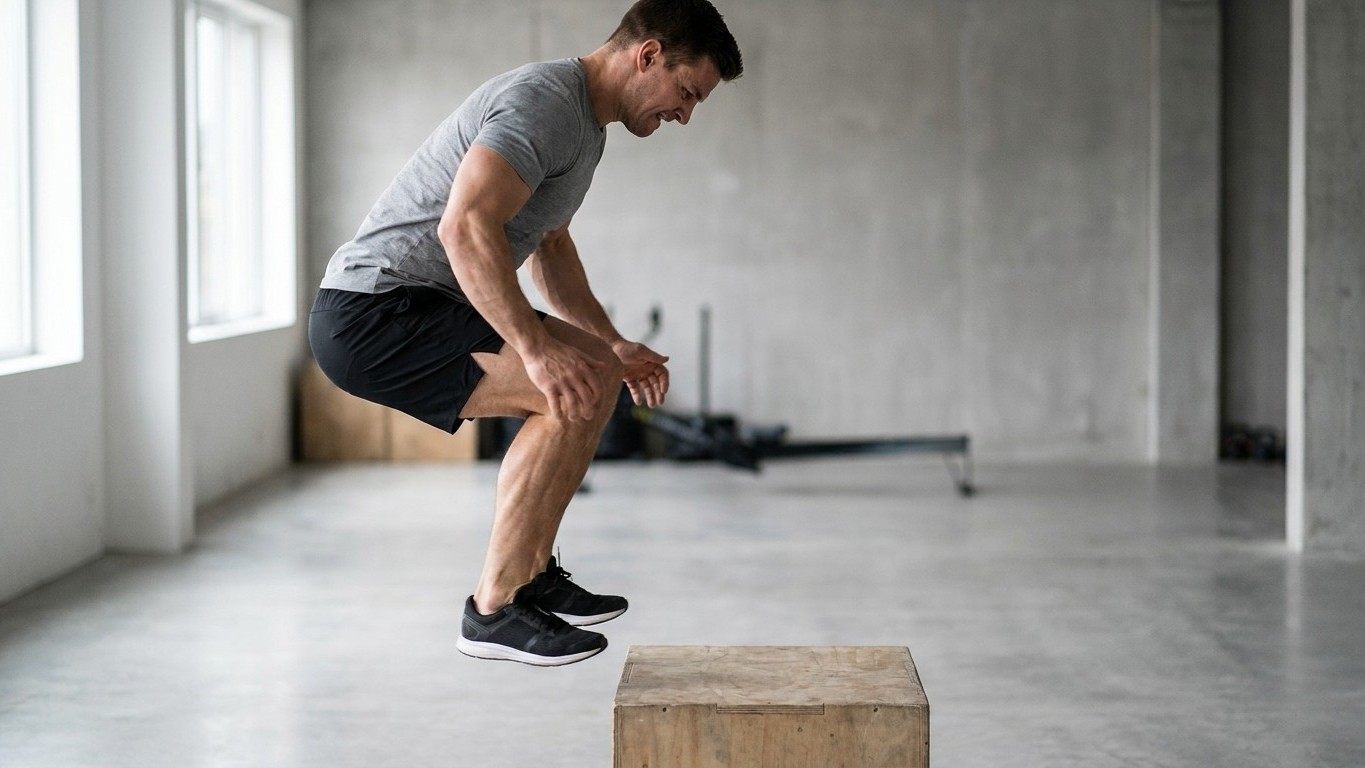
That first box jump felt wrong before my feet even left the floor. My legs were loose, my heart rate was low, my breathing was even, and yet the explosive snap I usually feel through my hips and calves just wasn’t there. Five minutes of slow, deliberate breathing had done exactly what it was supposed to do: it had calmed me down. What I hadn’t bargained for was that the same calm had quietly switched off the nervous system arousal my body needed to jump properly.
This isn’t a fluke or a one-off bad session. It touches on something sports scientists have been picking apart for years: the relationship between the autonomic nervous system and explosive performance, and the uncomfortable truth that what helps you recover isn’t always what helps you perform.
Key takeaways
- A lifter’s pre-session calm suddenly vanished on the box jump—and their power went with it
- Research shows slow breathing actually impairs force and power output, despite feeling better
- Elite performers use the opposite strategy: sharp exhales, self-talk, and deliberate arousal instead
Why slow breathing works against you in that moment
Slow, extended breathing (think long exhales, paced inhales, the kind of pattern used in techniques like 4-7-8 breathing) has a well-documented physiological signature. Slow breathing reduces sympathetic nervous system activity, heart rate, and blood pressure and increases parasympathetic nervous system activity, heart rate variability, and oxygen saturation. That’s genuinely useful when you need to recover between sets or bring your system back from the edge of panic before a heavy attempt. It is, essentially, a physiological off-switch.
The trouble is that a jump, a clean, a sprint start or a max-effort lift doesn’t run on a calm nervous system. It runs on sympathetic drive, the fight-or-flight machinery that recruits motor units faster, sharpens reaction time and primes fast-twitch fibres to fire in a hurry. Dial that down five minutes before a plyometric effort and you’re essentially asking your body to produce maximum force with the accelerator pedal half-released.
A 2024 study published in the Journal of Human Kinetics tested this directly. Researchers had resistance-trained men perform five sets of heavy barbell back squats, using either normal breathing or slow breathing (the 4-7-8 method) during the three-minute rest between sets, while tracking power output and bar velocity with a linear positioning transducer. They hypothesised that slow breathing would accelerate inter-set recovery and attenuate reductions in power and velocity performance set to set. The results didn’t back that up. Although heart rate recovery improved for the middle sets, this did not mitigate the normal set-to-set performance reductions or alter the blood pressure response compared with normal breathing. In plain terms: feeling calmer didn’t translate into moving faster or producing more power on the bar.
The flip side: what “psyching up” actually does
If slow breathing switches things down, the opposite approach, deliberately raising arousal, has a much stronger track record for force and power tasks. A 2024 systematic review in the Strength and Conditioning Journal examined 27 independent studies on psyching-up strategies and maximal force production. Twenty-seven independent studies met the inclusion criteria, and collectively 65% of the trials found that psyching-up facilitates maximal force production. Free-choice psyching-up, motivational self-talk, PETTLEP imagery, and prescribed preparatory arousal consistently enhanced performance. Of these, preparatory arousal appears to be the most effective strategy, although other strategies like imagery, self-talk and attentional focus also have empirical support.
This mirrors what you see on a lifting platform. Watch any elite powerlifter walk up to a heavy bar and you’ll notice sharp, forceful exhales, sometimes a shout, sometimes a slap on the thigh. That isn’t theatre. Elite powerlifters intuitively use this pattern during max lifts, often employing sharp, forceful exhales at the moment of greatest exertion. It’s a physiological strategy that recruits sympathetic drive right when it’s needed most.
None of this means arousal should be left unmanaged. Fast breathing can be a tool for arousal and power output but should be used cautiously to avoid hyperventilation. Go too far the other way, breathing hard and fast with no structure, and you risk lightheadedness, poor coordination and a false sense of readiness rather than genuine neuromuscular activation.
Putting this into practice without overthinking it
The mistake I made wasn’t using slow breathing. It was using it at the wrong moment, treating a technique built for recovery and anxiety management as if it were a universal pre-performance ritual. Slow breathing still has a real place in training. Between sets of heavy squats, deadlifts or bench press, where the priority is bringing heart rate and perceived exertion down before the next attempt, a paced breathing pattern can genuinely help you feel steadier and more in control, even if the Human Kinetics data suggests it won’t necessarily restore lost bar speed.
Before an explosive effort, though, the goal is different. You want your nervous system switched on, not soothed. That might mean a few short, forceful exhales rather than a long, slow one. It might mean a brief burst of self-talk, a specific cue word, or thirty seconds of imagining the movement at full speed rather than five minutes of stillness. The research doesn’t hand us a single magic ritual, and the authors of the psyching-up review themselves note that a comprehensive examination of psyching-up strategies prior to maximal force production is imperative to examine the efficacy of psyching-up and identify beneficial strategies for practitioners. But the direction of travel is clear enough: match your pre-performance state to the demand of the task in front of you.
What surprised me most, going back through the research, is how little attention power output specifically has received compared with strength and endurance measures. Power has received scant empirical attention and there are not enough data to support any conclusions in the psyching-up literature, which means anyone training for jumps, throws or sprint starts is currently working with less certainty than lifters chasing a one-rep max. Until that gap closes, the safest bet is simple: save the slow breathing for the rest periods, and save something sharper for the moment before you actually jump.
Sources : ncbi.nlm.nih.gov | jhk.termedia.pl