
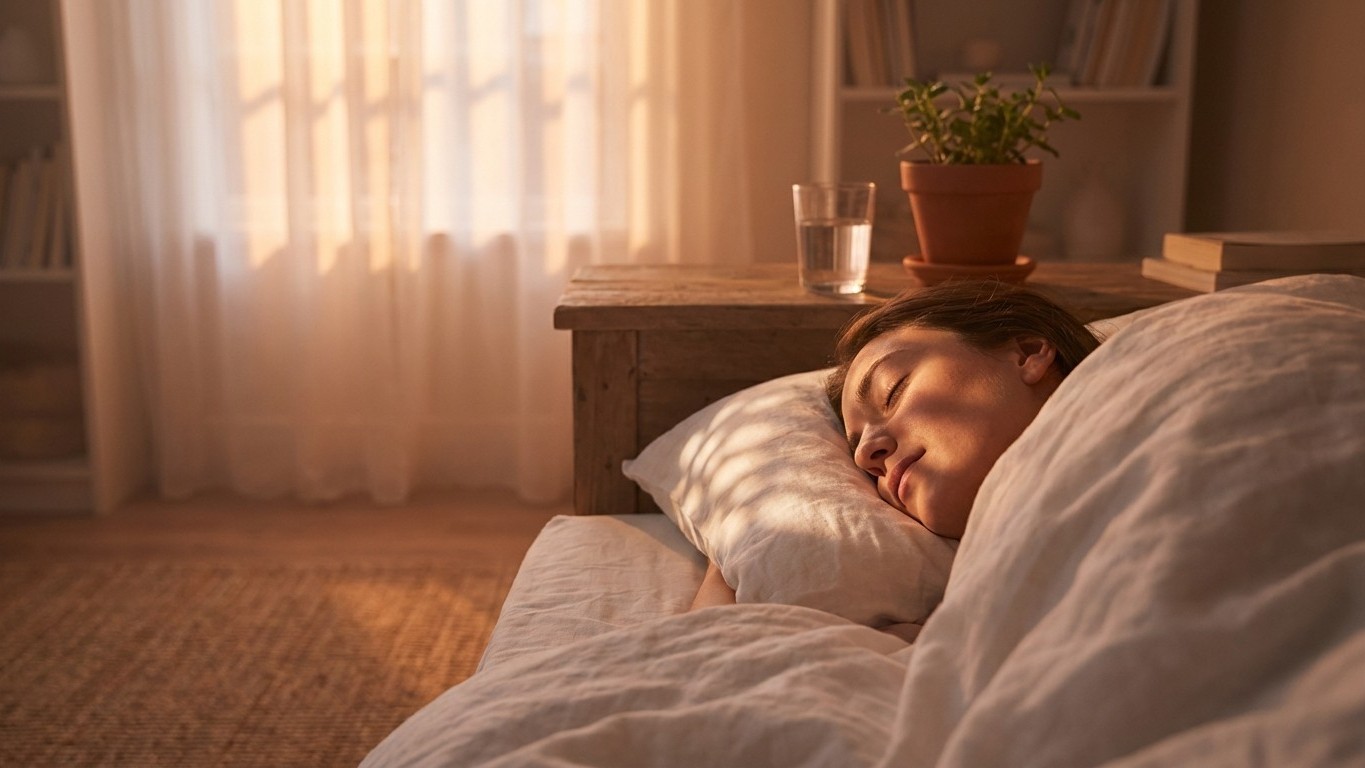
Light filtering through curtains at 4am. A streetlamp casting orange shadows across your pillow. The early summer dawn creeping in before your alarm. You’ve heard the advice a thousand times: invest in blackout curtains. But what if you live in rented accommodation where you can’t drill into walls? What if you find total darkness suffocating, or simply prefer waking with natural light rather than in artificial night?
The good news: blackout curtains aren’t the only path to restful sleep. Your body has evolved over millennia to manage light exposure, and with thoughtful adjustments to your environment and habits, you can sleep deeply without turning your bedroom into a cave. Here’s how to work with light rather than against it.
Why does light affect sleep in the first place?
How natural and artificial light shape your circadian rhythm
Your brain contains a master clock, the suprachiasmatic nucleus, that orchestrates your sleep-wake cycle based primarily on light signals received through your eyes. When light hits specialised retinal cells called intrinsically photosensitive retinal ganglion cells, they send signals directly to this clock, suppressing melatonin production and promoting alertness.
This system evolved when the sun was the only significant light source. Modern life throws wrenches into this elegant machinery. Electric lighting extends our “day” artificially. Screens emit wavelengths that mimic daylight. Street lighting and illuminated signs mean true darkness is increasingly rare, particularly in urban areas.
The timing matters enormously. Morning light exposure advances your clock, making you sleepy earlier in the evening. Evening light delays it, pushing your natural bedtime later. Light during the night, even brief exposures, can fragment sleep architecture and reduce time spent in restorative deep sleep phases.
What research tells us about light and sleep quality
Studies consistently show that sleeping in lit environments correlates with poorer outcomes. Research published in sleep medicine journals has found associations between bedroom light exposure and increased sleep latency, more frequent awakenings, and reduced sleep efficiency. Some longitudinal research suggests chronic exposure to light at night may contribute to metabolic disruption, though causation remains an active area of investigation.
However, and this is where nuance enters, complete darkness isn’t necessarily optimal for everyone. Some people experience anxiety in total darkness. Others rely on gentle morning light to wake naturally without jarring alarms. The goal isn’t eliminating all light; it’s managing light strategically to support your individual sleep needs.
Do you actually need blackout curtains? Challenging the assumption
The case for and against blackout curtains
Blackout curtains solve a real problem effectively. They block virtually all external light, create consistent sleeping conditions regardless of season, and can provide additional thermal insulation and noise dampening. For shift workers, people with light-sensitive conditions, or those facing particularly bright external lighting, they’re genuinely valuable.
Yet they come with trade-offs. Heavy fabrics can trap dust and require careful cleaning. Complete darkness can make morning waking difficult and disorienting. Some people report feeling claustrophobic or disconnected from natural time cues. Installation often requires drilling, problematic for renters. Quality blackout curtains cost considerably more than standard window treatments. And there’s something to be said for maintaining connection to natural light cycles rather than severing them entirely.
Why natural alternatives deserve consideration
Working with your biology rather than overriding it often produces more sustainable results. Complete darkness addresses symptoms, light entering your room, without necessarily addressing underlying circadian health. Someone who blocks all morning light but uses bright screens until midnight hasn’t solved their sleep problem; they’ve merely papered over part of it.
Natural approaches tend to work synergistically. Adjusting your light exposure throughout the day, modifying your bedroom environment thoughtfully, and wearing a quality sleep mask creates multiple layers of support. If one element fails, you forget your mask while travelling, for instance, the others continue working. For a comprehensive approach, explore natural ways to improve sleep environment beyond light management alone.
Practical methods to manage bedroom light naturally
Sleep masks: selection, effectiveness, and maintenance
A well-designed sleep mask achieves similar light reduction to blackout curtains at a fraction of the cost and with total portability. The key lies in proper selection. Look for masks with contoured eye cups that don’t press against your eyelids, as pressure can cause discomfort and disturb REM sleep when your eyes move rapidly. The nose bridge should sit flush against your face without gaps where light leaks in.
Materials matter for comfort. Silk feels luxurious and regulates temperature well but requires gentle washing. Cotton breathes effectively and tolerates machine washing. Some technical fabrics wick moisture, helpful if you sleep warm. Avoid masks with scratchy elastic that digs into your head or synthetic materials that trap heat against your face.
For maintenance, wash your mask weekly. Oils from your skin accumulate, and the mask sits against your face for hours nightly. Most cotton and synthetic masks tolerate gentle machine washing in a mesh bag. Silk benefits from hand washing in cool water with mild soap.
Strategic furniture placement and natural screening
Before purchasing anything, experiment with positioning. Moving your bed away from direct window lines can significantly reduce light exposure during sleep. If your bed currently faces east, even shifting it to another wall may mean streetlight no longer falls across your pillow.
Tall houseplants positioned near windows create natural light filtering. Ferns, peace lilies, and snake plants all thrive in bedroom conditions while softening incoming light. A folding screen placed between window and bed offers flexible, temporary light reduction without permanent installation, perfect for renters. Some people hang lightweight fabric from tension rods inside window frames, creating a soft barrier that diffuses light without blocking it entirely.
Light-reducing alternatives to blackout curtains
Layered window treatments offer adjustable light control. A sheer curtain combined with a heavier lined curtain allows you to block direct sunlight while maintaining ambient brightness, then close the heavier layer for sleeping. Roman blinds in medium-weight fabric reduce light substantially without the heaviness of traditional blackout materials.
For DIY approaches, consider temporary blackout film that adheres to glass with static cling rather than adhesive, removable without damage when you move. Magnetic blackout covers can be cut to fit windows and attach without drilling. Even hanging a dark blanket from a tension rod works as a temporary solution, though admittedly less aesthetically pleasing.
Adapting your daily routines to support nighttime sleep
Why daytime light exposure matters more than you think
Here’s what many sleep advice articles miss: managing nighttime light starts in the morning. Bright light exposure within the first hour of waking strengthens your circadian rhythm, making your body clock more robust and less susceptible to disruption from evening light.
Aim for 15-30 minutes of outdoor light exposure in the morning, even on overcast days. Outdoor light intensity dwarfs indoor lighting, a cloudy morning might provide 10,000 lux compared to 300-500 lux from typical indoor lighting. If outdoor time isn’t feasible, sit near a bright window during breakfast or consider a light therapy lamp, particularly during darker winter months.
This morning light anchors your circadian rhythm so firmly that moderate evening light exposure causes less disruption. Think of it as building circadian resilience.
Managing blue light in the hours before sleep
Blue wavelengths suppress melatonin most potently, and screens emit these wavelengths abundantly. Most devices now include night shift modes that reduce blue light emission, enable these to activate automatically several hours before your typical bedtime.
Blue-light-filtering glasses offer additional protection if your evening involves screens. Research on their effectiveness shows modest benefits, though results vary between studies. They’re not magic, but they reduce one source of stimulating light.
Beyond screens, examine your bedroom lighting. Warm-toned bulbs (2700K or lower) emit less blue light than cool white alternatives. Dimmer switches allow you to reduce intensity as bedtime approaches. Some people find that switching to candlelight or salt lamps for the final hour before bed creates a psychological transition that reinforces sleepiness. For additional evening relaxation strategies, natural sleep remedies covers complementary approaches.
Creating a sleep-friendly visual environment
Colours, textures, and reflective surfaces
Your bedroom’s visual character influences both light levels and psychological readiness for sleep. Dark matte surfaces absorb light; pale glossy surfaces reflect it. A bedroom with white gloss furniture and mirrored wardrobes amplifies every photon entering through windows. Switching to matte finishes, deeper colours on walls behind windows, and textured fabrics reduces this amplification effect.
Bedding colour matters too, though comfort trumps aesthetics. Darker bedding absorbs more light than white or pale colours, meaning less reflection toward your face. Navy, deep green, or charcoal sheets create a visually darker sleep environment without requiring room modifications.
Building an atmosphere that signals rest
Beyond light management, your bedroom should communicate sleep to your brain. Remove work materials, exercise equipment, and anything associated with wakefulness or stress. The principle is simple: your brain learns associations. A bedroom used only for sleep and intimacy becomes psychologically linked with rest.
Temperature interacts with light perception. A cooler room supports sleep, consider learning about the best room temperature for sleep to optimise this factor alongside your light management. Scent also plays a role; essential oils for sleep bedroom use can complement visual environment changes for a multi-sensory approach to sleep preparation.
FAQ: quick answers to common questions
How can I reduce bedroom light without blackout curtains? Layer window treatments using sheer and lined curtains together. Position furniture to block direct light paths to your bed. Use a contoured sleep mask. Apply temporary blackout film to glass. Place tall plants or folding screens near windows.
Are sleep masks as effective as blackout curtains? For the individual wearer, a properly fitted sleep mask blocks equivalent light. Masks don’t cool the room or reduce noise like heavy curtains can, but they’re portable, inexpensive, and require no installation.
What eco-friendly solutions exist for blocking bedroom light? Choose natural fibre masks in organic cotton or silk. Use bamboo roman blinds. Position houseplants as natural light filters. Opt for secondhand curtains in heavier natural fabrics. Avoid plastic-based blackout films in favour of reusable magnetic covers.
Do you really need blackout curtains to sleep well?
After examining the evidence, the answer is clearly no, with a caveat. Blackout curtains remain an excellent solution for specific situations: shift work, extremely bright external lighting, or genuine light sensitivity. They’re not wrong; they’re just not mandatory.
For most people, a combination of light management strategies produces excellent results. A quality sleep mask handles direct light exposure. Morning light practice strengthens circadian resilience. Evening blue light reduction prepares your brain for sleep. Thoughtful room arrangement minimises light reaching your bed in the first place.
Perhaps more importantly, these natural approaches keep you connected to environmental light cycles rather than isolating you from them entirely. Waking to gradually brightening morning light feels different from waking in artificial darkness, gentler, more aligned with how human bodies evolved to transition between sleep and waking.
What would happen if you spent the next week implementing just two of these strategies, morning outdoor light and a sleep mask at night? Your bedroom stays light and airy. Your wallet stays intact. And your sleep, quite possibly, improves anyway.