
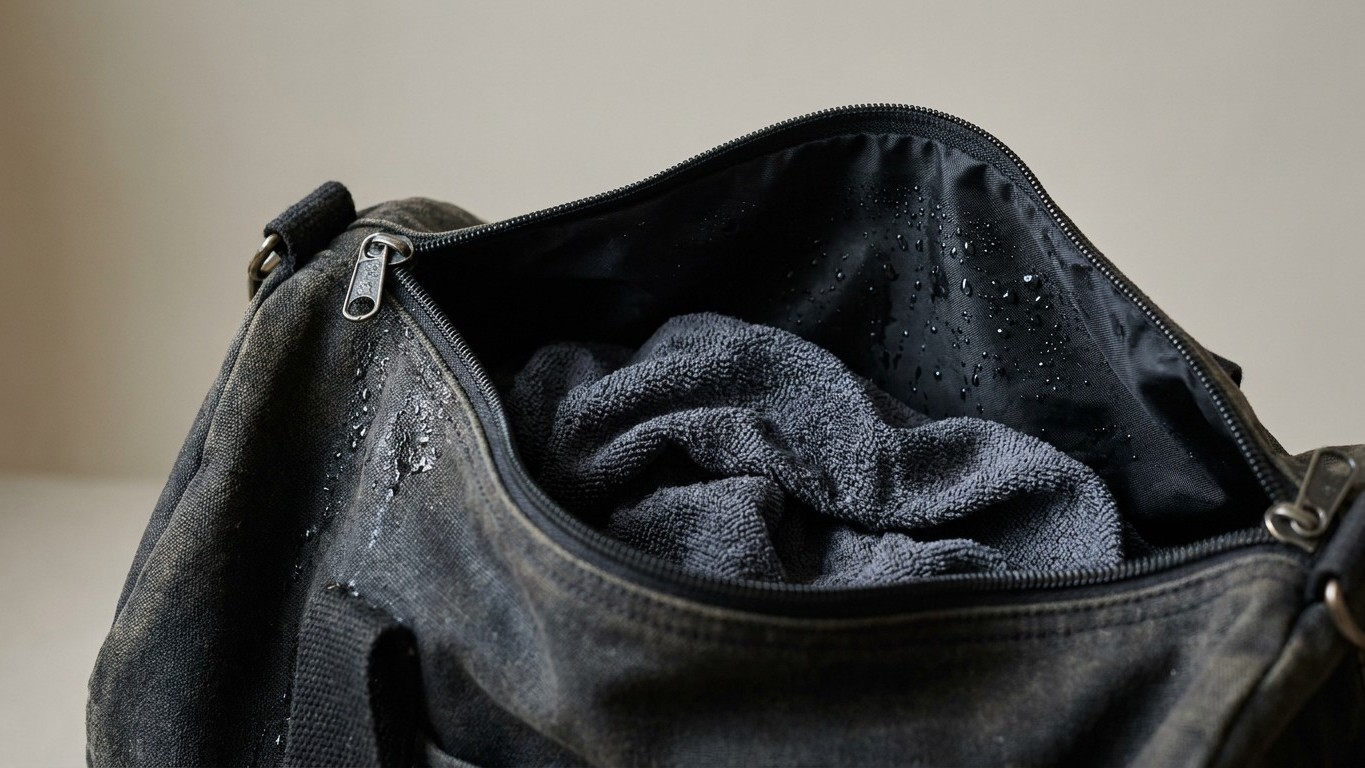
Those few hours between the final whistle and the next time you unzip your kit bag are not neutral. They are the window in which bacteria and fungi decide whether tomorrow’s session starts with fresh legs or with that familiar, maddening itch in the groin, feet or waistband. Sealing sweaty kit away in an airtight bag feels tidy and responsible. Biologically, it is closer to running a small greenhouse for the exact organisms you’re trying to avoid.
Key takeaways
- A closed, sweaty kit bag creates the perfect warm, moist greenhouse for fungal spores to multiply—exactly what causes recurring athlete’s foot and jock itch
- Moisture-wicking fabric feels dry but traps sweat inside the weave, meaning your ‘clean’ gym clothes are quietly reinfecting you before the next session
- The fix requires no special products—just unsealing your bag immediately after training and giving shoes 24+ hours to air dry between wears
What actually happens inside that zipped bag
Sweat itself doesn’t smell or cause skin problems. The trouble starts when it sits, warm and undisturbed, against fabric and skin for hours on end. Exercise creates more moisture and a higher temperature but also friction between the skin and clothing, creating a breeding ground for potentially harmful bacteria like staphylococcus aureus and streptococcus pyogenes. These aren’t harmless passengers either: they can cause harmful tissue infections, particularly if they manage to invade deeper regions of the skin.
Close the zip and you’ve simply relocated that environment. Pop your gym kit into the moist, warm environment of your bag, and the problem may worsen; bring your gym kit out again for another session, and the multiplication continues. Fungal spores behave the same way, latching onto damp fabric and waiting patiently for their next opportunity. A related piece on gym hygiene notes that gym bags themselves are far from clean vessels: research from the European Cleaning Journal found gym bags are frequently contaminated with coliform bacteria, typically found in faeces, which becomes a genuinely unpleasant problem once combined with damp, unwashed kit sitting for days.
Why the itch keeps coming back
The recurring itch so many active people put up with usually isn’t random bad luck. It has a name, and often several: tinea infections, the umbrella term for a family of fungal conditions that includes athlete’s foot, jock itch and ringworm. As one dermatologist puts it, “warmth, moisture and friction create the perfect environment for fungal infections to thrive.” That combination is precisely what a sealed, sweat-soaked kit bag delivers, hour after hour.
The mechanics are worth understanding rather than just accepting. Athlete’s foot is caused by the same type of fungi, called dermatophytes, that cause jock itch and ringworm, and they thrive in warm, damp places such as sweaty socks and shoes and wet towels. Crucially, this isn’t a one-and-done infection you clear and forget. It can be treated with antifungal medicines, but it often comes back. If your kit routine reintroduces the same warm, damp conditions every single week, you’re essentially reinfecting yourself on a loop, regardless of how diligently you treated the last flare-up.
Groin irritation follows an identical pattern for equally unglamorous reasons. Tight training gear worsens things further, according to research on athletes specifically: athletes are particularly prone to jock itch due to frequent sweating and the likelihood of remaining in damp sports gear for extended periods, and sports that require tight uniforms or equipment, like wrestling or running, can exacerbate the risk by creating an ideal environment for fungal growth. It isn’t just the workout itself doing the damage. It’s what happens to the shorts and socks afterwards, sitting balled up in the dark for the rest of the day.
Breaking the cycle without overhauling your routine
None of this requires a laboratory-grade solution, just a change in timing. The guidance from hygiene specialists is consistent on one point: get air moving as soon as possible after you’ve finished training. After each use, empty your gym bag and leave it open in a well ventilated space, since moisture trapped inside closed compartments encourages bacterial growth. A locker with airflow, a chair back, even a coat hook, all beat a zipped bag by a wide margin.
Footwear deserves particular attention, since trainers are often the last thing anyone thinks to air out. If you’ve had athlete’s foot before, dermatologists at Northwestern Medicine suggest going further than a quick wipe-down: clean shoes with antifungal or disinfecting sprays or wipes, and let them air dry for at least 24 hours before wearing them again. That’s a longer gap than most of us leave between sessions, which is exactly why the fungus so often wins.
Washing habits matter just as much as airing. Lukewarm or cool washes might be kinder to technical fabrics, but they’re gentler on fungal spores too, so where care labels allow it, a hotter wash genuinely helps. Fabric softener is also worth skipping on sweaty kit specifically, since it coats fibres in a way that can trap moisture rather than release it. And if you’re prone to recurrent groin or foot irritation, changing out of gym kit as soon as reasonably possible, rather than driving home or running errands in it, removes hours of exactly the conditions fungi need.
One detail catches most people out: moisture-wicking fabric isn’t the safeguard it’s marketed as. It pulls sweat away from the skin’s surface, which feels drier in the moment, but the moisture often ends up held within the weave of the fabric itself rather than actually leaving it. Worn again the next day without a proper wash, that “dry” top can be quietly damper than it looks, sitting against skin that’s about to sweat all over again. If the itch keeps returning despite everything else you’ve tried, that’s worth mentioning to your GP or pharmacist, since persistent or spreading fungal infections sometimes need a prescription-strength treatment rather than another over-the-counter cream.