Twenty per cent. That’s the proportion of people aged 51 to 75 who failed a 10-second single-leg stance test in a study of 1,702 individuals, with failure rates progressively increasing with age. If you’re one of the many midlifers who wobbled, grabbed a wall, or put your foot down before the count hit ten, you’ve just stumbled onto one of the more revealing (and completely free) health checks available. No blood draw, no appointment, no waiting list. Just you, a stopwatch, and an uncomfortable amount of honesty.
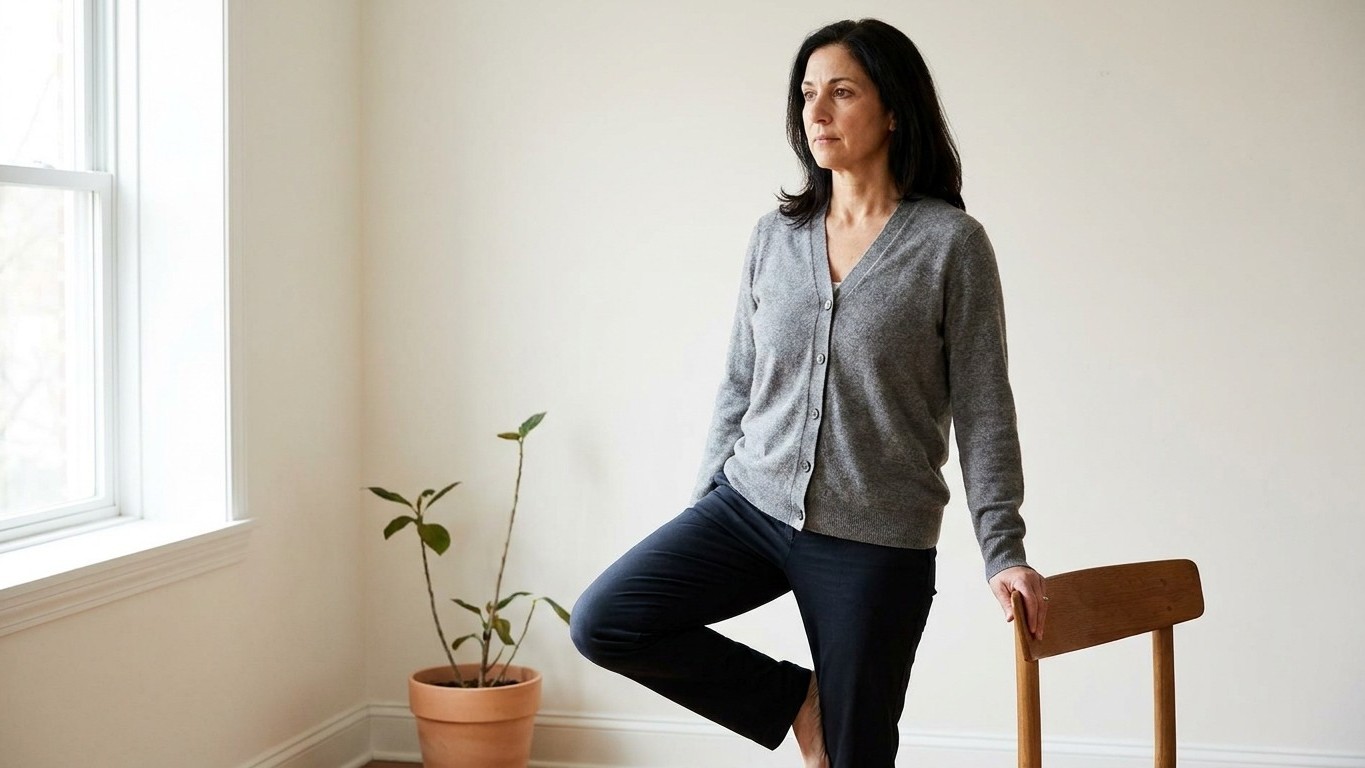
The test itself is almost laughably simple. Stand up, lift one foot off the ground without touching your other leg for support, and see how long you last before you sway, wobble, or plant that foot back down. Researchers in Brazil used exactly this method, asking participants to stand on one leg for 10 seconds without any additional support, with the front of the foot placed against the standing leg to standardise results. It’s the kind of thing physiotherapists have quietly used for decades. What changed in 2022 was the scale of evidence linking it to something far bigger than a wobbly ankle.
Key takeaways
- A free, one-leg balance test predicted mortality risk better than traditional health markers in a major study
- Balance declines faster and later than any other age-related fitness measure—until it suddenly doesn’t
- Being 54 and unable to hold one leg for 10 seconds puts you at the biological balance level of someone in their 70s
Why ten seconds became the magic number
The study that put this test on the map followed participants for years as part of a long-running Brazilian cohort. The analysis included 1,702 participants aged 51–75, with an average age of 61, and around two thirds were men. What researchers found, once they crunched the survival data, was startling. After accounting for age, sex, and underlying conditions, an inability to stand unsupported on one leg for 10 seconds was associated with an 84% heightened risk of death from any cause within the next decade. Not falls specifically. Not fractures. Death from any cause whatsoever.
The mortality gap between those who passed and those who failed wasn’t subtle either. Some 17.5% of people who failed the test were among those who had died, compared to 4.6% of those who passed. That’s nearly a fourfold difference in a study population followed for roughly seven years. And the failure rate climbs steeply with age: while it hovers around one in five for the whole cohort, eighteen per cent failed between 61 and 65, and more than one in three failed between ages 66 and 70, while more than half of those 71 to 75 were unable to complete the test at all.
What struck the research team, led by Dr Claudio Gil Araujo at Rio de Janeiro’s Clinimex exercise medicine clinic, was how balance behaves differently to almost every other fitness marker we track. Unlike aerobic fitness and muscle strength and flexibility, balance tends to be reasonably well preserved until the sixth decade of life, when it starts to wane relatively rapidly. In plain terms: you can be reasonably fit, still jog, still lift a decent weight at the gym, and yet your balance has quietly started crumbling behind the scenes without you noticing, because daily life rarely demands you stand on one leg for any length of time.
A second study, a different angle, the same warning
Balance research didn’t stop in Brazil. A 2024 study from the Mayo Clinic’s Motion Analysis Laboratory tested gait, grip strength, knee strength, and balance in a group of otherwise healthy adults over 50, split roughly evenly between under-65s and over-65s. The conclusion reshuffled the usual hierarchy of ageing markers. As lead researcher Kenton Kaufman put it, “if you look at all these factors that decrease with age, the ability to balance on one leg was affected the most, or declined the most, with age.” Grip strength fades gradually. Walking speed changes gently. Balance, by contrast, seems to fall off a cliff.
Separately, research from Duke Health has given us useful benchmarks by decade. Adults in their 30s and 40s could balance on one leg for nearly one minute, adults in their 50s were able to stand on one leg for about 45 seconds, and those in their 70s for 26 seconds. If you’re 54 and can’t reach ten seconds, you’re not simply below average for your age bracket. You’re closer to the numbers researchers see in people two decades older. That’s the uncomfortable arithmetic no routine blood pressure check or cholesterol panel ever reveals.
Why does balance erode faster than everything else? It isn’t one single failing part. It’s proprioception (the sense of where your joints are in space), vestibular function in the inner ear, ankle mobility, and the fast-twitch muscle fibres that make split-second corrective adjustments when you start to tip. All of these decline somewhat independently, which is precisely why balance can crumble even in someone who otherwise looks fit on paper. As Kaufman noted in a 2025 NIH research summary, if you have poor balance, you’re at risk of falling, whether or not you’re moving, and falls are a severe health risk with serious consequences.
What this actually means for you, practically
It’s important to be precise about what the research does and doesn’t show. As Harvard Health points out, because this study is observational research, it cannot prove cause-and-effect between balance ability and early death. Nobody is claiming that improving your balance alone will add years to your life. What’s more plausible is that poor balance is a visible symptom of deeper issues, weaker legs, a less responsive nervous system, reduced activity levels, that themselves carry mortality risk. The test doesn’t diagnose anything. It flags something worth investigating.
The genuinely good news is that balance responds to training remarkably well, and quickly. Structured programmes have shown measurable gains within a matter of weeks, even among much older adults, and tai chi in particular has strong evidence behind it for reducing fall risk. Start simply: practise standing on one leg while brushing your teeth, holding a chair back lightly at first, then without support. Progress to closing your eyes once you’re steady. Try standing from a chair without using your hands. None of this requires equipment or a gym membership, just consistency, ideally most days of the week.
One detail worth flagging: the original Brazilian study population was entirely white Brazilian adults, and the findings might not be more widely applicable to other ethnicities and nations, the researchers caution. It also didn’t account for smoking, diet, or recent falls history, factors that could influence both balance and mortality independently. Treat the ten-second mark as a useful personal benchmark rather than a verdict. If you struggled, mention it to your GP at your next check-up, particularly if you’ve also noticed unsteadiness on stairs or uneven ground. It costs nothing to ask, and balance training costs even less to start.
Sources : scitechdaily.com | ncbi.nlm.nih.gov