
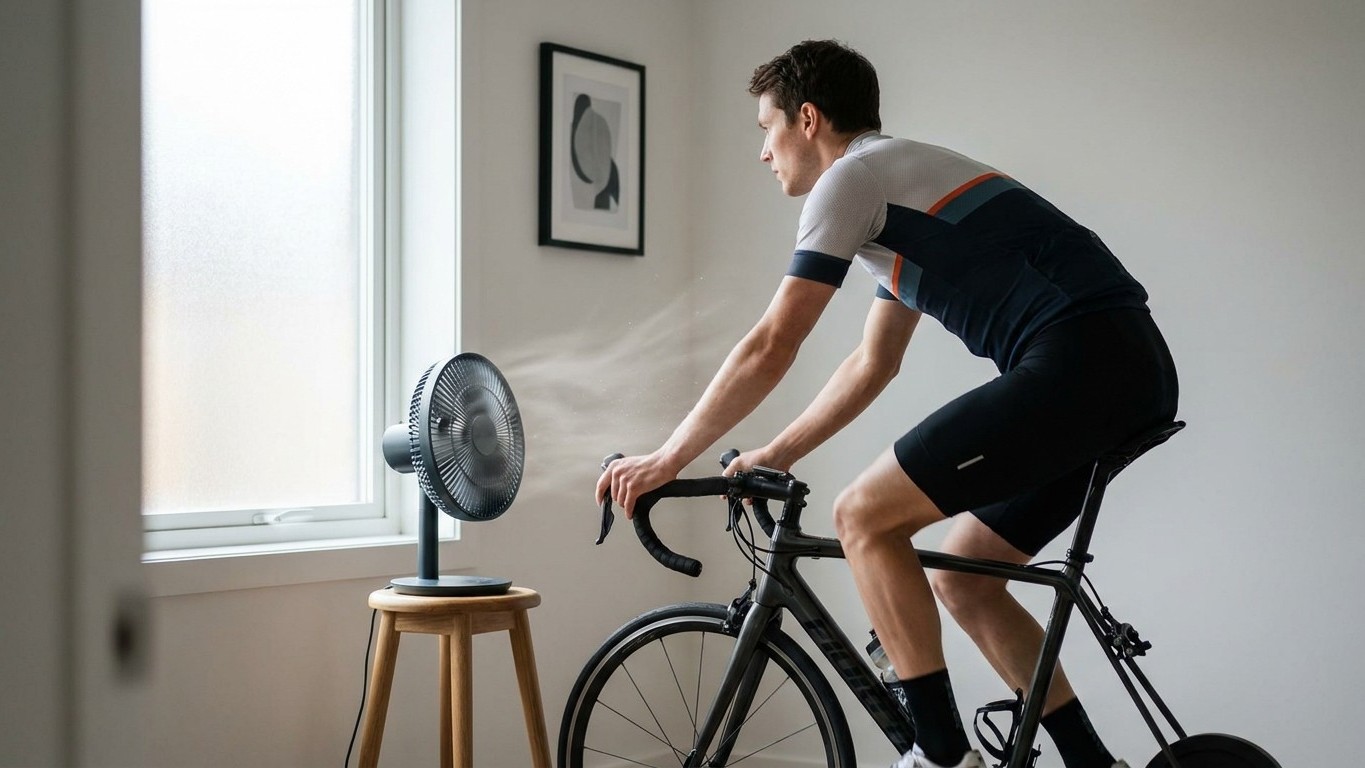
Sixty-five watts. That’s what the discrepancy came down to, in the end, once I finally pulled a small desk fan out of storage and pointed it at my chest during a steady endurance ride. My heart rate at 180 watts, a number I’d been holding for months on quiet, fan-free evenings, dropped by roughly 12 beats per minute the moment airflow hit my skin. Same bike, same trainer, same legs. The only variable was moving air. That single ride told me I’d spent an entire winter training my cardiovascular system to cope with heat stress, not with cycling.
Key takeaways
- A steady 180-watt effort dropped 12 bpm in heart rate the instant airflow was introduced—same bike, same legs, same power
- Cardiovascular drift is real, measurable, and amplified 2-3 times more indoors than outdoors, but most cyclists never realize it’s happening
- Your Zone 2 threshold might be calibrated to heat stress rather than actual aerobic fitness—and that gap could be costing you months of training accuracy
The moment the numbers stopped making sense
I’d kept the fan off deliberately. A wheezing box fan next to a smart trainer in a small flat, with a partner working from home down the hall, felt like an unreasonable ask. So for months I rode in a warm, still room and told myself the numbers were what they were. Power stayed consistent, session after session. Heart rate, though, crept upward in a way I’d stopped questioning. I assumed I was simply unfit, or under-recovered, or getting old. None of those turned out to be the real explanation.
What I was actually seeing has a name: cardiovascular drift. It’s a well-documented rise in heart rate during exercise at a completely constant power output or pace, and it has almost nothing to do with your legs getting weaker. Heart rate drift is the gradual increase in heart rate during exercise at a constant power or pace, and even when you maintain the exact same effort, Your Heart Rate will rise over time. The mechanism is thermal, not muscular, and a room with no airflow is close to the perfect environment to trigger it.
Why a warm room fools your heart, not your legs
Working muscle generates a surprising amount of heat as a by-product of turning the pedals. That heat has to go somewhere. Your body’s answer is to divert blood towards the skin, where it can radiate away, but every millilitre sent to the skin is a millilitre not returning to fill the heart’s chambers before the next beat. Stroke volume drops because there’s less blood to pump, and to maintain the same total blood flow per minute, heart rate has to rise to compensate. Nothing about your fitness has changed in that moment. You’re simply asking a smaller volume of blood per beat to do the same job, so the heart beats faster to make up the shortfall.
Indoors, with no wind, no forward motion and no evaporative cooling from the air passing over sweat, this effect is amplified dramatically compared with riding outside. Indoor sessions show two to three times more drift than outdoor rides at equivalent power, largely because of heat and humidity buildup with no airflow. A published protocol used in cardiovascular drift research even builds this in as a control variable: researchers running structured cycling tests explicitly used fan cooling directed towards the participants’ torso precisely because without it, the heat data would swamp the training data they were trying to measure.
Dehydration compounds the same problem. Sweat draws fluid straight out of your blood plasma, so total blood volume falls alongside the redirection towards the skin, and the two effects stack. Research summarised on cardiac drift suggests each 1% of body mass lost to sweat raises heart rate by roughly 3.3 beats per minute, so losing 4% can leave you around 13 bpm higher at the same pace. In a warm, unventilated room during a long trainer session, you can lose that much fluid without ever feeling dramatically thirsty, because sweat evaporates slowly in still air and simply drips rather than cooling you.
The fan isn’t a comfort item, it’s a data correction
This is where it gets genuinely useful rather than just uncomfortable to know. A laboratory study on cyclists exercising in heat found that even directing strong airflow at participants once heat strain had already built up wasn’t enough to reverse the drop in maximal oxygen uptake that heat stress had caused, which tells you the damage from overheating happens progressively and is hard to undo mid-session. The magnitude of cardiovascular drift is proportional to the decrease in maximal oxygen uptake, with reduced stroke volume likely driving the reduction. The lesson isn’t that fans are useless. It’s the opposite: cooling has to be present from the start of the ride, not switched on once you’re already struggling, because by then your body has already committed to the compensation.
For anyone training by heart rate zones rather than a power meter, this Matters More Than it sounds. If your “Zone 2” number was calibrated on a warm afternoon with no airflow, you’ve effectively set your easy-pace ceiling using heat stress data rather than aerobic fitness data. Ride the same session on a cooler day, or with proper cooling, and you’ll hold noticeably higher power at the identical heart rate, which can wrongly feel like you’ve lost fitness when actually you’ve simply removed a confounding variable.
What actually changed once I fixed it
I didn’t need an industrial fan. A single unit angled at the torso, running from the first pedal stroke rather than switched on halfway through, was enough to bring my numbers back in line with what I’d expect outdoors. If you train indoors through winter, I’d treat two fans, one on the chest and one on the back if space allows, as being as important to your session as the trainer itself. Combine that with drinking to match your sweat rate rather than sipping out of habit, and keeping the room a few degrees cooler than feels sociable, and heart rate becomes a genuinely useful training signal again rather than a running commentary on how stuffy your spare room is. If you’re working with a coach or a structured plan and your indoor heart rate numbers have never quite matched your outdoor ones, that gap is worth investigating before you assume anything about your engine. As always, if you notice unusually high heart rate readings, chest discomfort or symptoms that concern you during exercise, that’s a conversation for your GP, not a training blog.
Sources : tandfonline.com | pubmed.ncbi.nlm.nih.gov