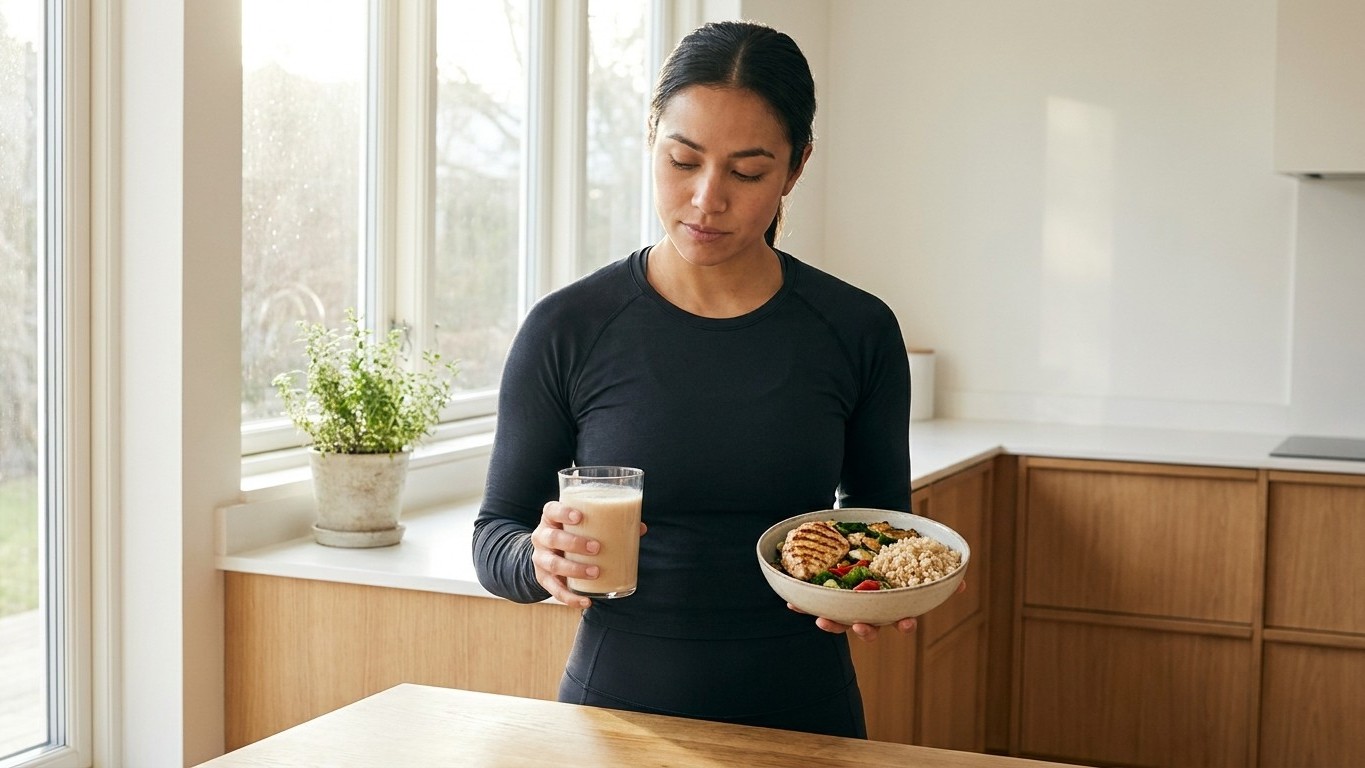
Two hours after a protein shake, your stomach is growling again, even though you just consumed 300 or 400 calories. Swap that same shake for a chicken and rice meal of identical calories and protein, and the hunger pangs take noticeably longer to arrive. The difference isn’t the ingredients. It’s the ten to fifteen seconds it takes to swallow a shake compared with the several minutes your jaw spends working through solid food.
Chewing isn’t just a mechanical step before digestion starts. It’s a hormonal trigger. Every bite you grind down sends signals to your gut and brain that begin shaping how full you’ll feel an hour, two hours, even four hours later. Skip that step by drinking your calories, and you skip a good chunk of the biological messaging that tells your body “enough.”
Key takeaways
- A metronome-paced pizza study revealed that chewing 40 times versus 15 times dramatically shifts your fullness hormones
- Liquids slip through your stomach too fast to activate the stretch receptors that send satiety signals to your brain
- Four-hour hunger tracking shows solid meals suppress ghrelin (appetite hormone) while shakes let it creep back up within hours
The forty-chew experiment that changed the conversation
A widely cited trial from Iowa State University asked one straightforward question: does it matter how many times you chew before swallowing? Researchers gave students identical portions of pizza, split into two groups, one told to chew each bite 15 times, the other 40 times, keeping pace with a metronome. When people chewed the pizza 40 times before swallowing, there was a reduction in hunger, preoccupation with food and a desire to eat. The hormonal readout backed up what participants reported. There was an increase in CCK, which is a hormone related to fullness and satiety, and a reduction in ghrelin, another hormone that stimulates the brain to increase appetite.
Blood glucose and insulin told an interesting story too. Plasma glucose and insulin levels were higher among the subjects who chewed the pizza 40 times. One theory for why: the increased mastication breaks down the food more thoroughly in the mouth, and this really facilitates nutrient absorption. A follow-up meta-analysis of similar chewing studies found much the same pattern with a different food. Compared to 15 times, chewing 40 times before swallowing resulted in significantly elevated postprandial insulin, glucose, CCK and GIP and trends towards suppressed ghrelin. Not every study agrees on magnitude, and some found no measurable shift in blood markers despite people reporting feeling fuller, which tells us the mouth-to-brain signal isn’t the whole story, but it’s clearly part of it.
Why a shake can’t replicate what chewing does
This is where the ready-to-drink shake runs into trouble. There’s simply nothing to chew. Beyond the missing mechanical trigger, liquids behave completely differently once they hit your stomach. Gastric satiation appears to be affected to a greater degree by the volume of a food or beverage, while satiety signals relayed by the intestine are influenced by nutrients, with gastric distension detected by stretch receptors in the stomach leading to hormonal and neuronal signaling of satiety to the brain. The catch is that because beverages have short gastrointestinal transit times, they do not activate stretch receptors to a degree consistent with their volume. Your shake slips through the stomach fast, barely stretching those receptors before it’s gone, leaving the fullness message weaker than the calorie count would suggest.
A study comparing solid and liquid meal-replacements of identical energy content in adults found this play out over hours, not minutes. The post-prandial hunger composite was lower following the solid versus liquid meal-replacement and remained below baseline over 4 hours. The hormone data lined up with the subjective ratings: the insulin and ghrelin composites were lower following the solid trial compared to the liquid. That’s a four-hour window where solid food kept hunger hormones quieter, while the liquid version let them creep back up sooner. Broader reviews reach the same conclusion across different types of food. Liquid carbohydrates produce less satiety compared with solid carbohydrates, and some energy from liquids may be compensated for at subsequent meals but because the compensation is incomplete, it leads to an increase in total long-term energy intake. A large systematic review of food texture research backs this up too: the quantitative analysis clearly indicated a significant decrease in hunger with solid food compared to liquid food.
What this means for your post-training routine
None of this means shakes are a mistake after a session at the gym. The protein still gets delivered, the convenience still matters when you’re rushing between the changing room and the rest of your day. But if you’re the person who’s ravenous by mid-afternoon despite necking a shake at lunchtime, the fix might be less about what’s in the bottle and more about giving your jaw something to do.
A few practical adjustments make a real difference without overhauling your whole diet:
- Add a solid component alongside the shake, such as a banana, a handful of nuts, or a slice of wholemeal toast, rather than relying on liquid calories alone.
- Drink slowly rather than downing it in one go, giving your gut more time to register what’s arriving.
- Where possible, choose a thicker smoothie with whole fruit and oats blended in over a thin, watery ready-to-drink option, since higher viscosity foods tend to prolong fullness more effectively.
Chewing gum studies add a curious footnote here. Research on mastication effort found that chewing reportedly contributes to satiation and satiety signals, though attempts to document and quantify this have led to small and inconsistent effects, meaning the relationship isn’t a simple dial you can turn up indefinitely. Chew your porridge for five minutes and you won’t feel twice as full as someone who ate it normally. But the underlying pattern holds up across dozens of trials, from pizza to meal-replacement drinks to plain carbohydrates: the less your food asks of your jaw, the sooner your stomach starts asking for more. Something worth remembering next time you’re tempted to skip breakfast in favour of drinking it instead.
Sources : pubmed.ncbi.nlm.nih.gov | sciencedirect.com