
Every rep of a full sit-up loads Your Lower Back with roughly 3,300 newtons of compressive force, the equivalent of 3,300 newtons, or the equivalent of 340 kilograms, of compressive force on the spine when bent in flexion. That single number explains why the exercise millions of us still do in gyms and living rooms across Britain was quietly dropped from one of the toughest fitness assessments in the world.
The U.S. National Institute for Occupational Safety and Health sets a safety threshold for repetitive low back loading, and it sits almost exactly where the sit-up begins to do damage. The U.S. National Institute of Occupational Safety and Health sets the safe limit for low back compression at 3300N, and repetitive loading above this level is linked with significantly higher rates of low back injuries in workers. A traditional bent-knee sit-up sails straight past that line with almost every repetition, which is precisely the finding that emerged from biomechanics research conducted by Stuart McGill, a spine biomechanics professor who has spent decades studying how the low back fails.
Key takeaways
- A single sit-up loads your lower back with the equivalent of 340kg of compressive force
- Over half of injuries in US Army fitness tests traced back to the sit-up exercise alone
- Military branches now use planks and dead bugs instead—same core strength, zero spinal flex
Why the US Army walked away from a fitness staple
This wasn’t a fad or a marketing decision. It came from injury data collected during actual military testing. In 2005, a study was done on over 1500 U.S. army soldiers after completing the Army Physical Fitness Test, and over 50% of injuries that occurred as a result of the test were attributed to the sit-ups they performed. Put another way: more than half of every injury logged during that gruelling assessment traced back to a single 60-second exercise most of us think of as harmless.
The response followed a few years later. The US Army has already put 10,000 soldiers through a pilot of a revamped physical-fitness test that excluded sit-ups. The Navy followed a similar path some years later, with the U.S. Navy retiring the sit-up from its fitness test in 2020, replacing it with the forearm plank. Even trade commentary picked up on the shift, with one American Council on Exercise spokesperson quoted by the Wall Street Journal as saying sit-ups are “an antiquity of exercise best left in the dustbin of fitness history”. Strong words for a movement that’s been a gym class staple since most of us were at school.
What’s actually happening to your spine
The mechanics are worth understanding, because they explain why this isn’t just about brute force. When doing a sit-up, most of the work is done by the hip flexors, with the first 20-30° of movement done by the abdominals, while the remaining 60-70° is accomplished by the hip flexors. So the exercise most of us believe is chiselling our abs is, for the majority of its range, actually training muscles that run from the thigh into the lower spine.
That matters because of what those tight hip flexors do next. Sit ups tend to activate the hip flexor muscles instead of isolating the abdominals, and tight hip flexors “tug” on the lower back and pelvis, leading to anterior pelvic tilt and low back pain. Meanwhile, the repeated bending itself is doing its own quiet damage. Discs in the lumbar spine aren’t rigid; they’ve got a soft, gel-like centre held in place by tougher outer fibres, not unlike the structure of a grape. “If you keep flexing your spine and bending the disk over and over again when combined with compressive load, that nucleus slowly breaches the layers and causes a disk bulge, or a disk herniation,” says McGill. It’s a cumulative process rather than a single dramatic failure, which is exactly why so many keen exercisers never connect years of sit-ups with the back pain that eventually shows up.
I’ll admit I used to be one of those people prescribing daily sit-up sets without a second thought. The research changed my mind, not because sit-ups are instantly dangerous, but because there are simply better tools available that don’t ask your lumbar discs to absorb hundreds of kilograms of force for a training effect you can get more safely elsewhere.
Better ways to train the same muscles
None of this means your core has to go untrained. It means choosing movements that build strength without repeatedly flexing a loaded spine. The curl-up has been found to place a higher demand on the abdominal muscles than the traditional sit-up, while decreasing the activation of the hip flexors. It’s a small technical change, keeping the lower back anchored and lifting only the shoulders, but it shifts the work back onto the muscles you’re actually trying to strengthen.
Beyond the curl-up, a handful of movements have become the go-to replacements in both military and clinical settings:
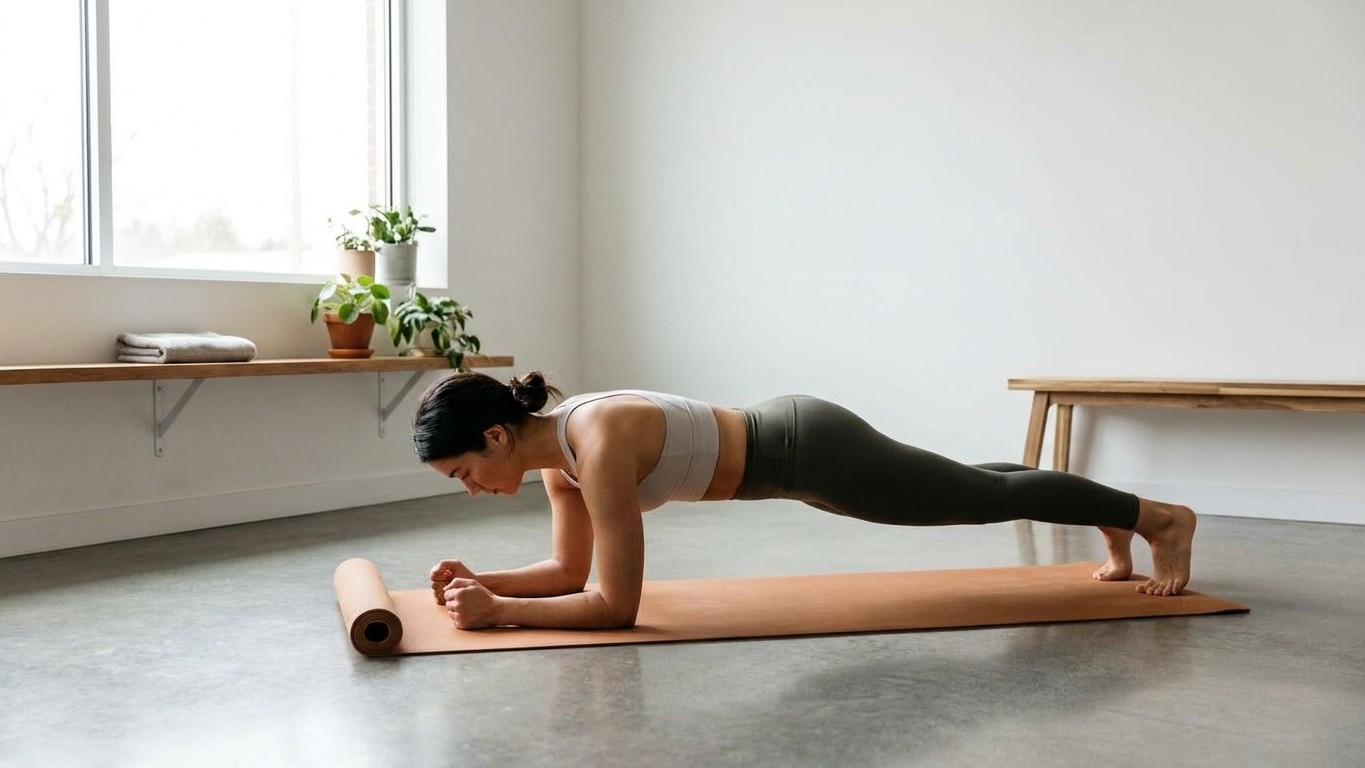
- The forearm plank, now the Navy’s preferred test of core endurance
- The dead bug, which trains anti-rotation control while the spine stays pinned to the floor
- The glute bridge, which strengthens the posterior chain without spinal flexion
- The Pallof press, an anti-rotation exercise using a band or cable
These share one feature: the spine holds still while the limbs move around it, rather than the spine itself doing the bending. That’s the real shift in modern core training philosophy, treating the trunk as something to stabilise rather than something to flex repeatedly against resistance.
If you’ve done thousands of sit-ups over the years with no apparent problems, that doesn’t mean the concern is overblown, disc damage tends to be cumulative and doesn’t always announce itself early. Equally, if you already have back pain or a diagnosed disc issue, don’t simply swap exercises based on an article; that’s a conversation for your GP or a physiotherapist, who can assess your specific spine and movement pattern. For most healthy adults, though, retiring the sit-up in favour of plank variations and dead bugs is a low-cost, evidence-backed change that costs you nothing in results and potentially saves Your Lower Back decades of unnecessary wear.
Sources : ascentchiropractic.com | linkedin.com