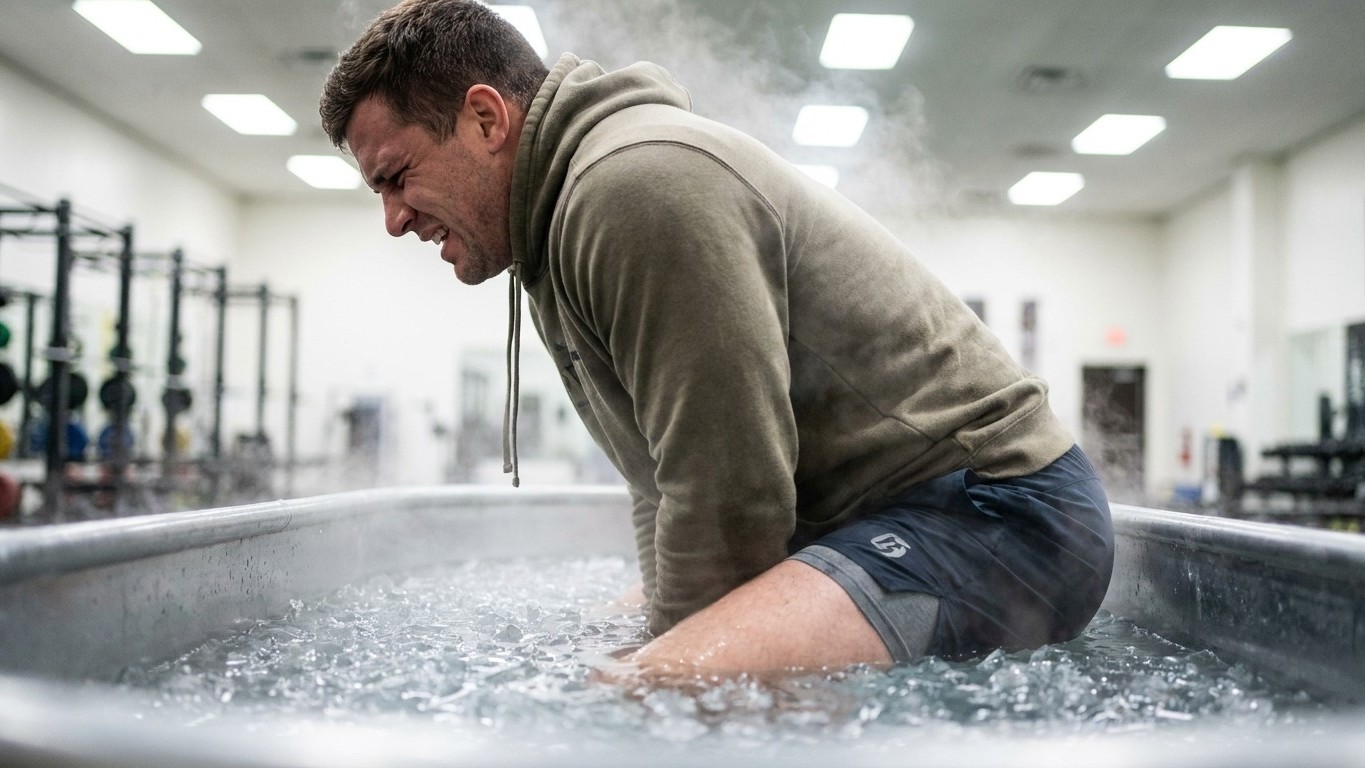
Cold water immersion after a heavy lifting session does more than numb sore quads. Research now shows it can quietly cut the muscle-building signal your body sends out after resistance training, sometimes by a striking margin. If hypertrophy is the goal, jumping into that ice bath the moment you rack the bar may be working against you.
For years, plunging into freezing water after training was treated as a badge of discipline, something serious athletes did to bounce back faster. The Wim Hof craze and countless social media posts turned it into a wellness ritual. But the physiology tells a more complicated story, one that matters if you’re chasing size and strength rather than simply feeling less achy the next morning.
Key takeaways
- Cold water immersion at 10°C can reduce muscle growth by up to 15% compared to passive recovery—even for experienced lifters
- The mechanism: vasoconstriction reduces blood flow to muscles precisely when they need growth-signaling molecules most
- Strategic timing changes everything—separation matters far more than abstinence for those chasing size and strength
What the research actually found
The clearest evidence comes from a study published in the Journal of Applied Physiology, in which sixteen men trained three times a week for seven weeks, with each session followed by either fifteen minutes of cold water immersion at 10°C or a passive recovery period at room temperature. Sixteen men performed resistance training three days per week for seven weeks, with each session followed by either cold water immersion at 10°C or passive recovery at 23°C. The result was unambiguous: cold water immersion blunted resistance training-induced muscle fibre hypertrophy, but not maximal strength, potentially via reduced skeletal muscle protein anabolism and increased catabolism.
An even more striking demonstration came from a 2015 study in The Journal of Physiology using a within-subject design, where post-exercise application of cold water immersion at roughly 10°C attenuated the increase in quadriceps muscle mass, around 15% for the control leg versus around 2% for the cold-treated leg, after 12 weeks of resistance training in young resistance-trained men. Because each participant acted as their own control, with one leg trained normally and the other trained then plunged, genetics, diet and training volume were ruled out as explanations. The difference came down to the ice.
A 2024 systematic review and meta-analysis in the European Journal of Sport Science pulled together the available trials to settle the question more broadly. Although research indicates that cold water immersion does not completely prevent muscular gains, the results provide some evidence that it likely attenuates adaptations compared with resistance training alone, with the data suggesting at least a small magnitude of reduction in hypertrophy. Interestingly, the meta-regression found no evidence that training status altered this likely attenuation of muscle hypertrophy with cold water immersion, meaning it’s not just a beginner’s problem, seasoned lifters aren’t spared either.
Why cold water interferes with muscle-building
The mechanism isn’t just about temperature discomfort. Immersing yourself in cold water immediately after training triggers a cascade that runs directly counter to the repair process your muscles need. Cold-induced vasoconstriction reduces muscle blood flow, which is positively associated with post-exercise muscle protein synthesis rates. Less blood flow to the tissue means fewer amino acids and fewer growth-signalling molecules reaching the fibres that just did the work.
There’s also a hormonal piece to this puzzle. A 2019 study looking at circulating markers found that cold water immersion delayed and reduced the normal post-exercise rise in testosterone and inflammatory cytokines such as IL-6, molecules that, counterintuitively, IL-6 is one of the inflammatory molecules secreted by the immune system following resistance training, and is a critical component for stimulating muscle growth, so blunting this inflammatory response following lifting could theoretically blunt the ability to build muscle. It’s a reminder that the inflammation we’re often told to eliminate is, within reason, doing useful work.
Muscle biopsy data reinforce this at the molecular level. In the whole-body training study, training-induced increases in heat shock protein 27 were attenuated in the cold-water group, which also showed reduced total heat shock protein 72 content, both markers involved in helping muscle cells adapt and repair. Strength, curiously, wasn’t affected the same way in every trial. More complex motor tasks likely evoke a greater neural, non-hypertrophic contribution to strength gain with resistance training, and neural adaptations may be less susceptible to interference from cold water immersion compared with morphological adaptations like muscle hypertrophy. In plainer terms, your nervous system might still get better at lifting a weight even while the muscle itself grows less.
So should you ditch the ice bath altogether?
Not necessarily, but timing and goals matter enormously. If you’re a marathon runner or a footballer chasing quick turnaround between matches, the calculus is different. Cold water immersion, generally practised by immersing the torso and limbs in water below 15°C for 10 to 20 minutes following an exercise bout, has been found to improve recovery for certain types of subsequent athletic or training performance, and there seem to be little or no negative effects of postexercise cold water immersion on endurance training adaptations. It’s specifically the combination of cold water and resistance training, done back-to-back, that appears to cause friction.
If your priority is building size or strength, the pragmatic move is separation rather than abstinence. As one recovery physiologist put it, hypothetically doing your cold plunge at a different time of day than your lifting session might reduce the interference, though there hasn’t been research to support this specifically yet. A sensible interim approach, until more targeted trials exist, is to save the ice bath for rest days, or to leave several hours between your last set and your plunge rather than diving in straight from the gym floor.
A more nuanced view of “recovery”
None of this makes cold water immersion useless, and it doesn’t mean the practice is inherently unsafe (though anyone with cardiovascular conditions should always check with their GP before trying it). What the evidence really does is separate two things we’ve lazily lumped together: feeling recovered and actually growing stronger. Reduced soreness the next day isn’t the same as maximised muscle adaptation weeks later. According to current literature, ice baths seem most beneficial for reducing muscle soreness post-intense exercise, which is a genuinely useful outcome if you’ve got back-to-back training days or competitions. It’s simply not the same outcome as hypertrophy, and conflating the two is where the habit stops being a harmless quirk and starts quietly costing you gains.
Sources : onlinelibrary.wiley.com | journals.physiology.org