Prolonged sitting doesn’t just make you stiff, it gradually switches off the muscles that hold your entire lower body together. The gluteal muscles, three of them stacked across the back of your pelvis, are supposed to be among the strongest in the body. Spend enough hours slumped in a chair and they essentially forget their job. Physiotherapists have a blunt term for it: gluteal amnesia. And the consequences travel directly up the spine.
Key takeaways
- Your glutes aren’t lazy by choice—they’re neuromuscularly disconnected from hours of sitting
- Lower back pain is often just the symptom; the real problem is hiding in your dormant backside
- One physio press can make you suddenly feel the difference between a real glute contraction and a back clench
What actually happens when you sit for eight hours
The mechanics are worth understanding properly, because “sitting is bad for you” has become such a tired refrain that most people have stopped actually listening to it. When you sit, your hip flexors, the muscles running along the front of your hips, are held in a shortened position for hours on end. Over time, they tighten and pull the pelvis into an anterior tilt, tipping it forward. This flattens the natural curve of the lumbar spine, compresses the intervertebral discs unevenly, and forces the surrounding soft tissue to compensate. The lower back muscles, which were never designed to work as primary stabilisers, end up chronically overloaded.
Meanwhile, the glutes sit there doing almost nothing. A muscle that isn’t recruited regularly loses its neural activation, its connection to the brain weakens. This isn’t a dramatic injury or a sudden event; it’s a slow, quiet decommissioning. By the time lower back pain appears, the glutes have often been underperforming for months. The back pain is the symptom. The dormant backside is frequently the cause.
The moment the penny dropped
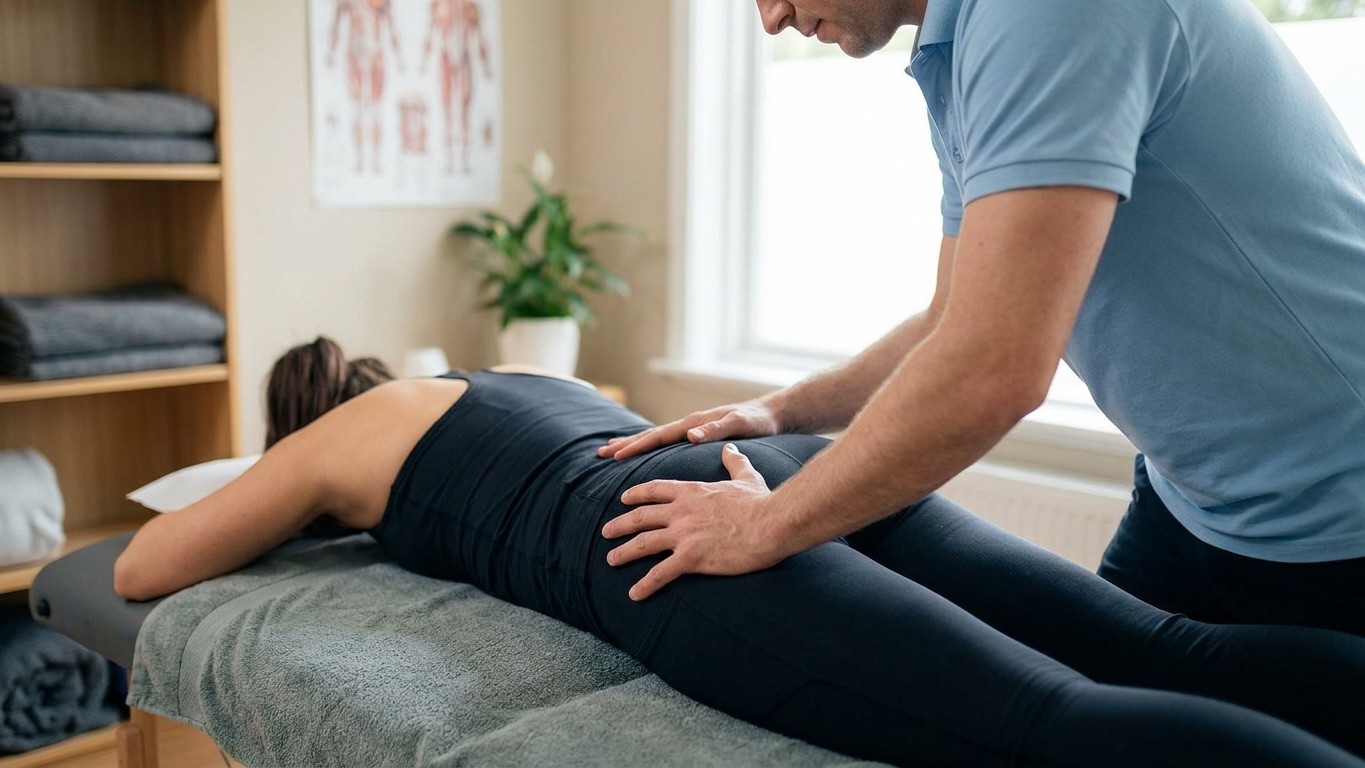
A physiotherapy assessment doesn’t always feel like much from the outside. You lie face down, the physio presses along the muscle belly of each gluteus maximus, asks you to squeeze, and watches what fires first. For many desk workers, what fires first is the hamstrings, or the lower erector spinae, anything but the glutes themselves. The body has rewired around the problem. When a physio presses into that soft, underactivated tissue and asks you to feel the difference between a genuine glute contraction and a lower back clench, the gap can be startling. That moment of realisation, that the muscle you assumed was working simply wasn’t, tends to reframe everything.
The hip flexor test often follows. Lie on your back, pull one knee to your chest, and let the other leg drop flat. If it floats up off the table, that’s a tight iliopsoas announcing itself. Tight hip flexors and dormant glutes are almost always found together, two sides of the same postural coin. Neither is painful in isolation. Together, they create the conditions for chronic lower back pain that no amount of heat packs or anti-inflammatory gel will actually fix.
Reactivating muscles that have gone quiet
The reassuring part is that gluteal amnesia responds well to targeted work, provided you approach it with some patience and precision. Simply doing more exercise isn’t enough if the movement patterns are wrong. Squatting heavily with dormant glutes, for instance, tends to reinforce the compensation patterns rather than correct them. The work usually needs to start much simpler.
Glute bridges are the standard starting point for good reason. Lying on your back with knees bent, you drive through the heels and lift the hips, consciously squeezing the glutes at the top. The key is feeling where the effort actually is, lower back engagement is a sign the glutes still aren’t pulling their weight. Clamshells, done lying on your side with a resistance band around the thighs, target the gluteus medius, the middle layer that stabilises the pelvis laterally. Hip thrusts, once you’ve rebuilt the mind-muscle connection, allow progressive loading. None of this is complicated. All of it requires attention to what you’re actually feeling rather than just going through the motion.
Hip flexor stretching works in tandem. A half-kneeling lunge position, held for 30 to 60 seconds with the pelvis tucked under rather than tipped forward, begins to restore length to the iliopsoas. The stretch should be felt at the front of the hip on the kneeling side, not in the lower back. If the back is complaining during the stretch, the pelvis position needs adjusting.
The sitting habits that matter more than you’d think
Corrective exercises help, but they’re only part of the equation. Eight hours of problematic sitting will undo 20 minutes of glute bridges rather efficiently. The research on sedentary behaviour consistently points toward the value of breaking up sitting time rather than simply compensating for it afterwards. Standing briefly every 30 to 45 minutes, even just to walk to the kitchen and back, keeps the neuromuscular system more engaged than one long uninterrupted stretch followed by a gym session.
Chair setup matters too, though it’s rarely discussed with enough specificity. A seat that’s too high tilts the pelvis backward and increases lumbar flexion. A seat that’s too low does the opposite. The goal is a hip angle close to 90 degrees with feet flat on the floor, which keeps the pelvis in a more neutral position and reduces the strain on the lumbar discs. Lumbar support helps, but it won’t rescue a fundamentally poor position.
One thing that often surprises people recovering from this pattern: the lower back pain frequently improves before the glutes feel genuinely strong. The pain was a signal from an overworked compensatory system, and once the load is redistributed, that system quietens down relatively quickly. Building real gluteal strength takes considerably longer, months rather than weeks. That gap is worth knowing about, because it’s easy to stop the work once the pain disappears, leaving the underlying weakness unresolved.
Always consult your GP or a registered physiotherapist before starting a new exercise programme, particularly if you are experiencing persistent or severe pain.