
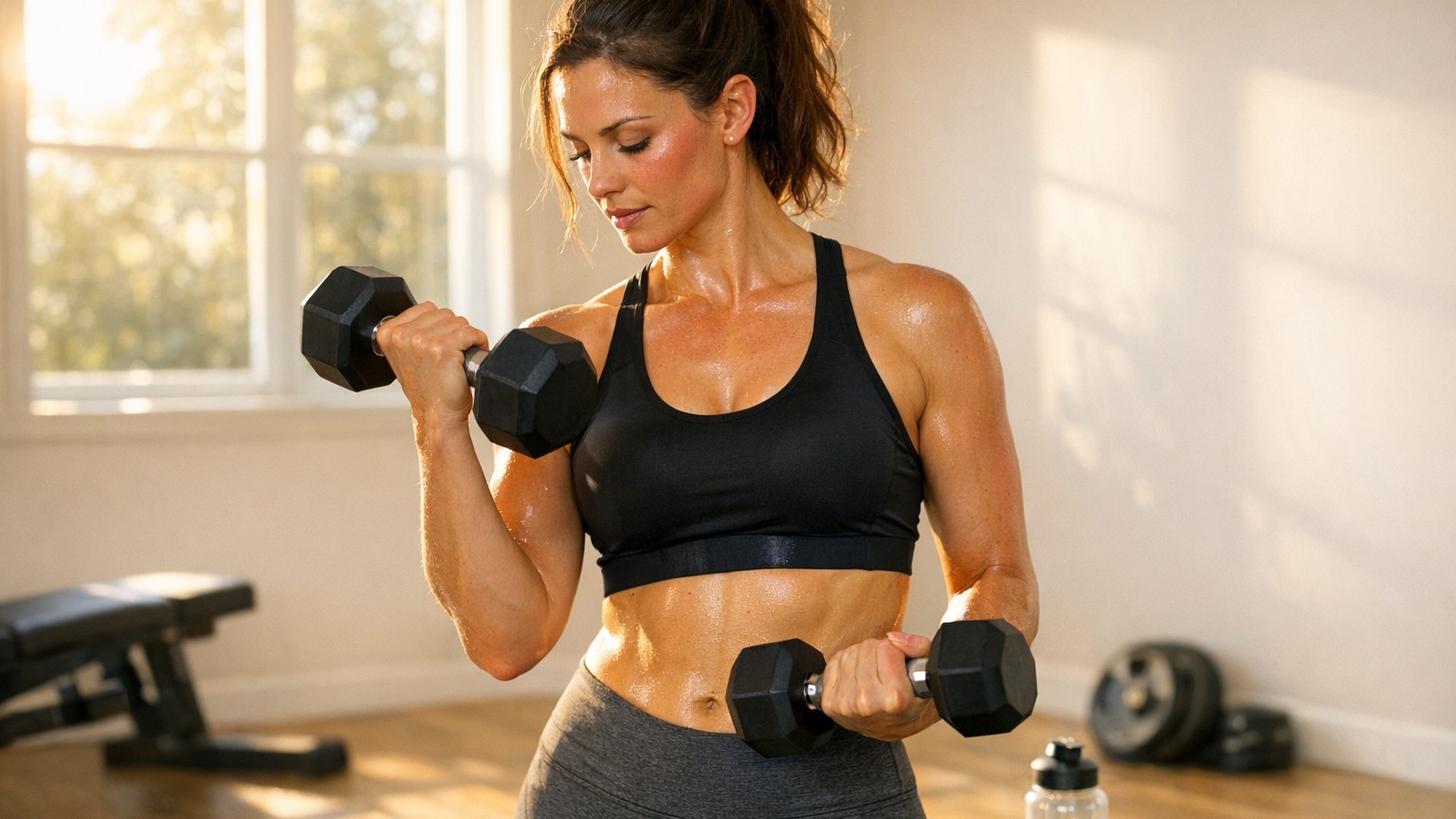
Setting your air conditioning to 18°C before a home workout feels like a sensible act of self-preservation. The room is cool, breathing is easy, sweat arrives fashionably late, and you can push harder without that clammy, suffocating sensation of working out in a sauna. The logic seems airtight. The problem is, the logic is largely wrong, and the physiological explanation is rather humbling.
Key takeaways
- Cold rooms suppress the inflammatory response your muscles need to grow and recover
- Heat acclimatization produces measurable cardiovascular upgrades that persist even in cool weather
- The ideal home workout temperature sits around 24°C, not the 18°C many people assume is optimal
What your body actually does when it trains in the cold
The body adapts to the specific demands you place on it. Train at altitude, your red blood cell count rises. Train for endurance, your heart grows more efficient. Train in excessive cold, well, your body adapts to the cold, not necessarily to your workout. Cold environmental temperatures during exercise and recovery alter the acute cellular signalling responses and training adaptations. That shift matters more than most people realise.
The concern is sharpest for anyone doing Resistance or strength-based sessions at home. Research suggests that cold interventions can blunt molecular adaptations, including protein synthesis and satellite cell activation, and oxi-inflammatory responses after resistance exercise, resulting in diminished exercise-induced hypertrophy and lower gains in isometric strength during training protocols. The mechanism is worth understanding, because it overturns a popular assumption about inflammation. We tend to think of post-exercise inflammation as something to suppress at all costs, with ice packs, cold baths, and, apparently, blasted air conditioning. But that inflammatory response is precisely what triggers muscle repair and growth. Its benefits have been questioned recently as our understanding of the crucial role inflammation plays in tissue regeneration and response to exercise has evolved.
Cold also affects blood flow in ways that directly compromise recovery. Cold-induced vasoconstriction reduces muscle blood flow, which is positively associated with post-exercise muscle protein synthesis rates. Less blood reaching the muscle means fewer amino acids arriving at the site where repair is happening. Cooling lowers skin and muscle temperature and blunts the post-exercise increase in myofibrillar protein synthesis rate, with less dietary protein-derived amino acids being taken up and used for de novo myofibrillar protein synthesis. All those post-workout protein shakes, and the cold room was quietly undermining them.
The picture for endurance training is more nuanced. Most studies indicate that chronic cooling does not affect endurance training adaptations following a 4–6 week training intervention. So if your home workouts are primarily cardio-based, the 18°C concern is considerably less pressing. Where the evidence stacks up most clearly against sustained cold training is in strength and hypertrophy work. Repeated post-exercise cooling appears to blunt muscle strength adaptations and decrease fatigue resistance following resistance training.
The hidden upside of training warm: what heat actually does to physiology
Here is where the science becomes genuinely surprising. Not only does excessive cold potentially blunt your gains, training in warmer conditions actively confers measurable physiological benefits. Heat acclimation is the process of intentional and consistent exercise in the heat that results in positive physiological adaptations, which can improve exercise Performance both in the heat and thermoneutral conditions.
The headline adaptation is plasma volume expansion. Heat acclimatisation results in 10–25% expansion of plasma volume and isotonic expansion of the interstitial fluid. More plasma means the heart can pump blood more efficiently to both working muscles and the skin for cooling simultaneously. Studies show that heat training can increase the volume of plasma, the watery portion of blood that carries blood cells and other essential compounds throughout the body, and “the benefit of having more blood volume is that it makes it easier for your heart to pump blood to the rest of the body.” The cardiovascular system, in short, gets a free upgrade.
Crucially, these benefits don’t disappear the moment the temperature drops. Heat acclimation improved time-trial performance by 6% in cool conditions and by 8% in hot conditions, and increased power output at lactate threshold by 5% in both cool and hot conditions. The adaptation transfers. A decrease in heart rate, internal body temperature, sweat electrolyte concentration, and perceptual measures, and an increase in sweat rate and plasma volume, are all positive adaptations that occur throughout heat acclimation. The body becomes a more thermally efficient machine, not just in hot weather but year-round.
Through daily exercise in a warm climate, most of the improvements in heart rate, skin and core temperatures, and sweat rate are achieved during the first week of exposure. The heart rate reduction develops most rapidly in 4–5 days, and the thermoregulatory benefits from heat acclimatisation are generally complete by 10–14 days of exposure. Two weeks of letting your living room warm up a little before your workout could reshape how your cardiovascular system handles effort across an entire summer.
Finding the temperature sweet spot for home workouts
None of this means you should train in a tropical greenhouse. Excessive heat carries its own risks: dehydration, heat exhaustion, and cardiovascular overload are all real concerns, particularly during intense cardio sessions. Heat is a stressor. More is not automatically better, and unsafe heat exposure can cause dehydration, syncope, heat exhaustion, or heat stroke.
Research on gym environments offers a helpful anchor. Around 24°C is recommended to support exercise performance, comfort, and energy conservation. Temperatures below 22°C can degrade exercise performance, particularly among women. The 18°C setting on your remote control sits in a range where the cold itself becomes a physiological drag, muscles function less efficiently, warm-up takes longer, and the anabolic window post-exercise is quietly compromised.
A practical approach: let the room sit at ambient summer temperature (typically 22–26°C in the UK on a warm day) for a strength or resistance session, hydrate proactively, and wear breathable kit. Heat acclimatisation programmes should include gradual exposure to warm environments, both with and without exercise. You don’t need to suffer. You just need to stop aggressively eliminating the very stimulus your body was gearing up to adapt to.
One important caveat before you unplug the air con entirely
The research on cold and training adaptations is drawn largely from cold water immersion studies, rather than from controlled experiments using air conditioning specifically. The cooling effect of 18°C ambient air is considerably milder than a 10°C ice bath. The primary benefit of cooling was in the early recovery phase, under one hour post-exercise, in improving fatigue resistance in hot ambient conditions following endurance exercise. So for those returning from a sweltering outdoor run, a cooler room during the first hour of recovery may still be useful. The key distinction is between cooling as an acute recovery aid in specific circumstances, versus habitually training in a cold room across an entire season on the assumption that comfort equals performance.
There is also an interesting asymmetry worth noting: heat acclimatisation gradually disappears if not maintained by continued repeated exercise-heat exposures. The benefits are retained for roughly one week and then decay, with about 75% lost by three weeks, once heat exposure ends. The body gives up its hard-won adaptations relatively quickly, which makes consistent environmental conditions during training all the more consequential. Set the AC to 24°C, not 18°C, and your summer workouts may end up building something that lasts well beyond September.
Always consult your GP before making significant changes to your exercise routine, particularly if you have a cardiovascular condition or are sensitive to heat.
Sources : journals.physiology.org | pmc.ncbi.nlm.nih.gov