
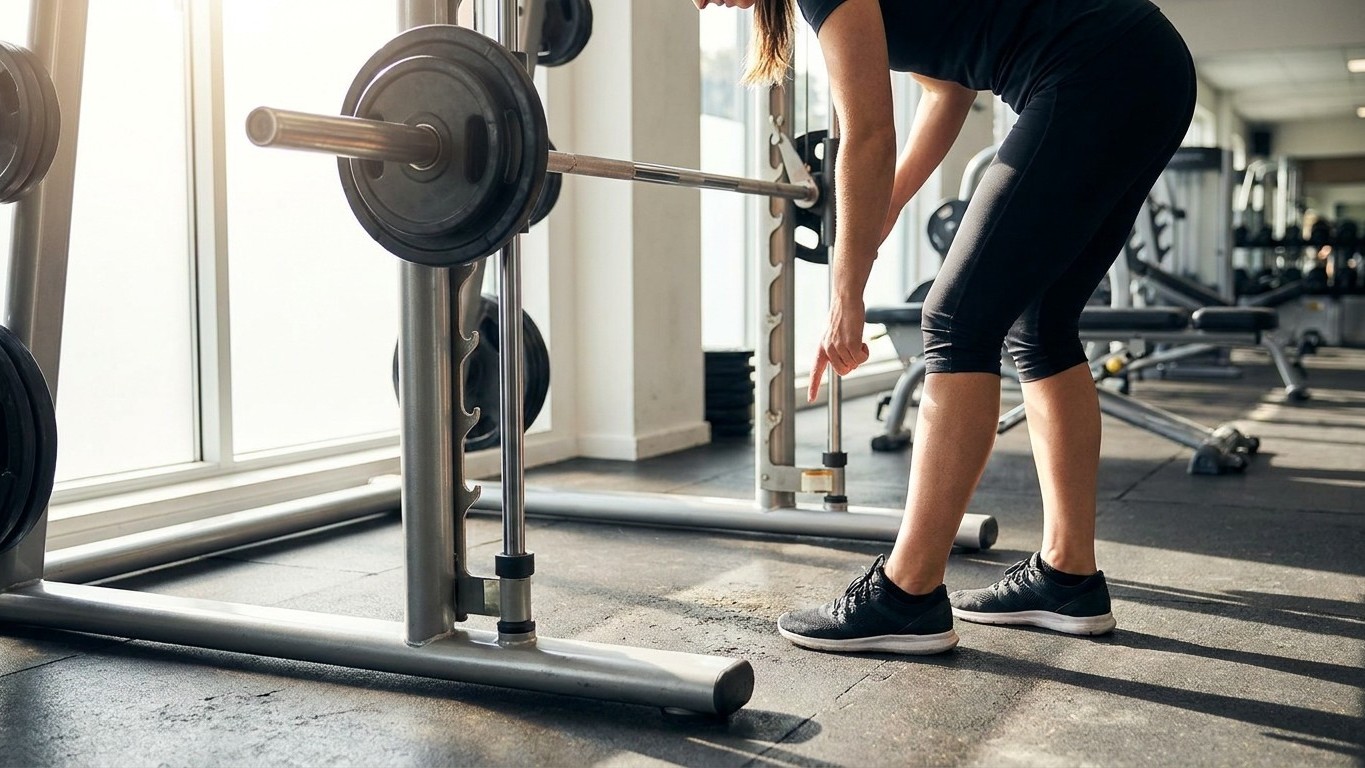
The Smith machine squat is one of the most popular exercises in any commercial gym, and for good reason: the guided bar takes away the balance equation, letting you focus purely on loading the legs. The problem is that “loading the legs” often becomes “loading the knees”, and the difference matters enormously, especially if your feet have been creeping forward for years without anyone flagging it.
Key takeaways
- A physiotherapist’s MRI discovery reveals what years of ‘feet under the bar’ squats actually do to your knee joint
- The fixed bar path forces disproportionate stress on the patellofemoral joint in ways free-weight squats don’t
- A 15-30cm foot position adjustment replicates natural squat mechanics and shifts load away from your knees
What “feet forward” actually does to your knee joint
When you position your feet directly beneath the bar on a Smith machine (rather than slightly in front of it), every rep drives your knees forward over your toes with far greater force than a free-weight squat would allow. The fixed, vertical bar path is the culprit here. Unlike a barbell squat, where your torso naturally tilts forward to counterbalance the load, the Smith machine holds the bar in a rigid vertical track. Your hips stay back, your torso stays upright, and your knees compensate by travelling aggressively forward.
This places disproportionate compressive load on the patellofemoral joint, the interface between your kneecap and the groove at the bottom of your femur. Research published in the Journal of Strength and Conditioning Research has consistently shown that greater forward knee travel correlates with elevated patellofemoral joint stress. Over months and years of heavy loading, the cartilage in that groove can begin to break down, a process visible on MRI as cartilage thinning, fissuring, or the characteristic “softening” that physiotherapists call chondromalacia patellae.
The MRI finding that stops people mid-set is usually one of two things: early cartilage wear that they had no idea was there, or a small but symptomatic lesion that explains months of vague, dismissed knee discomfort. Neither is catastrophic at early stages. Both are significantly worsened by continuing the same movement pattern with the same loading.
The foot position fix that changes everything
The adjustment is surprisingly simple, though it feels counterintuitive the first time you do it. On a Smith machine, your feet need to be placed roughly 15 to 30 centimetres in front of the bar, not underneath it. This replicates a more natural squat mechanics by allowing your torso to incline slightly, shifting more of the load onto your hip extensors and posterior chain rather than dumping it all onto the knee joint.
Physiotherapists often use a simple observational cue: watch where your shins are at the bottom of the movement. In a healthy Smith machine squat with appropriate foot placement, the shin should remain relatively vertical, or only moderately inclined. If your shins are nearly parallel to the bar at the bottom, your knees are doing far too much of the work.
Heel elevation can also make a meaningful difference. Placing a 1-2cm wedge or weight plate under your heels reduces the ankle dorsiflexion demand, which is frequently the underlying reason feet migrate forward in the first place. Limited ankle mobility forces the knee forward as a compensatory strategy. Addressing ankle flexibility with targeted stretching (especially the soleus, which most people neglect in favour of the gastrocnemius) often resolves the compensatory pattern at the knee without any changes to the exercise itself.
Why the Smith machine gets unfairly blamed
The machine itself is not the villain. A Smith machine squat with correct foot placement, appropriate depth, and controlled tempo is a legitimate, low-risk strengthening tool, particularly for rehabilitation settings where the guided path actually reduces the proprioceptive demands on a healing joint. Some sports medicine clinics use Smith machine work specifically in early-stage knee rehab precisely because of the predictable bar path.
The real issue is that gym culture rewards loading the bar rather than interrogating the movement. Someone squatting 100kg on a Smith machine with feet planted directly beneath the bar looks impressive; someone squatting 70kg with feet forward, tempo controlled and depth earned through range of motion looks like a beginner. That social dynamic quietly perpetuates poor mechanics across thousands of gym sessions.
There is also a straightforward anatomical asymmetry worth knowing. The Smith machine’s fixed vertical path suits some people’s proportions reasonably well and suits others very poorly. Taller lifters with longer femurs face a structurally harder challenge keeping knees from travelling forward, regardless of where they put their feet. For these individuals, the goblet squat or Bulgarian split squat often distributes load more kindly across the knee, hip and ankle simultaneously.
After the MRI: what actually helps
If you have already seen cartilage changes on imaging, the conversation changes slightly, though the mechanical principles remain the same. The knee cartilage has a limited but real capacity to respond positively to appropriate loading, and complete rest is rarely the answer. What physiotherapists typically recommend is a graduated return to loading with corrected mechanics, combined with work to strengthen the VMO (the teardrop-shaped muscle on the inner side of the quadriceps) which plays an outsized role in keeping the kneecap tracking correctly within its groove.
Terminal knee extensions, step-downs, and Spanish squats are all exercises that load the knee with reduced patellofemoral compression compared to a deep squat. They are not glamorous. They do not feature heavily on training influencer accounts. They do, however, allow damaged cartilage tissue to remodel under load without the compressive forces that caused the problem.
One detail that surprises many people: body weight has a larger effect on patellofemoral joint stress than exercise load does. A study examining joint loading in people with patellofemoral pain found that even modest reductions in body weight produced measurable reductions in knee joint forces during everyday activities, independent of any change in training. That context matters when you are building a long-term plan for knee health, not just a short-term fix for a specific exercise.
This article is for informational purposes only. Please consult your GP or a registered physiotherapist for advice specific to your situation.