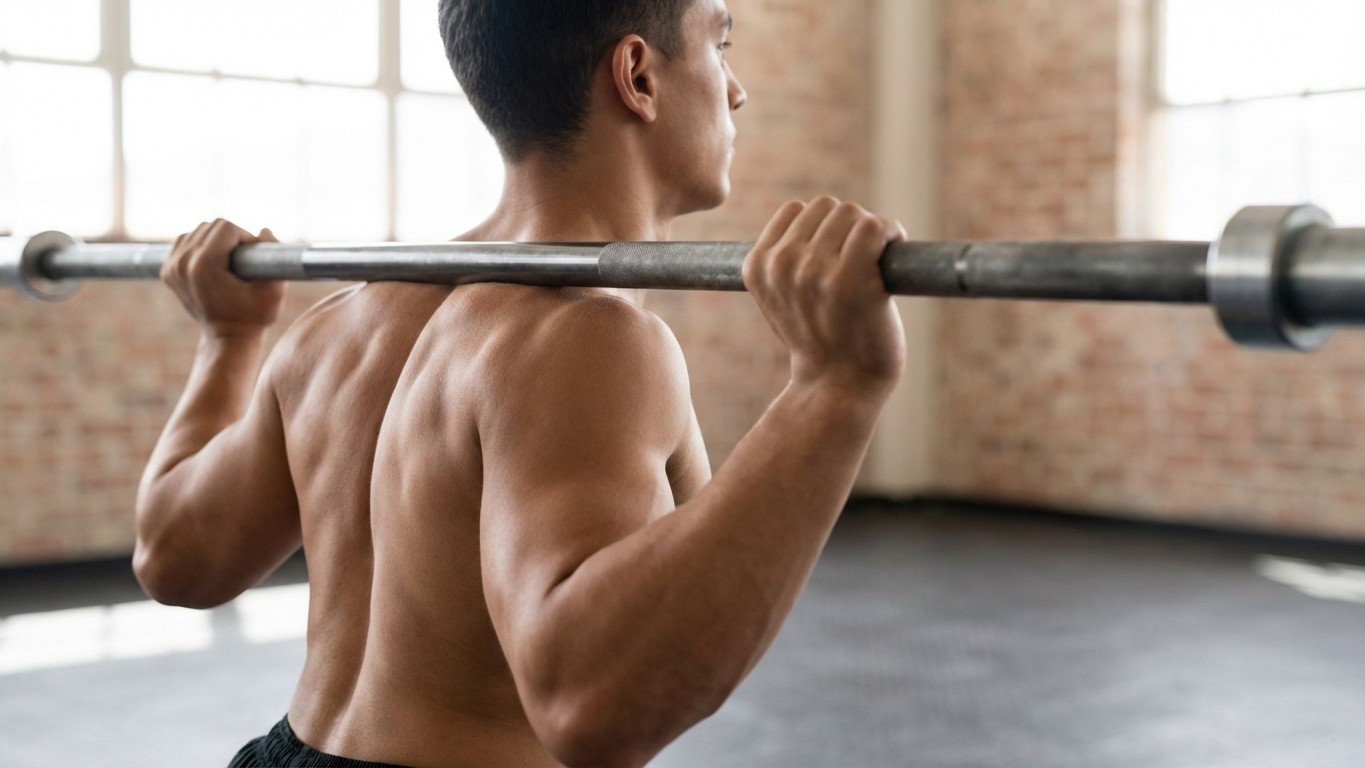
One small adjustment. That’s all it took. After years of squatting with my arms extended straight in front of me, a coach nudged my hands slightly wider and asked me to pull them apart as if tearing a piece of paper. The difference in how my torso felt was immediate and, frankly, a little embarrassing given how long I’d been getting it wrong.
The squat is often described as one of the most “natural” human movements, something our bodies were built to do. Toddlers squat perfectly without anyone teaching them. Yet somewhere between childhood and adulthood, most of us lose that intuitive pattern, and the gym doesn’t always help us find it again. The cues we receive tend to focus on the lower body: push your knees out, keep your chest up, drive through your heels. Rarely does anyone talk about what your hands are doing, or why it matters enormously for what happens in your torso.
Key takeaways
- Your arms aren’t decorative during squats—they directly influence spinal stability through shoulder and lat engagement
- A 10-second cue adjustment created instantly noticeable changes in how my trunk felt under load
- This discovery raises an uncomfortable question: what other hidden layers are you missing in your training?
Why your arms aren’t just along for the ride
The upper body position during a squat isn’t decorative. Your arms and hands influence the tension patterns across your entire trunk through a network of muscular connections that run from your shoulders through your lats, down into the thoracolumbar fascia, a broad sheet of connective tissue that essentially wraps your lower back and connects to your pelvis. When you create active tension in your upper arms and shoulders, that tension travels down this chain and contributes to what coaches call “bracing,” the full 360-degree stiffening of the trunk that protects your spine under load.
Think of it like tightening the guy-wires on a tent. The central pole (your spine) becomes far more stable when the lines pulling outward from multiple directions are all taut. Letting your arms hang passively, or simply floating them forward as an afterthought, leaves some of those wires slack. The tent still stands, but it wobbles.
The specific cue my coach used, pulling the hands apart as if stretching a resistance band, engages the external rotators of the shoulder and activates the lats more forcefully. The lats, running from the upper arm all the way down to the lower back, are the most underappreciated muscle in a squat. They don’t directly move your legs, but they create the rigid cylinder your spine needs to transfer force efficiently from the ground upward.
The science behind the cue
Intra-abdominal pressure, the internal “bubble” of pressure generated when you brace properly, is your spine’s best friend during loaded movement. Research published in sports biomechanics journals has consistently shown that trunk stiffness during squatting is influenced by how effectively lifters can generate this pressure, and that upper body positioning plays a supporting role in this process. When the lats are actively engaged, they assist in creating circumferential tension around the core rather than leaving the bracing work entirely to the diaphragm and abdominals.
There’s also a proprioceptive element worth considering. Giving your hands an active job, something to do rather than just existing in space, appears to sharpen your body’s awareness of its own position. Coaches sometimes call this “irradiation,” the phenomenon where intense muscle contraction in one area seems to spread neural activation to surrounding muscles. Grip something tightly, and your arm muscles fire harder. Pull your hands apart actively, and your lats, rhomboids and mid-back muscles all join the party.
I’d been leaving all of that on the table. Every session, for years.
Getting the cue right in practice
The adjustment works whether you’re squatting with a barbell, a goblet squat with a single weight, or even a bodyweight squat. The principle adapts across variations, which is what makes it genuinely useful rather than a niche trick for competitive powerlifters.
For a barbell back squat, the hands are already gripping the bar, so the cue becomes: try to bend the bar around your back, or pull your hands toward each other as if doing a lat pulldown while standing. This is isometric, nothing actually moves, but the muscular intent is what generates the tension. For a goblet squat, hold the weight and actively try to pull your elbows apart and down, driving them toward your hips rather than letting them drift forward. For a bodyweight squat, extending the arms but then actively pulling the shoulder blades together and down while simultaneously trying to pull the hands apart gives your nervous system a clear task.
The key is that the movement is intentional, not incidental. There’s a meaningful difference between arms that happen to be in position and arms that are actively contributing to the structure of the lift.
One practical way to feel the difference before loading up: stand tall, take a big breath into your belly, brace as if expecting a punch, and then add the arm cue on top. Most people notice the bracing feels qualitatively firmer, almost as if someone has tightened a belt around their waist from the inside.
What this reveals about learning movement
The broader lesson here might be the most valuable part. Complex movement patterns have layers, and most of us, however experienced, are working with an incomplete picture. We nail one layer, plateau, and assume we’ve reached our ceiling, when actually a coach with fresh eyes can see an entire dimension we’ve been missing.
Squatting “correctly” by one standard, knees tracking, depth achieved, back not rounding, I had been treating my arms as ballast for years. The adjustment took perhaps ten seconds to explain and two repetitions to feel. Which raises an uncomfortable question for anyone who trains independently: how many other movements in your routine have a similar hidden layer quietly waiting to be unlocked?
Always consult your GP or a qualified physiotherapist before beginning or significantly changing an exercise programme, particularly if you have any existing back, hip or knee concerns.