
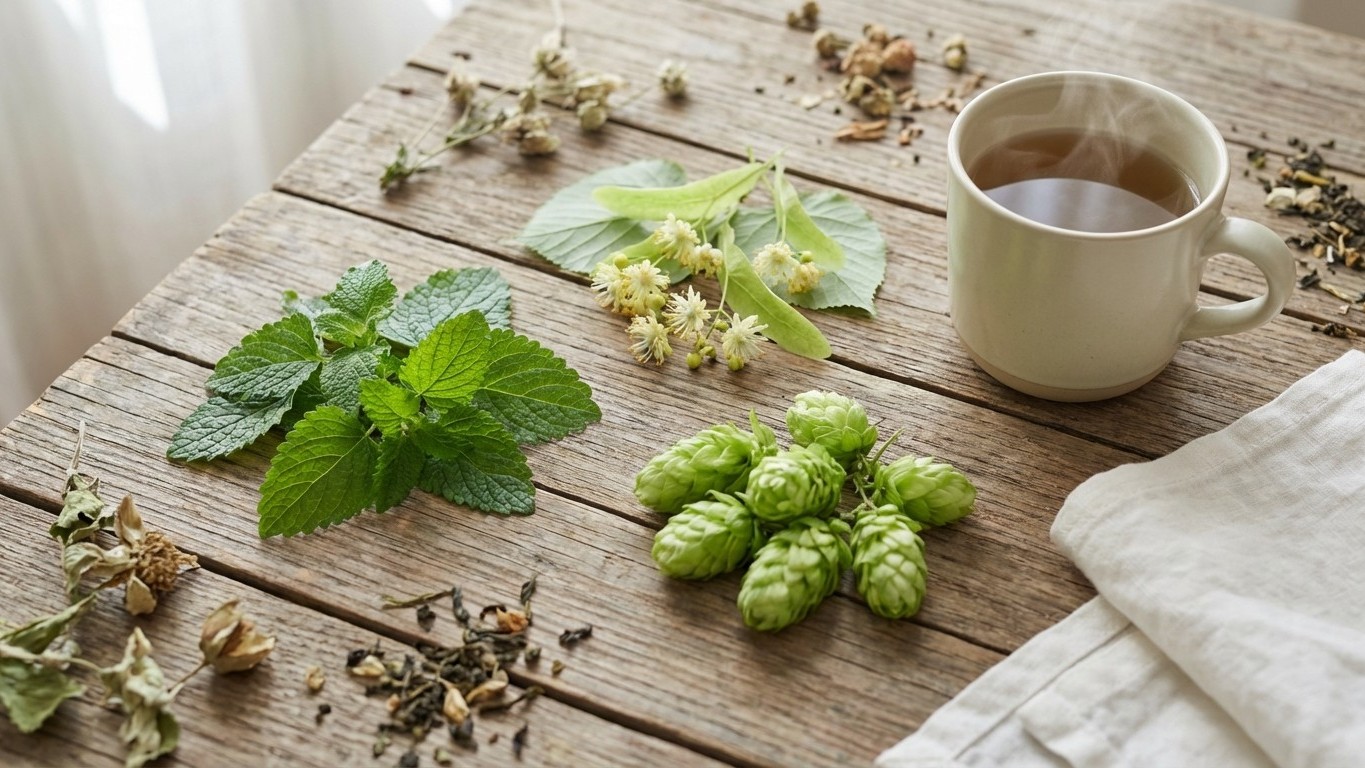
Valerian gets all the headlines. Chamomile sits on every supermarket shelf. Passionflower has its devoted fans. But tucked quietly in the background of herbal medicine, three plants have been soothing restless minds and helping people drift off for centuries, with surprisingly solid science to back them up. Lemon balm, linden, and hops deserve a proper introduction.
These aren’t obscure botanical curiosities. They’re widely available, generally well-tolerated, and when used thoughtfully, they can address different aspects of poor sleep in ways that the more famous herbs simply don’t. If you’ve been relying on the same chamomile tea for years with middling results, or you’re curious about natural sleep remedies herbs beyond the usual suspects, this is worth reading carefully.
Why Look Beyond Melatonin and Sleeping Tablets
Sleep problems are extraordinarily common in the UK. Around one in three adults reports difficulty sleeping at some point, and the impulse to reach for a quick solution is entirely understandable. Melatonin supplements (available over the counter since 2021 for adults) and prescription sleeping tablets both have their place, but they also come with caveats: dependency risks, morning grogginess, and the fact that they don’t always address the reason you can’t sleep in the first place.
Herbal approaches work differently. Rather than switching sleep on artificially, most sleep herbs work by reducing the nervous system arousal that keeps you awake. They tend to act on the anxiety, the mental chatter, the tight chest at 11pm. That’s a meaningful distinction. The plants discussed here won’t knock you out, but used consistently as part of a bedtime routine, they can genuinely change the texture of your evenings.
Meet the Three Plants: Lemon Balm, Linden, and Hops
Lemon Balm (Melissa officinalis)
Native to the Mediterranean but long naturalised across Europe, lemon balm is a mint-family plant with a gentle citrus scent that gives it its common name. Its use as a calming remedy goes back at least to medieval monastic gardens, where it was grown specifically for anxiety and insomnia. The science has gradually caught up with this tradition.
Lemon balm appears to work primarily by inhibiting an enzyme called GABA transaminase, which breaks down gamma-aminobutyric acid (GABA) in the brain. GABA is the nervous system’s main inhibitory neurotransmitter, the chemical that essentially tells your brain to calm down. By slowing its breakdown, lemon balm effectively helps sustain a state of calm. Several small clinical trials have shown reductions in anxiety scores and improvements in sleep quality in participants taking lemon balm extracts, though it’s worth noting these trials were generally short-term and involved modest sample sizes. The effect is real but subtle.
What makes lemon balm slightly unusual among sleep herbs is its mild mood-lifting quality. It’s not sedating in any heavy sense. People often describe it as taking the edge off rather than making them drowsy, which makes it particularly useful for those who can’t sleep because their mind won’t stop.
Linden (Tilia spp.)
Walk past a linden tree in full flower in June and the fragrance alone feels vaguely soporific. In France and much of continental Europe, tilleul (linden flower tea) is as standard a bedtime drink as chamomile is in the UK. The flowers and bracts of the Tilia genus have been used in phytotherapy for nervous tension, restlessness, and sleep difficulties for generations.
The active compounds include flavonoids, particularly kaempferol and quercetin derivatives, as well as volatile oils. Research on linden specifically for sleep is thinner than for lemon balm or hops, but the plant has a well-established profile as an anxiolytic and mild antispasmodic. That antispasmodic quality is worth noting: linden can help ease physical tension that accompanies anxiety, such as tight muscles and mild palpitations, which are common contributors to lying awake.
Linden is exceptionally gentle. This is the herb you’d reach for on behalf of an elderly parent or someone who simply needs unwinding after a stressful day, without any concern about strong sedative effects.
Hops (Humulus lupulus)
The same plant that gives beer its bitterness has a rather distinguished history as a sleep aid. Hops pillows, filled with dried hop cones, were used in folk medicine across northern Europe, and there’s an old story (probably apocryphal, but enjoyably persistent) that hop harvesters were noted for falling asleep on the job, supposedly due to absorbing the plant’s volatile compounds through their skin.
The sedative action of hops is better documented than the other two plants discussed here. The primary active compound is 2-methyl-3-buten-2-ol, a degradation product of the bitter acids in hops, which has demonstrated central nervous system depressant activity in laboratory research. Hops also appear to interact with melatonin receptors, which gives them a more directly sleep-promoting mechanism than lemon balm or linden. Some human studies have shown that hops, particularly in combination with valerian, can reduce the time it takes to fall asleep and improve sleep quality ratings.
The taste of hops in tea, however, is aggressively bitter. Most people find it much more palatable in capsule or tincture form, or blended with sweeter herbs.
How These Plants Act on the Body
The three plants work through overlapping but distinct pathways. Lemon balm targets GABA metabolism. Hops influence melatonin receptors and have direct sedative compounds. Linden works largely through flavonoid-mediated anxiolytic activity and muscle relaxation. Together, they address the sleep problem from multiple angles simultaneously: calming the racing mind (lemon balm), releasing physical tension (linden), and nudging the body towards genuine sleepiness (hops).
This multi-pathway action is precisely why herbal combinations often outperform single herbs in practice. The body’s sleep system is complex; it rarely fails for just one reason. A combination that addresses both cognitive arousal and physical restlessness is going to be more effective for most people than a single-target approach.
Which Plant (or Combination) Suits Your Profile?
Matching the Herb to the Person
If your sleeplessness is driven primarily by an overactive mind, intrusive thoughts, or mild anxiety, lemon balm is likely your starting point. It’s the most mentally focused of the three, with that characteristic quality of quieting internal noise without inducing grogginess the next morning.
Linden tends to suit people whose tension is more physical: jaw clenching, shoulder tightness, the sensation of not being able to fully exhale. It also has a mild digestive-relaxing effect, making it useful if you notice your stomach is tense or uncomfortable in the evenings. Older adults often respond particularly well to linden, partly because its gentle action rarely conflicts with other medications, though checking with a GP is still sensible.
Hops are the choice when the problem is less about winding down and more about actually falling asleep once you’re already fairly relaxed. If you lie in bed feeling calm but just… not sleepy, hops may provide the nudge the other two can’t. They’re also worth considering for people who wake in the early hours and struggle to return to sleep.
Synergies and Blends: Getting the Most from These Three Plants
The good news is that lemon balm, linden, and hops combine well with each other and with the better-known sleep herbs. A classic evening blend might use equal parts lemon balm and linden, with a smaller proportion of hops (perhaps one part hops to two parts of each of the others) to avoid the bitterness overwhelming the cup.
For someone dealing with significant stress and difficulty falling asleep, adding valerian to this blend creates a more robust effect. You can read more about getting the dosing right in our guide to valerian root for sleep how to use. For a gentler, daytime-appropriate blend, lemon balm and linden without hops pairs beautifully with chamomile, a combination explored further in this article on chamomile tea for sleep benefits.
The broader landscape of herbal sleep remedies, including passiflora, lavender, and lifestyle-based approaches, is covered in our comprehensive natural sleep remedies guide, which puts all of this into context.
Preparing and Using These Herbs Effectively
For tisanes using dried herbs, the standard approach is one to two teaspoons of dried herb per cup of just-boiled water, steeped covered for ten minutes. Covering the cup matters, because the volatile aromatic compounds that contribute to the calming effect will otherwise evaporate. Lemon balm and linden make pleasant-tasting teas on their own; hops is best blended or taken as a capsule or tincture.
Timing is worth thinking about. Drinking your herbal tea roughly 30 to 45 minutes before bed, as part of a deliberate wind-down routine, tends to produce better results than simply gulping it down at the last moment. The ritual itself, the warmth, the pause, the signal to your nervous system that the day is ending, contributes meaningfully to the effect.
Capsule or tablet forms are practical for hops and lemon balm in particular, especially if you travel or find tea preparation inconvenient. Standardised extracts can offer more consistent dosing, though the quality varies between products. Look for preparations that specify the extract ratio or the content of key compounds.
Precautions and Contraindications
These three plants are generally considered safe for healthy adults at typical doses, but some cautions apply. Lemon balm may interact with thyroid medication and sedative drugs; people with thyroid conditions should seek medical advice before using it regularly. Hops are not recommended during pregnancy, and their mild oestrogenic activity means people with hormone-sensitive conditions should check with their GP. Linden is one of the safest options available, but like any herb, excessive consumption over long periods isn’t advisable.
None of these herbs should be combined with prescription sedatives, benzodiazepines, or alcohol without medical guidance. And if your sleep problems are severe, persistent, or accompanied by symptoms like depression, breathlessness, or pain, please speak to your GP rather than attempting to manage them purely with herbal remedies. Herbs are genuinely useful tools, but they’re not a substitute for proper diagnosis.
Frequently Asked Questions
Which of these three plants is best for falling asleep? Hops has the most direct sleep-promoting action of the three, particularly for the transition into sleep. Lemon balm is more effective at reducing the anxiety that prevents sleep, while linden addresses physical tension. For most people, a combination works better than any single herb.
Can you mix lemon balm, linden, and hops in one tea? Absolutely, and many traditional herbal sleep blends do exactly this. The key is balancing the proportions to keep the bitterness of hops manageable. A ratio of roughly 2:2:1 (lemon balm to linden to hops) is a good starting point.
Are there any contraindications? As outlined above, lemon balm warrants caution for those on thyroid medication or sedatives. Hops should be avoided in pregnancy and with hormone-sensitive conditions. Always consult your GP if you’re on prescription medication or have an underlying health condition.
Going Further
The research into these herbs is genuinely promising, but it’s also still developing. What the science reflects, even imperfectly, is what traditional herbalists and generations of grandmothers across Europe already knew: that these plants, used thoughtfully, can make evenings quieter and nights more restorative. For a wider view of the herbal toolkit available to you, the guide to natural sleep remedies herbs offers a thorough overview of the full range of options and how to navigate them.
Sleep is not just a biological necessity; it’s the foundation of how you feel, think, and function. If three overlooked plants can help you get there a little more reliably, that’s worth exploring. Your evening cup of tea might be more powerful than you think.