
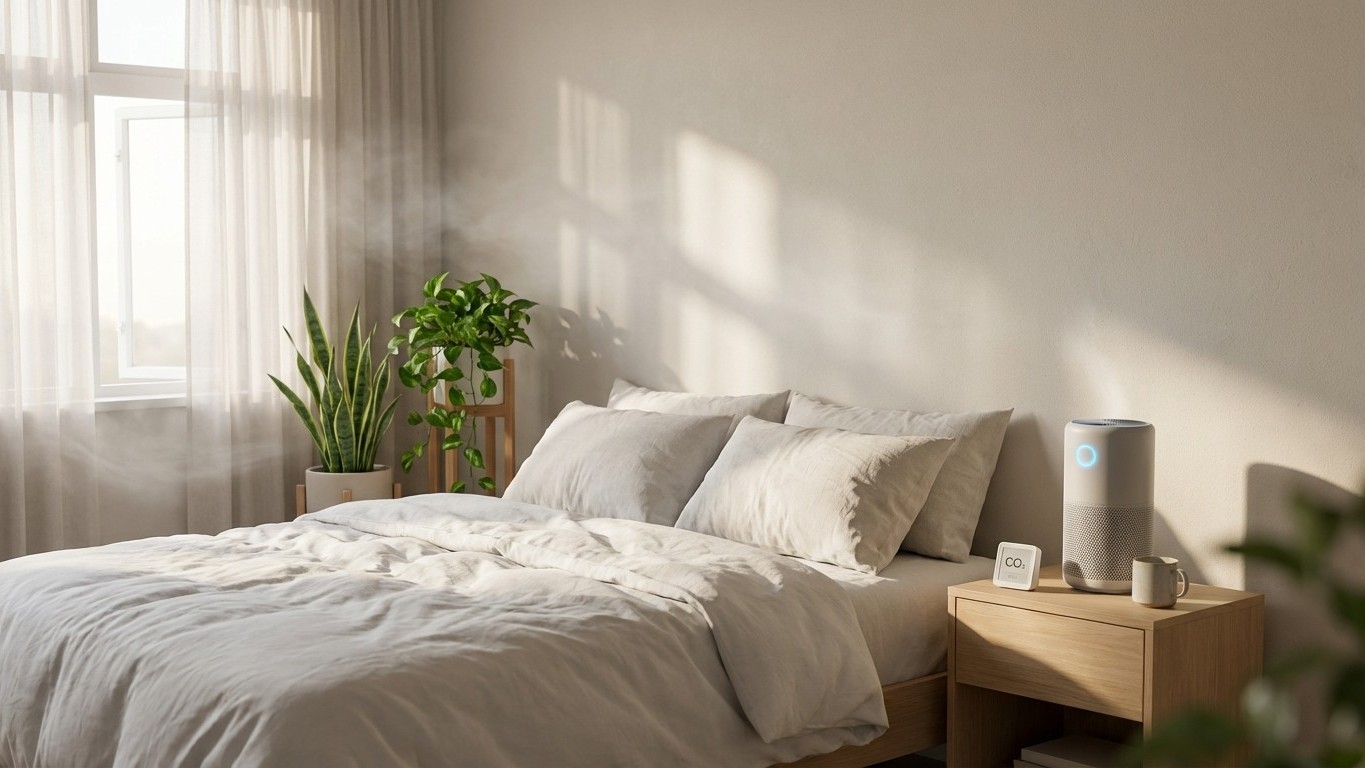
You could buy the most expensive mattress on the market, invest in silk pillowcases, and still wake up at 3am feeling groggy and unrested. The culprit? Quite possibly the air you’ve been breathing all night. Sleep air quality, ventilation, and CO2 levels in the bedroom are among the most overlooked factors in sleep health, and yet the science behind them is surprisingly compelling.
Why Air Quality Directly Affects Your Sleep
The Hidden Role of CO2 and Indoor Pollutants
When you sleep in a sealed room, you’re not just resting, you’re continuously exhaling carbon dioxide into an enclosed space. CO2 concentrations in unventilated bedrooms can climb from the outdoor baseline of around 400 parts per million (ppm) to well above 2,000 ppm by morning. Research published in peer-reviewed environmental health journals has found that elevated CO2 levels (above 1,000 ppm) are associated with reduced sleep quality, more frequent micro-arousals, and increased next-day fatigue, even when sleepers aren’t consciously aware of waking.
The problem doesn’t stop at CO2. Modern bedrooms are surprisingly polluted environments. Volatile organic compounds (VOCs) off-gas from furniture, flooring, and synthetic textiles. Dust mites thrive in soft furnishings. Formaldehyde can leach from flat-pack furniture. All of these compounds compete with oxygen in the air you breathe during the most restorative hours of your night. Your body, already in a state of reduced physiological arousal during deep sleep, is less equipped to compensate, which is why poor air quality tends to degrade sleep architecture in ways that feel mysteriously inexplicable the next day.
What Happens When Ventilation Is Poor at Night
A poorly ventilated bedroom doesn’t just feel stuffy, it creates a physiological stress response. As oxygen availability drops and CO2 builds, your respiratory rate subtly increases, your sleep becomes lighter, and your body spends less time in the slow-wave and REM stages that drive memory consolidation, emotional regulation, and physical repair. Some people report this as “restless” sleep without any obvious cause.
There’s also a humidity factor. Poor ventilation traps moisture exhaled during sleep (the average person exhales about a litre of water vapour overnight), raising relative humidity. Damp, warm air creates ideal conditions for mould spores and dust mite proliferation, both known respiratory irritants. If you regularly wake up with a blocked nose or scratchy throat and haven’t found a medical explanation, your bedroom ventilation may deserve closer attention. For a broader view of environmental sleep factors, the guide on natural ways to improve sleep environment covers light, temperature, noise, and smell together.
Scent, Comfort, and the Olfactory Connection to Rest
Which Smells Help or Hinder Sleep?
The olfactory system has a uniquely direct pathway to the limbic brain, the seat of emotion and memory, which means scent can influence your nervous system state faster than almost any other sensory input. Certain aromas are associated with reduced cortisol, slower heart rate, and a shift towards parasympathetic (rest-and-digest) dominance. Lavender is the most studied, with multiple small trials suggesting it can reduce anxiety and promote lighter, more restorative sleep onset. Chamomile, cedarwood, and sandalwood have a similar, if less-researched, profile.
On the other side of the equation: synthetic air fresheners, scented candles made from paraffin wax, and many conventional fabric sprays release VOCs, fine particulates, and sometimes formaldehyde into your sleeping space. The irony of perfuming your bedroom with a product that then degrades your air quality is real. If the room “smells clean” but contains a cocktail of synthetic fragrance compounds, your body may register a stress response even as you think you’re creating a relaxing atmosphere.
What the Research Actually Shows
Studies on olfactory influences on sleep are smaller in scale than those on light or temperature, which makes it harder to draw firm conclusions. That said, lavender aromatherapy has shown measurable effects in several controlled trials, particularly in people with mild sleep disturbances. The mechanism likely involves modulation of the autonomic nervous system rather than any direct sedative effect. A single drop of lavender essential oil on a pillow, or a diffuser run briefly before bed (and switched off before sleeping, to avoid respiratory irritation from prolonged exposure), is a low-risk, low-cost intervention worth trying.
Unpleasant smells, conversely, can increase sleep fragmentation. Research using polysomnography has shown that aversive odours presented during sleep increase waking frequency. The implication for your bedroom is practical: damp laundry, gym clothes, and even some cleaning products left in the room can quietly chip away at your rest. Keeping the bedroom space genuinely clean, rather than just masked with fragrance, is the more durable solution. You’ll find detailed guidance on using natural scents and essential oils in the companion guide on natural sleep remedies.
Ventilating Your Bedroom Effectively (Without Spending a Fortune)
Practical Steps to Reduce Nocturnal CO2
The single most effective and accessible intervention is also the simplest: open a window. Even a small gap of two to three centimetres allows sufficient air exchange to keep CO2 levels significantly lower throughout the night. Studies comparing sealed versus slightly open windows in residential bedrooms have shown reductions of several hundred ppm in CO2 concentration, enough to measurably improve sleep depth and next-morning alertness.
Timing matters more than most people realise. Airing the room before bed removes accumulated daytime pollutants, but leaving the window slightly open during sleep is what actually prevents CO2 from building overnight. A brief, vigorous airing of ten to fifteen minutes with the window fully open (ideally creating a cross-draught by opening a door on the opposite side of the room) before you get into bed is more effective than a slight gap left all day. The best room temperature for sleep also influences how much ventilation feels comfortable, the two factors are closely linked.
Window Position, Duration, and Seasonal Timing
Cross-ventilation, achieved by opening windows or doors on opposite sides of the room or flat, dramatically increases air exchange compared to a single open window. In summer, airing in the early morning or late evening (when outdoor air is cooler and air quality is generally better than midday in urban areas) makes more sense. In winter, many people avoid opening windows for fear of cold, but even a few minutes of brisk ventilation before bed followed by a slightly cracked window through the night is far preferable to a sealed, CO2-saturated room. A cooler room also happens to support sleep onset: research consistently points to a bedroom temperature of around 16-18°C as optimal for most adults.
Natural vs. Mechanical Ventilation and Common Mistakes
Mechanical ventilation systems (extractor fans, heat recovery units) are effective but not necessary for most people. The most common mistake with natural ventilation is treating it as a daytime-only activity, closing everything up before bed for the sake of quiet or warmth, and then wondering why sleep quality is poor. Another frequent error is over-relying on air fresheners, which add chemicals without removing CO2 or improving oxygen levels.
If you live in a flat with little natural airflow, or if street noise makes an open window impractical, a small gap at the top of a window combined with a how to sleep better naturally without blackout curtains approach to light management can help you fine-tune your environment without costly solutions. Acoustic concerns aside, most people adapt to ambient city noise within a few nights : CO2 accumulation, by contrast, doesn’t adapt away.
Natural Techniques for Cleaner, Calmer Air
Bedroom Plants: Which Ones Actually Help?
The idea that houseplants can meaningfully purify indoor air became popular after a NASA study in the 1980s, but subsequent research has tempered expectations. A single plant has a negligible effect on VOC levels in a real bedroom compared to a controlled chamber. That said, plants aren’t useless, they contribute modestly to humidity regulation, and their psychological effect (a sense of calm, a connection to nature) may itself be sleep-supporting. Spider plants, peace lilies, and snake plants are often mentioned for their low-maintenance profiles and some air-filtering capacity.
One important caveat: some plants release CO2 at night through respiration, which slightly counters the benefit. Succulents and cacti are exceptions, they use a different photosynthetic pathway (CAM metabolism) that means they absorb CO2 and release oxygen even in darkness. A few well-chosen plants are pleasant additions to a bedroom environment, but they work best alongside proper ventilation rather than as a substitute for it.
Essential Oils, Natural Sprays, and Reducing Hidden Pollutants
If you’d like to introduce calming scent into your sleeping space, a diffuser run for thirty minutes before bed (then switched off) or a light application to your pillow is far preferable to synthetic sprays. Lavender, vetiver, and cedarwood are good starting points. Choose 100% pure essential oils from reputable suppliers and avoid burning anything in the room (incense, paraffin candles), the combustion products from these create particulate matter that is actively harmful to your respiratory system during sleep.
Reducing indoor pollutant sources is more impactful than adding anything. Choose low-VOC paints if you’re redecorating. Air out new furniture for several days in a garage or well-ventilated room before bringing it into your sleeping space. Wash new bedding before use. Keep cleaning products out of the bedroom. These small decisions, collectively, lower the baseline chemical load in the air you breathe for eight hours every night.
Your Evening Air Quality Checklist
Steps to Take Each Evening
- Open windows fully for ten to fifteen minutes before bed, creating a cross-draught where possible.
- Remove any damp laundry, gym clothing, or strong-smelling items from the bedroom.
- If using essential oils, diffuse for thirty minutes then switch off before sleeping.
- Leave a small window gap open overnight (even in winter, a thin gap makes a significant difference).
- Keep bedroom temperature between 16°C and 18°C for optimal sleep-supporting conditions.
Simple Tools for Monitoring and Improving Air Quality
You don’t need sophisticated equipment to start improving your sleep air quality. That said, an inexpensive CO2 monitor (widely available online for under £40) can be genuinely illuminating, seeing the numbers climb from 600 ppm to 2,500 ppm overnight in a sealed room is a persuasive argument for that cracked window. Many models also display humidity and temperature, giving you a fuller picture of your sleeping environment without requiring any expensive smart-home infrastructure.
The air in your bedroom tonight will either work with your sleep or against it. Given that you’ll spend roughly a third of your life in that room, the quality of what you’re breathing deserves at least as much attention as the quality of your mattress. And the interventions, as this guide has shown, are mostly free.