
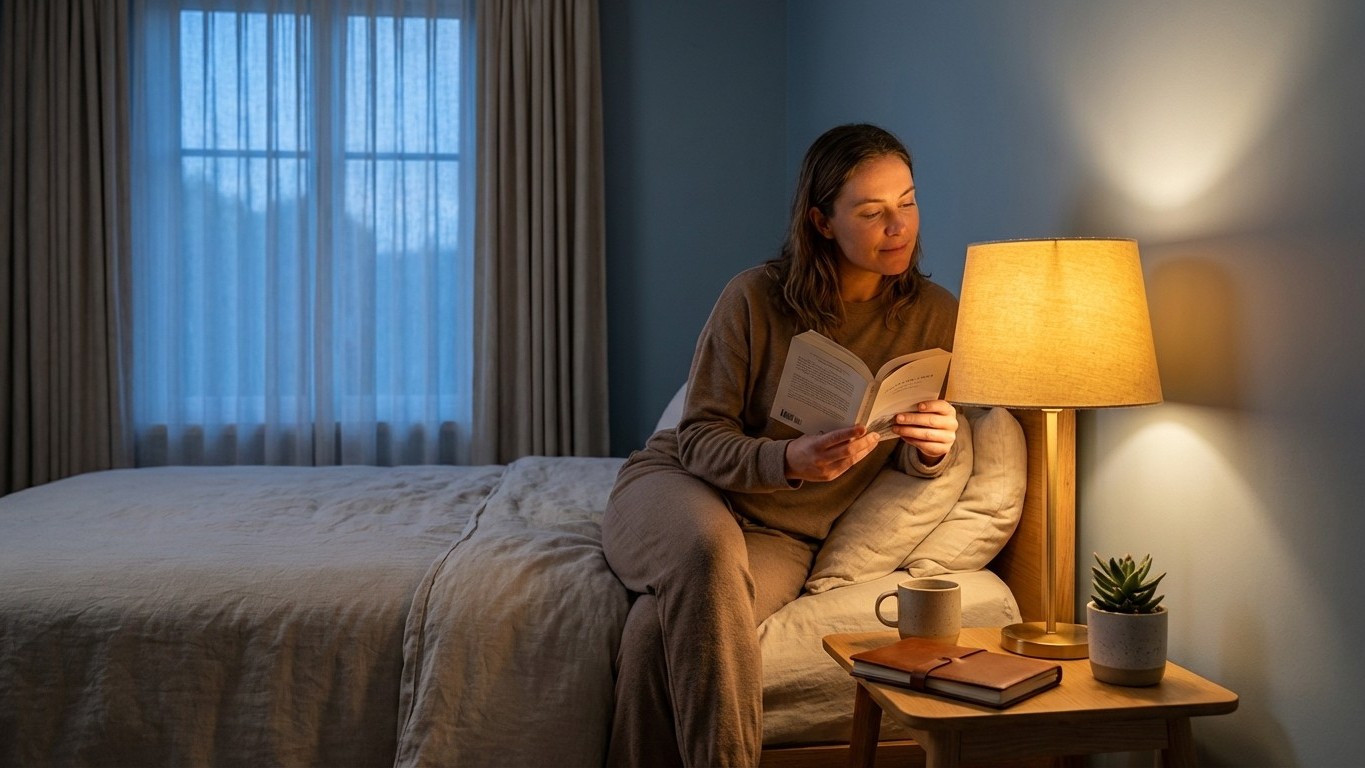
The sixty minutes before you climb into bed might be the most underestimated window of your entire day. What you do (or don’t do) during that hour can mean the difference between drifting off with ease and lying wide awake at midnight, rehearsing tomorrow’s to-do list. The good news is that no special gadgets or extreme protocols are required. A handful of natural, well-evidenced habits, applied consistently, genuinely change how quickly you fall asleep and how restorative that sleep feels.
Why the hour before bed matters more than you think
Your circadian rhythm is listening
Your body runs on a roughly 24-hour internal clock, and that clock takes its cues from your environment. Light, temperature, physical activity, and even the smell of your surroundings all send signals that tell your brain whether it’s time to be alert or time to wind down. In the natural world, the hours after sunset brought dimmer light, cooler air, and stillness. Modern life, of course, offers the opposite: bright overhead lighting, central heating cranked up, screens pulsing blue light, and a news feed engineered to keep you engaged.
When the brain receives mixed signals (your body chemistry says “sleep”, but your environment says “stay alert”), the release of melatonin, the hormone that initiates sleep, gets delayed. Research published in peer-reviewed sleep medicine journals consistently shows that light exposure in the evening, particularly short-wavelength blue light, suppresses melatonin production. The result is a pushed-back sleep onset that quietly erodes the duration and depth of your rest, night after night.
The most common mistakes people make
Scrolling through a phone in bed is the obvious culprit, but it’s rarely the only one. Vigorous exercise within two hours of bedtime raises core body temperature and cortisol levels, both of which work against sleep onset. A heavy meal late in the evening keeps your digestive system active when it should be winding down. A glass of wine feels relaxing, but alcohol fragments sleep architecture in the second half of the night, robbing you of the deep, restorative stages. And checking work emails or reading distressing news right before bed activates the stress response, which is physiologically incompatible with drifting off peacefully.
The encouraging flip side of all this is that small, intentional changes to this one-hour window can produce noticeable improvements relatively quickly. You don’t need to overhaul your entire lifestyle. You need a realistic, structured pre-sleep ritual.
What to do 60 to 30 minutes before bed
Setting the scene: light, temperature, and scent
Start by dimming the lights in your home at least an hour before you intend to sleep. Swap overhead lights for lamps with warm, amber-toned bulbs, or use a simple dimmer switch. If your bedroom has blackout curtains, draw them now, before you actually need to sleep, so the room begins to feel like a genuine sanctuary rather than just the place where your phone lives.
Temperature matters more than most people realise. The body needs to drop its core temperature slightly to initiate and maintain sleep. Setting your bedroom to somewhere between 16 and 19°C is widely recommended by sleep researchers, though individual preference varies. If you share a bed with a partner who runs warmer or cooler than you, a breathable natural-fibre duvet and layering options are your best allies here.
A small touch that’s easy to dismiss but worth trying: lavender. Several controlled studies have found that lavender aromatherapy can reduce subjective sleep latency (the time it takes to feel sleepy) and improve sleep quality scores. A couple of drops of lavender essential oil on your pillow or in a diffuser is a two-second ritual with a reasonable evidence base behind it.
Managing screens and blue light
The screen question is one people love to argue around, but the evidence is fairly settled. Evening exposure to the blue wavelengths emitted by smartphones, tablets, and laptops delays melatonin release and shifts your internal clock later. Ideally, you’d set a firm screen-off boundary sixty minutes before bed. If that feels impossible on some evenings, activating your device’s night mode (which warms the colour temperature of the screen) and reducing brightness both help, though they don’t fully eliminate the problem. The most effective strategy remains simply putting the phone in another room.
What to drink (and what not to)
A warm, caffeine-free herbal infusion is one of the most time-honoured pre-sleep rituals, and the science does support it. Chamomile contains an antioxidant called apigenin, which binds to receptors in the brain associated with sleepiness. Valerian root, passionflower, and lemon balm have also been studied in the context of sleep, with modest but positive findings. There’s something to be said, too, for the simple ritual of holding a warm cup, which encourages slower breathing and a gentle shift in attention away from the day’s concerns. For more detailed guidance on plant-based options, this guide to natural sleep remedies covers the evidence behind each herb thoroughly.
Hydration matters, but timing it is an art. Drinking plenty of water is healthy; drinking a large glass right before sleep means a trip to the bathroom at 2am. Sip your herbal tea slowly during this window, and avoid large drinks in the thirty minutes immediately before you lie down.
Choosing the right activity
Reading a physical book (not a screen) is one of the most reliably effective pre-sleep activities. It gently engages attention without stimulating the nervous system, and it provides a clear psychological transition: you are no longer in work mode, problem-solving mode, or social mode. Journalling works similarly well, particularly if you use it to offload tomorrow’s worries onto paper rather than carrying them mentally into bed. Some people find that jotting down three things they’re grateful for shifts their nervous system towards a calmer baseline. Simple craft activities, gentle stretching, or listening to calm music are equally valid choices, provided they don’t involve a screen.
20 to 10 minutes before bed: going deeper
Breathing, meditation, and progressive muscle relaxation
This is the window where you move from winding down to actively preparing the body for sleep. Slow, diaphragmatic breathing (breathing into your belly rather than your chest) activates the parasympathetic nervous system, the branch responsible for rest and digestion. A simple 4-7-8 pattern, where you inhale for four counts, hold for seven, and exhale for eight, can noticeably reduce physical tension within a few cycles.
Progressive muscle relaxation, a technique where you systematically tense and release each muscle group from your feet upward, has a solid evidence base for reducing insomnia symptoms and is particularly helpful for people who carry physical tension from stress. If you’re new to it, even five minutes makes a difference, and it’s worth integrating into your regular natural sleep routine as a consistent anchor habit.
Brief body-scan meditation (simply noticing physical sensations without trying to change them) serves a similar purpose. You don’t need an app, though many people find guided audio helpful when first learning.
Gentle body rituals
A warm bath or shower taken about ninety minutes before bed has an interesting physiological mechanism: it draws blood to the skin’s surface, which actually speeds up the core temperature drop your body needs to initiate sleep. The effect is subtle but real. If a full bath isn’t practical, soaking your feet in warm water achieves something similar through a more modest route.
Gentle self-massage, whether to the scalp, feet, or hands, using a fragrant natural oil, is deeply underused as a pre-sleep tool. It doesn’t require any skill, costs almost nothing, and simultaneously addresses the twin obstacles of physical tension and an overactive mind.
What to avoid: the traps that derail your sleep
Caffeine has a half-life of roughly five to seven hours in most adults, which means a 4pm coffee still has a meaningful presence in your bloodstream at 10pm. For people who are sensitive to caffeine (which varies significantly by genetics), even a mid-afternoon cup can delay sleep onset. Alcohol is the more insidious trap, because the initial sedative effect feels like it’s helping. What alcohol actually does is suppress REM sleep and cause more frequent awakenings in the second half of the night, leaving you groggy regardless of how many hours you spent in bed.
Late-evening news consumption deserves its own mention. The modern news cycle is specifically designed to hold attention through arousal, uncertainty, and mild anxiety. Engaging with it in the final hour before bed is a reliable way to activate your stress response at the worst possible moment. This isn’t about being uninformed; it’s about choosing when to engage. The news will still be there in the morning.
Heavy snacking also undermines sleep. If you’re genuinely hungry, a small, protein-light snack (a banana, a small portion of porridge oats, or a handful of nuts) is preferable to going to bed uncomfortably hungry, but eating a full meal within two hours of sleep asks your digestive system to do the opposite of what your brain needs it to do right now. For a broader look at how daily habits interconnect with sleep quality, the section on sleep hygiene tips natural goes into considerable detail on dietary timing and its effects.
A practical 60-minute template
Translating principles into an actual evening can be the hardest part. Here’s a simple framework, not a rigid prescription, that many people find genuinely workable:
- 60 min before bed: Dim lights, start herbal tea, put phone in another room (or enable strict screen limits)
- 45 min before bed: Light reading, journalling, or a gentle craft activity
- 30 min before bed: Warm shower or footbath; brief self-massage if desired
- 15 min before bed: 5-minute breathing exercise or progressive muscle relaxation; bedroom temperature check
- 5 min before bed: Dim remaining lights to near-dark; settle into bed with a final few slow breaths
The specific activities matter less than the consistency of the signal you send to your nervous system. The brain learns quickly what the sequence means, and after a few weeks, each step in your ritual begins to prime the next one automatically.
Frequently asked questions
How long before a new evening routine improves sleep?
Most people notice some improvement within one to two weeks of consistent practice, though the full benefits of a well-established routine typically emerge over four to six weeks. Sleep, like most biological systems, responds to patterns over time rather than one-off interventions. Consistency matters far more than perfection; a routine followed six nights out of seven will serve you considerably better than a perfect routine followed sporadically. If you want more detail on specific techniques that accelerate sleep onset, the resource on how to fall asleep faster naturally covers twelve evidence-backed strategies in depth.
Do you need to follow every step every night?
Absolutely not, and treating this as a rigid to-do list is likely to create more anxiety than it resolves. Think of it as a menu: the more items you include on a given evening, the stronger the cumulative signal to your nervous system. On a chaotic Tuesday when you only manage to dim the lights and make a chamomile tea, you’re still doing something useful. On a calmer evening, you might work through the full sequence. Flexibility is not a failure; it’s the only way any routine survives contact with real life.
Connecting to the bigger picture
An evening ritual is one pillar of a broader approach to sleep health. What happens during the day, including your morning light exposure, your caffeine timing, your physical activity, and how you manage stress, all feeds into how easily you fall asleep at night. The practices discussed here work most powerfully when they’re part of a coherent overall strategy rather than isolated tricks applied to a sleep problem. For a comprehensive view of how natural sleep remedies, plant-based options, and lifestyle changes can work together as a complete system, the guide to natural sleep remedies is a natural next step.
Sleep is not a passive state you fall into when you’re exhausted enough. It’s something your body actively needs to prepare for, and you can either help or hinder that process in the hour before bed. The question worth sitting with is not “which technique should I try?” but “what does my current pre-bed hour actually look like, and what one thing could I change tonight?”
This article is for informational purposes only. If you experience persistent insomnia or sleep difficulties that affect your daily functioning, please consult your GP. There may be underlying factors that benefit from professional assessment.