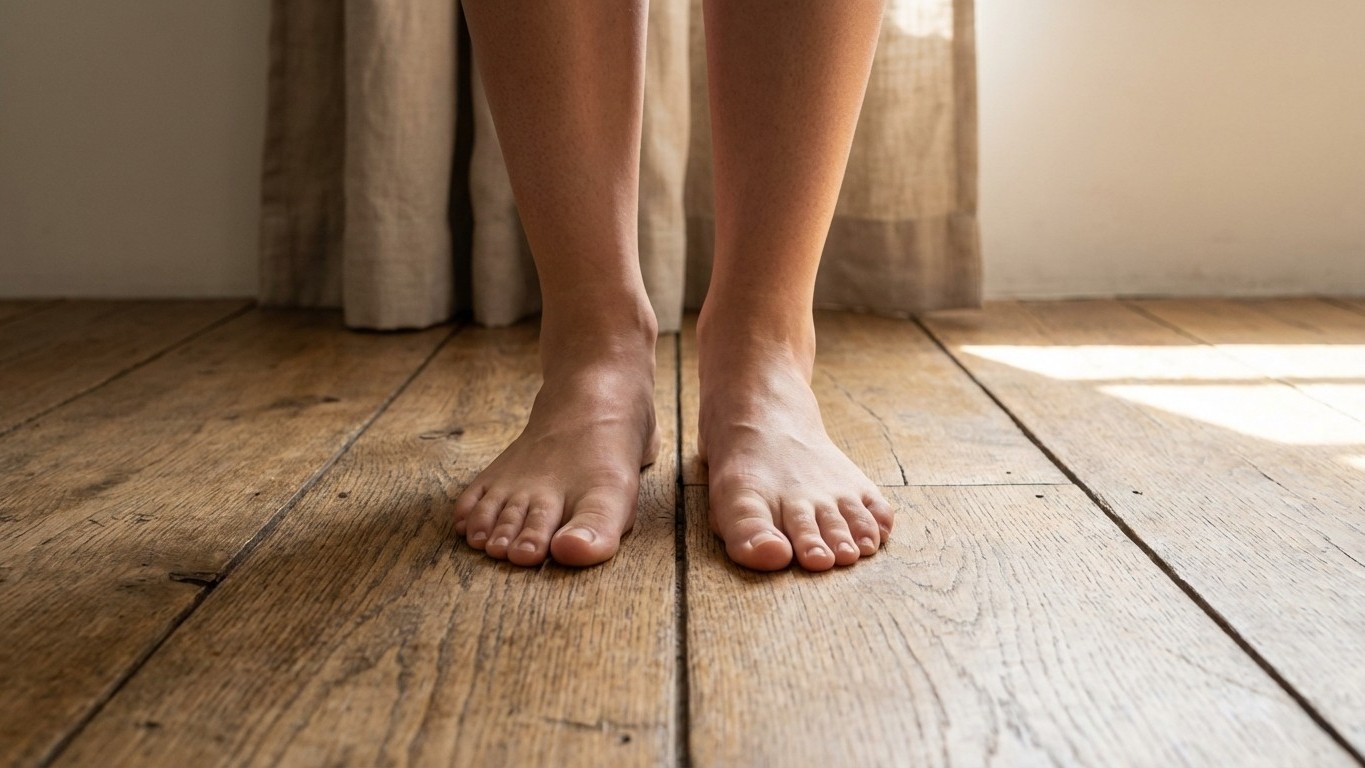
Going barefoot at home for a month Changed something I hadn’t expected: my physiotherapist noticed the difference before I even mentioned the experiment. After 30 days without shoes or slippers on my home floors, my single-leg balance had improved enough that she commented on it unprompted during a routine appointment. That small moment of validation sent me down a rabbit hole of research into what our feet are actually capable of when we stop wrapping them in cushioned, rigid footwear for most of our waking hours.
Key takeaways
- A simple 30-day experiment indoors led to measurable balance improvements that caught a medical professional off-guard
- Your feet contain over 100 muscles that have been on ‘standby’ inside supportive shoes—and they remember how to activate
- Going barefoot fundamentally changes how your nervous system reads your position in space, with surprising postural side effects
Why shoes might be quietly undermining your feet
The human foot contains 26 bones, 33 joints, and over 100 muscles, tendons and ligaments. That’s a genuinely staggering amount of anatomical complexity devoted to a structure we spend most of our lives squeezing into leather and rubber. Many of those small intrinsic muscles, the ones that live entirely within the foot itself, barely fire when we’re wearing supportive footwear. The shoe does the stabilising work, so the muscles simply don’t need to. Over years, this can lead to what some podiatrists describe as a kind of functional disuse: the architecture is there, but it’s been on standby for so long it’s lost some of its responsiveness.
Research published in scientific journals has shown that habitually barefoot populations tend to have wider feet with greater toe splay, stronger intrinsic foot muscles, and in some studies, better balance scores than habitually shod populations. The sensory component is a large part of this. The sole of the foot is densely packed with proprioceptive nerve endings, receptors that constantly send positional information to your brain. A thick rubber sole essentially muffles that signal, the way a heavy glove makes it harder to feel the shape of a key. Walking barefoot on varied surfaces turns that signal back up.
What actually happened over 30 days
The first week was, frankly, uncomfortable. Not painful, but unfamiliar. My feet felt every slight irregularity in the kitchen tiles, and I noticed an odd fatigue in my arches by early evening, a sensation I later understood was those neglected intrinsic Muscles actually working for once. I kept a simple log: daily observations, and twice-weekly assessments of how long I could hold a single-leg stand with eyes closed (a basic proprioception test you can do anywhere).
By day ten, the arch fatigue had largely gone. My feet seemed to be adapting, spreading slightly when I stood, gripping the floor in a way that felt almost instinctive. By week three, I noticed something subtler: my posture during Everyday tasks had shifted. I was standing with my weight more evenly distributed, less tendency to lock my knees or shift onto one hip. Whether this was the foot muscles, or improved sensory feedback from the ground telling my nervous system where my body actually was in space, I couldn’t say definitively. Probably both.
At the 30-day mark, my eyes-closed single-leg balance had gone from roughly 12 seconds to just over 22 seconds on my weaker left side. My physiotherapist, who had no idea I’d been conducting this informal experiment, remarked during my appointment that my ankle stability had “noticeably improved.” She asked what I’d been doing differently. The answer, stopping wearing slippers at home, made her laugh, then nod thoughtfully.
The science behind barefoot balance
Balance is a genuinely complex system, drawing on input from your eyes, your inner ear, and crucially, the proprioceptors in your joints and the skin of your feet. When one system is dampened (thick-soled shoes reducing tactile and proprioceptive feedback), the others compensate, but the overall system is less precise. Barefoot walking restores that sensory loop. Studies in older adults have specifically examined this, with some trials finding that time spent barefoot or in minimal footwear correlates with improved postural sway measurements and reduced fall risk, though it’s worth noting the evidence base is still building and results vary by population.
There’s also the question of toe function. Most conventional shoes taper toward the front, compressing the toes into a space smaller than their natural spread. Over time, this affects how the toes contribute to balance and propulsion. The big toe in particular plays a significant role in push-off during walking and in lateral stability when standing. When it’s been squashed against its neighbours for years, it may lose some of that function. Going barefoot at home gives it room to do its actual job.
A word of caution before you kick off your shoes
This isn’t a prescription for everyone. People with diabetes need to be especially careful about going barefoot due to reduced sensation and infection risk, and anyone with existing foot conditions, plantar fasciitis, fallen arches, certain structural issues, should speak to a podiatrist or their GP before making changes. The transition should be gradual regardless of your starting point; jumping to hours of barefoot standing on hard floors can overload muscles that haven’t been asked to work properly in years. Think of it less as removing something harmful and more as a form of gentle, progressive training.
Minimalist footwear, for times when bare feet aren’t practical, can offer a middle ground: thin, flexible soles that allow proprioceptive feedback while providing some protection. A number of brands have built their entire philosophy around this approach, and the market has grown considerably over the past decade as awareness of foot health has increased.
What struck me most about this whole experiment was how little effort it actually required. No gym equipment, no programme, no cost. Just the decision to feel the floor beneath my feet. The body, given the right conditions, seems remarkably willing to remember what it already knows how to do. Which raises a question worth sitting with: how many other small, structural changes in how we move through ordinary days might be quietly costing us more than we realise?
If you have concerns about your foot health or balance, please consult your GP or a qualified podiatrist for personalised advice.