
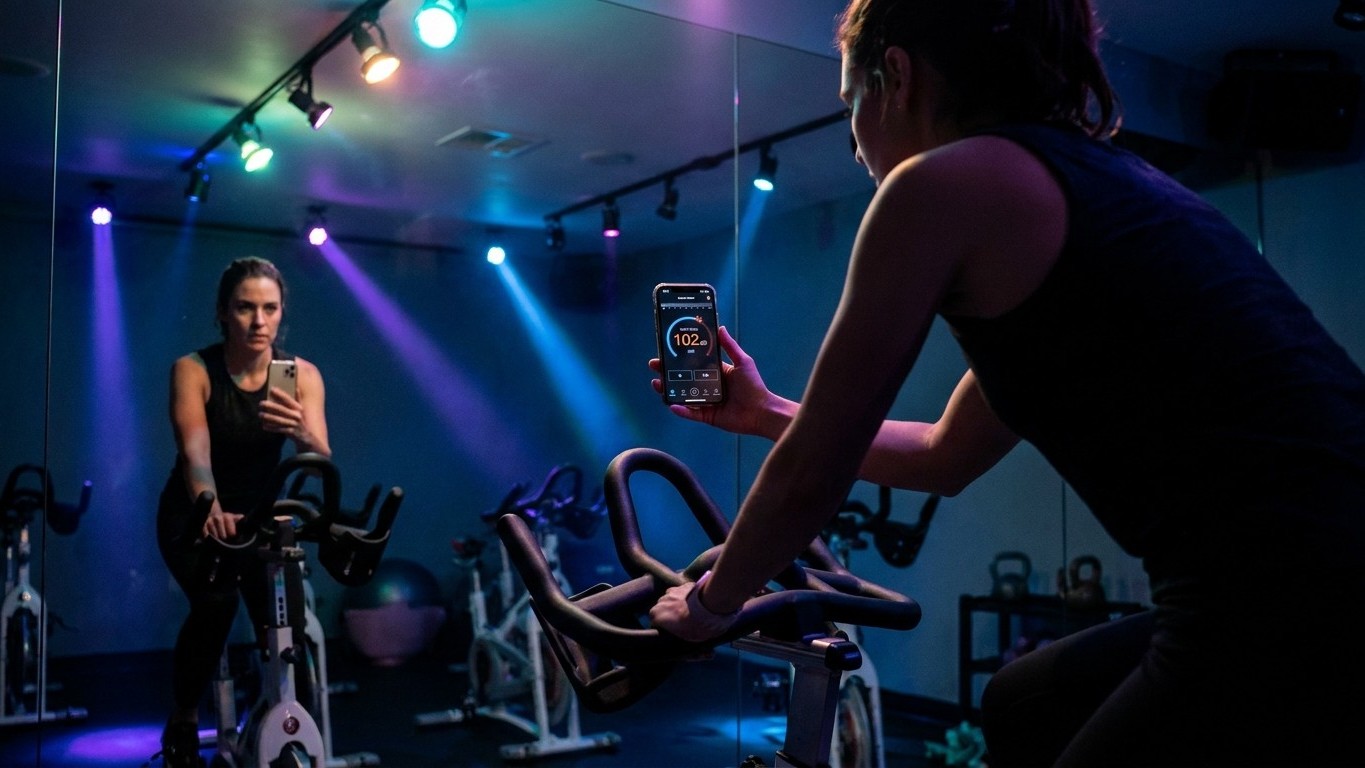
Ninety-eight decibels. That’s what my phone’s sound meter app read for a solid ten minutes into last Tuesday’s spin class, and it barely dipped below 95 for the rest of the hour. My instructor laughed it off as “just the vibe” when I showed her the screen afterwards. But the number wasn’t a fluke, and it wasn’t harmless either. According to occupational safety guidance, the National Institute for Occupational Safety and Health recommends that a noise exposure of one hour not exceed 94 dB, and exposures to levels of 100 dB should not exceed 15 minutes to protect against permanent hearing loss. My class ran for sixty.
Key takeaways
- A sound meter test revealed spin class noise levels repeatedly exceeded safety thresholds by dangerous margins
- Research shows the ‘louder = harder effort’ assumption is scientifically wrong, yet instructors persist anyway
- Over 25% of study participants reported hearing damage symptoms, but almost none wore protection
The maths nobody mentions on the bike
Sound doesn’t scale the way most people assume. A jump from 85 to 100 decibels isn’t a 15 percent increase, it’s roughly a doubling of intensity for every 3 decibels, which is why the difference between a “loud but fine” class and a genuinely risky one can feel deceptively small to the ear while being enormous on a meter. Research backs up what I measured. A study from the University of Maryland School of Medicine found that music volumes in the spinning classes during the study ranged from 93 to 101 dB, in one-hour classes with participants aged 31 on average. Other researchers have recorded even higher peaks. One study found average sound levels in spin classes of 100.8 dBA. and separate work from George Mason University found that music played during spin classes at fitness clubs in the United States can reach 100 to 110 dB.
Put that in context and it gets uncomfortable. The average sound levels in group fitness classes frequently exceed 90 decibels, as loud as an approaching subway train, and often exceed 100 decibels, as loud as a power lawn mower. For comparison, the typical decibel level for a live rock show is 120 decibels, yet these are usually held in massive arenas. A spin studio is a converted retail unit with concrete floors and mirrored walls, nowhere near the size of an arena, which means the sound has nowhere to escape. It just bounces back at you.
Why instructors crank the volume anyway
The assumption driving most playlists is that louder music equals harder effort. It’s a reasonable-sounding theory, and it’s also wrong, at least according to the data. The Maryland researchers tested this directly by dialling the volume down mid-study. The National Institute for Occupational Safety and Health recommends that a noise exposure of one hour not exceed 94 decibels, whereas exposures to levels of 100 decibels not exceed 15 minutes, and in classes that were 2 to 3 decibels lower than the loudest classes, participants reported no differences in their exercise intensity. People pedalled just as hard, sprinted just as fast, and didn’t notice the difference in effort at all.
What they did notice was their ears. More than one in four study participants reported experiencing auditory symptoms following their spinning class, including ringing in their ears or muffled hearing. Among those stuck in the loudest sessions, nearly one-third of participants reported that the sound level was too high, and nearly one-third reported that they would prefer a decrease of the music level. Almost nobody protected themselves against it either. Only three of the participants reported using hearing protection, such as ear plugs, during the study. I count myself in that camp. I’d never once thought to bring earplugs to a fitness class, the same way I would to a gig.
The instructor mindset isn’t malicious, it’s just outdated. Industry surveys tracked over more than a decade found that about 85% of instructors found loud music motivating, whereas about one fifth of clients found it stressful. That gap between what motivates the person at the front of the room and what the people on the bikes are actually experiencing is, frankly, the whole problem in a nutshell.
What “safe” actually looks like
The World Health Organization’s benchmark is blunt: the World Health Organization recommends that noise levels should not exceed 85 decibels over a one-hour period. That happens to line up neatly with a typical class length, which is presumably not a coincidence. In the UK, workplace noise regulations set a similar bar, if aimed at protecting staff rather than gym-goers. Under the Control of Noise at Work Regulations 2005, the level at which employers must provide hearing protection and hearing protection zones is 85 dB(A) daily or weekly average exposure, and there is also an exposure limit value of 87 dB(A) above which workers must not be exposed. Your spin instructor, teaching back-to-back classes five days a week, is in a more precarious position than any single attendee, and there’s currently no equivalent legal safety net covering them in a fitness studio the way there would be on a factory floor.
There’s a rough rule of thumb worth remembering, one an audiologist offered to Fox News Digital: sounds at or below 70 decibels are considered safe for an extended period of time, meaning classes held constantly at this level could be attended back to back without any hearing concerns. Anything meaningfully above that, and duration starts mattering as much as volume.
What I’ll actually do differently
I’m not quitting spin. I like the class, I like the instructor, and I’m not about to become the person who ruins group fitness for everyone by staging a decibel protest. But I’ve moved my bike away from the speaker stack, I’ve started keeping a pair of foam earplugs in my kit bag (cheap, and they take the edge off without muffling the beat entirely), and I’ve asked, politely, whether the volume could come down a notch. If the University of Maryland research is right, nobody’s sprint intervals will suffer for it. One detail from that same study stuck with me more than any decibel figure: participants were most likely to report that the music level was satisfactory in classes where sound levels were lowest. The loudest class in the room, it turns out, is rarely anyone’s favourite. As always, if you’re experiencing persistent ringing, muffled hearing, or pain after exercise classes, it’s worth having a chat with your GP or an audiologist rather than assuming it will simply pass.
Sources : foxnews.com | pmc.ncbi.nlm.nih.gov