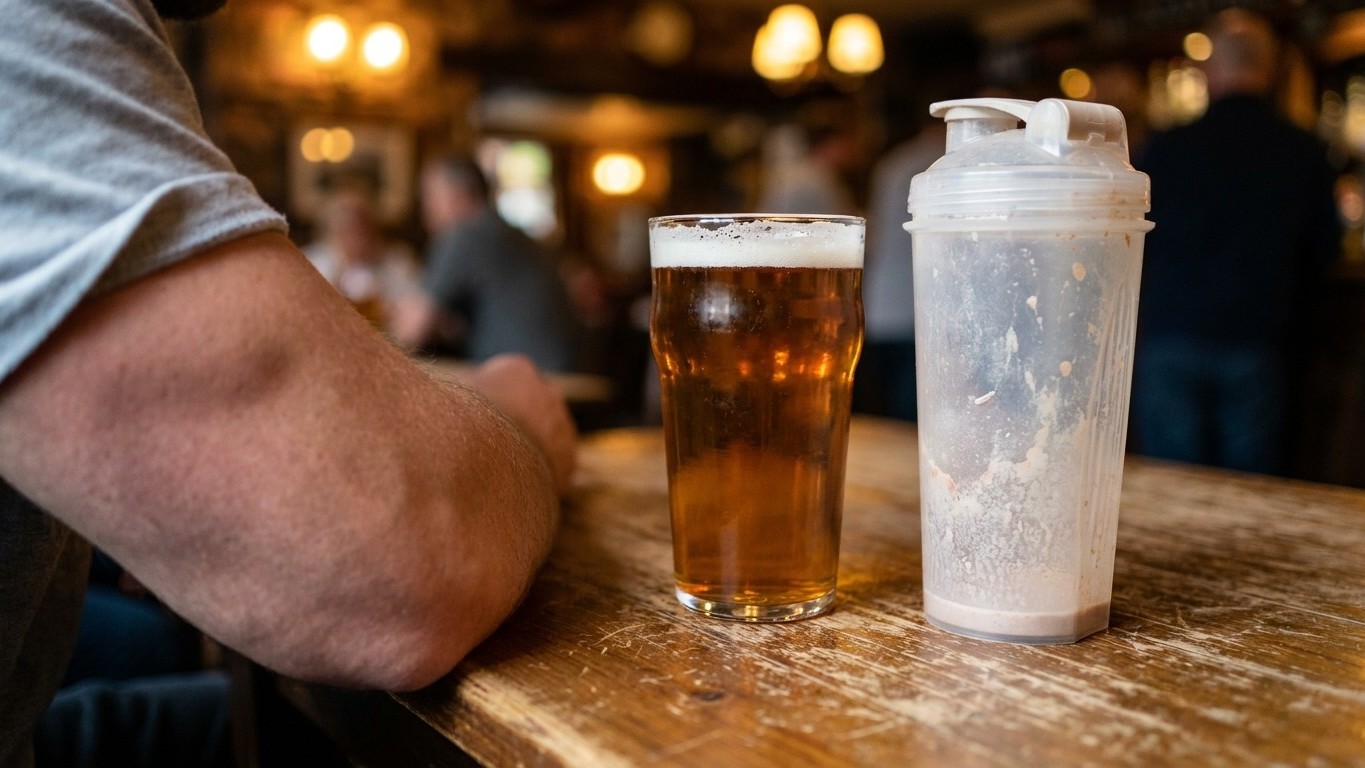
Twenty-five grams of whey, necked within the hour after training. Then a shower, a lift home, and three pints at the clubhouse bar because the team won. That sequence is not a minor inconsistency in an otherwise disciplined routine. According to the research on post-exercise alcohol intake, it can wipe out a meaningful chunk of the muscle-building signal that protein shake was supposed to switch on.
The number that keeps turning up in exercise physiology papers is 37%. That is the reduction in muscle protein synthesis observed in physically active men who consumed a substantial dose of alcohol (around 1.5g per kilogram of bodyweight, roughly equivalent to several pints for an average adult male) after a training session. In one study that looked at the effects of alcohol consumption in physically active males, there was a significant reduction in muscle protein synthesis (37%) when 1.5g/kg of alcohol was consumed after exercise. The uncomfortable twist is that adding protein to the mix does not rescue the situation as much as most lifters assume. Even when 20-30g of protein was consumed in combination with alcohol, muscle protein synthesis was still reduced by 24%!
Key takeaways
- A specific percentage reduction in muscle building shows up in studies—but the dose matters enormously
- The mechanism involves a cellular pathway most lifters have never heard of, and hormones tell a story that changes completely above a certain threshold
- The damage peaks hours later, while you’re asleep, in the exact window when your body should be repairing hardest
Why a pint after the match does more than make you sleepy
The mechanism traces back to a signalling pathway called mTOR, the switch that tells muscle fibres to start repairing and rebuilding after mechanical stress. Both acute and chronic alcohol ingestion can have a detrimental effect on cell signalling and protein synthesis in skeletal muscle during recovery from strenuous exercise, including team sports such as football and rugby. A 2014 study published in PLOS ONE, run on athletes doing exactly the kind of concurrent resistance and endurance training that mirrors a match day, found that alcohol ingestion impaired the maximal post-exercise rates of muscle building even when researchers controlled for protein intake.
Hormones tell the same story. There are a number of hormones that affect muscle growth. For example, cortisol stimulates protein breakdown while testosterone increases protein synthesis. Push the alcohol dose up and the balance tips the wrong way. Research has found that high doses of alcohol intake after resistance exercise increased cortisol levels and decreased the testosterone-to-cortisol ratio, which can interfere with the adaptive process of long-term resistance training. A systematic review pulling together twelve separate trials on alcohol and resistance training recovery reached a similar conclusion, noting that cortisol levels seemed to be increased while testosterone, plasma amino acids, and rates of muscle protein synthesis decreased.
What I find genuinely interesting, and something rarely mentioned in gym changing rooms, is that alcohol’s effect on testosterone is not straightforwardly bad at every dose. Research shows that moderate doses of alcohol, equivalent to around two beers, can actually increase testosterone levels. Before anyone reaches for a third pint as a supplement strategy, that bump is fleeting. This increase doesn’t last very long, making it therefore unlikely to significantly contribute to muscle gain. Cross a higher threshold, though, and the picture flips entirely: high levels of alcohol intake can actually reduce testosterone levels, suggesting there’s a threshold beyond which alcohol impairs the benefits of exercise.
The dehydration problem nobody mentions at the bar
Training already leaves you fluid-depleted through sweat. Alcohol is a diuretic, so it compounds the deficit rather than replacing it, which matters more than people realise because muscle repair is partly a hydration-dependent process. Beer might look like a fluid on the surface, but the net effect on your hydration status after a hard session is negative, not neutral. That is worth remembering before assuming a few pints “count” towards rehydration simply because they are liquid.
There is also the displacement effect, quietly working against recovery in a way that has nothing to do with alcohol’s direct biology. Alcohol can indirectly displace carbohydrate and protein intake, and when protein-rich foods are displaced with alcohol during the post-exercise recovery period, muscle protein synthesis is not optimally stimulated, which can potentially inhibit muscle growth and repair. A pub session that replaces the post-match meal with crisps and a second round does double duty in undermining recovery: less protein and carbohydrate in, more alcohol competing for the liver’s attention.
So does one pint actually ruin your gains?
Here is where nuance matters, and where I’d push back gently against the more alarmist corners of fitness media. A systematic review of the available trials found that alcohol consumption following resistance exercise doesn’t seem to be a modulating factor for creatine kinase, heart rate, lactate, blood glucose, and several other markers, and that force, power, muscular endurance, soreness and rate of perceived exertion are also unmodified following alcohol consumption during recovery. The damage shows up specifically in the biochemical signalling for muscle growth and in hormone ratios, not necessarily in how you’ll perform at next week’s training session.
The dose is what separates a genuine setback from a rounding error. Casual analysis of the research suggests the studies showing the steepest 30-37% drops in protein synthesis used alcohol quantities equivalent to several pints in one sitting, not a single 330ml bottle with dinner. If you’re the sort who has one pint to mark the result and heads home, the physiological hit is likely to be modest. If match day regularly means four or five pints followed by a kebab instead of a proper meal, the maths changes considerably, and doing that weekly for a whole season adds up to a lot of missed recovery windows.
What to actually do about it
Get your 25g of whey (or equivalent, roughly three large eggs’ worth of protein, in approximately 20g-25g the equivalent research suggests can help offset alcohol’s impact to some extent) in before the drinking starts, not as an afterthought hours later. Eat a proper meal with your round rather than letting crisps and peanuts substitute for it, since carbohydrate and protein displacement is a bigger practical problem than the alcohol’s direct biochemistry for most weekend players. Match every pint with a pint of water if you can manage it, given the double dehydration effect of training plus drinking. And if there’s a genuine hypertrophy or strength goal riding on a training block, consider saving the bigger sessions for after a rest day rather than straight off the back of a heavy match.
One detail that rarely gets airtime: the reduction in protein synthesis peaks a few hours after drinking rather than immediately, meaning the damage is still unfolding while you’re asleep, precisely when growth hormone release and tissue repair should be doing their best work. That’s the part of the equation most lifters never think to bank against.
This article is for general information and does not replace personalised medical advice. If you have concerns about alcohol intake, training recovery, or hormone levels, speak to your GP.
Sources : journals.plos.org | mdpi.com