
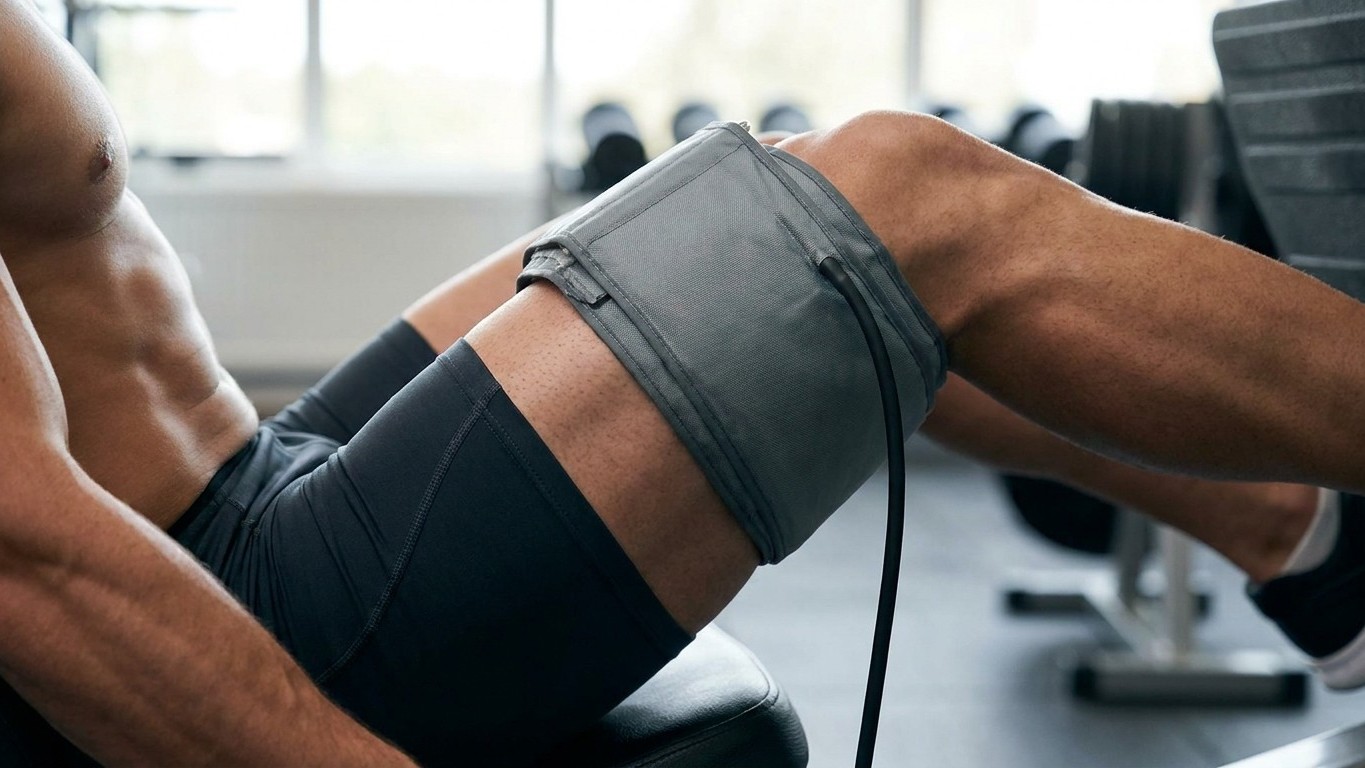
My knee had had enough of squats loaded with 80% of my max, so I swapped the barbell for a pressure cuff and dropped my working weight to roughly a quarter of what I normally lift. Four weeks on, my thigh measured noticeably larger around the mid-point, not smaller as I’d braced myself for when I first cut the load that drastically. This is blood flow restriction training, and the tape measure result I got lines up with what a growing pile of clinical research has been showing for years.
Blood flow restriction (BFR), sometimes called occlusion or ischaemic training, involves wrapping an inflatable cuff around the top of the limb you’re working, in my case the upper thigh, then performing standard exercises like leg extensions or squats at a fraction of your usual intensity. The tourniquet is placed on the upper thigh and inflated to restrict about 80% of arterial blood flow and 100% of venous flow, while normal exercises are performed at roughly 20-30% of 1RM. That’s the bit that sounds counterintuitive: you’re lifting less, with blood partially trapped in the muscle, and somehow that’s meant to build more tissue than lifting light without the cuff ever would.
Key takeaways
- One month of restricted blood flow + quarter-load exercises delivered measurable muscle growth
- Light weights under occlusion recruit fast-twitch fibers like heavy lifting would—but your joints stay safer
- Research shows BFR produces comparable hypertrophy to heavy training in 4–6 weeks, not 8–12
Why a squeezed thigh tricks your muscles into growing
The mechanism isn’t magic, it’s metabolic. By applying external pressure to limit venous return while maintaining arterial inflow, BFR training creates a hypoxic environment that induces metabolic stress, thereby promoting muscle hypertrophy and strength gains. Starved of full oxygen delivery and unable to clear waste products, the muscle fibres get worked far harder than the light load would suggest, recruiting fast-twitch fibres earlier than they normally would at low intensities. That’s the piece I found genuinely fascinating: my quads weren’t lifting more weight, they were just working under conditions that fooled them into thinking they were.
The numbers from actual trials back this up in a way that surprised me when I first read them. The increase in muscle strength and mass with BFR exercise is generally greater than lifting light loads without restriction, while often being closely matched to moderate-heavy load resistance training. One meta-analysis focused specifically on knee rehabilitation found something similar: compared to low-load control training, blood flow restriction training showed no significant difference in pain scores but significantly improved muscle strength. For anyone nursing a cranky knee, that combination, more strength without more pain, is exactly the trade-off you’re chasing.
Four weeks is enough, and the research on timing agrees
I half expected to need months before seeing anything on the tape measure. Instead, the change showed up inside a single month, which tracks with what’s been documented elsewhere. BFR resistance training may provide several advantages over traditional moderate-heavy load training, achieving muscular adaptations despite lower relative external loads, producing less muscle damage, and showing hypertrophy in as little as 1-2 weeks. A separate review looking at knee osteoarthritis patients found that when the training period was 4-6 weeks, low-load BFR training was more effective in alleviating pain and enhancing muscle strength than conventional resistance training. Compare that with ordinary heavy resistance training, where traditional resistance training typically requires 8-12 weeks to achieve significant improvements in osteoarthritis-related pain and physical function. Suddenly my four-week thigh measurement made a lot more sense; it wasn’t a fluke, it was roughly the timeframe the literature would have predicted.
None of this means BFR is some shortcut that outperforms heavy lifting outright. Traditional non-BFR strength training requires loads of at least 60% of 1RM to stimulate muscle hypertrophy and loads over 80% of 1RM to stimulate strength gains, and BFR essentially finds a workaround for people who, for whatever reason, can’t tolerate those loads right now. That’s precisely the population it was designed for. For people who are injured, pre- or post-operative, or have compromised joints, low-load BFR resistance exercise can effectively improve muscle strength and hypertrophy while decreasing joint articular and ligament stress, which has positive implications for those who need strength gains but can’t tolerate high loads.
Doing it safely: what I’d tell a friend before they try it
I wouldn’t recommend anyone strap a blood pressure cuff to their leg and start guessing at pressure settings. The studies I looked at use carefully calibrated equipment, and the protocols matter more than they might seem to from the outside. The most commonly used training volume in the literature is 75 repetitions across four sets of 30, 15, 15 and 15, with rest periods of about 30-60 seconds between sets, and it’s important to keep the cuff inflated during those rests to capture the metabolic byproducts. Get the pressure wrong, too loose and you get none of the metabolic effect, too tight and you’re restricting arterial flow rather than just venous return, which isn’t the point and isn’t comfortable either.
Safety data so far looks reassuring rather than alarming. Several of the trials I came across, including one specifically testing BFR on knee flexor fatigue in recreational athletes, documented the occurrence of any adverse events, and none were noted. That said, this isn’t something to self-prescribe if you’ve got vascular disease, uncontrolled high blood pressure, a history of blood clots, or you’re pregnant. Anyone recovering from knee surgery or nursing a persistent joint problem should get proper guidance from a physiotherapist or their GP before strapping on a cuff, partly because correct pressure calibration genuinely requires proper equipment and training, not a rough guess with a bathroom-scale mentality.
What stuck with me most wasn’t the tape measure reading itself, but a detail buried in one of the studies on older adults: research on this population found that low-load BFR training with 20-30% of 1RM produced hypertrophy and strength increases comparable to what’s typically seen with high-load training at 70-85% of 1RM, meaning the people who need joint-friendly strength training the most, those with sarcopenia or age-related muscle loss, may stand to benefit the most from a method that looks, on paper, far too gentle to work.
Sources : frontiersin.org | journals.plos.org