
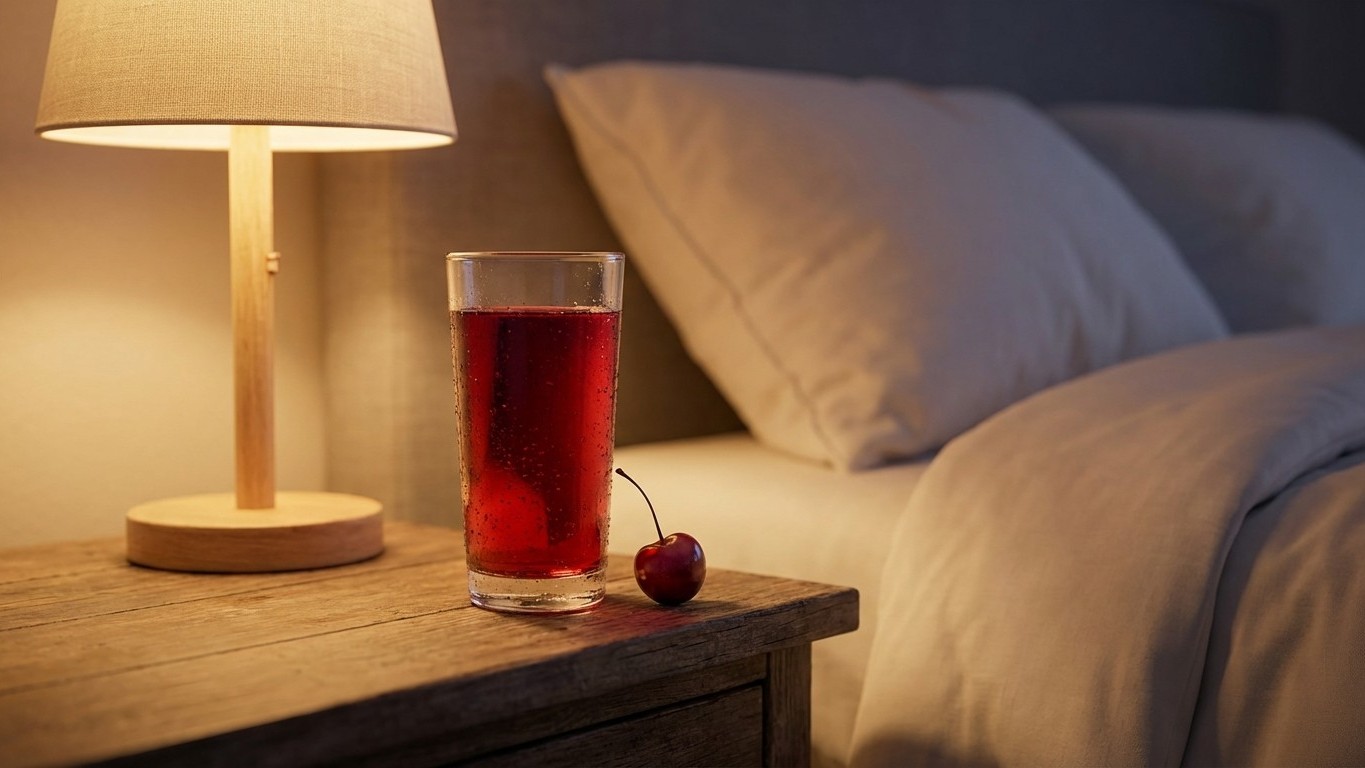
A glass of deep red juice sits on your bedside table, promising better sleep without pills. Sounds almost too simple, doesn’t it? Yet tart cherry juice has quietly earned a reputation among sleep researchers as one of the few food-derived sources of melatonin worth investigating. Unlike most supplements that flood your system with synthetic hormones, this ruby-coloured drink works through multiple pathways, offering something closer to how nature intended us to wind down.
Whether you’ve been struggling with broken sleep, early morning waking, or simply want to optimise your rest without medication, understanding exactly how tart cherry juice affects your sleep architecture could change your evening routine for the better.
Jus de cerise acidulée : comment ça marche sur le sommeil ?
Quels composés du jus de cerise acidulée favorisent le sommeil ?
Tart cherries, particularly the Montmorency variety, contain a surprisingly complex cocktail of sleep-promoting compounds. The headliner is melatonin, the hormone your brain produces when darkness falls to signal bedtime. Most foods contain negligible amounts, but Montmorency cherries pack roughly 13.5 nanograms per gram, making them one of the richest dietary sources known.
The supporting cast matters equally. Tryptophan, an amino acid your body converts into serotonin and eventually melatonin, appears in meaningful quantities. Then there are the anthocyanins, the pigments responsible for that intense red colour. These antioxidants do something clever: they inhibit an enzyme called indoleamine 2,3-dioxygenase, which normally breaks down tryptophan before it can become useful. By slowing this degradation, more tryptophan remains available for sleep-related neurotransmitter production.
This triple mechanism distinguishes tart cherry juice from single-compound supplements. You’re not just adding melatonin; you’re supporting the entire biochemical pathway that leads to restful sleep.
Quelles preuves scientifiques de l’efficacité pour dormir ?
The research base, while not enormous, shows consistent patterns. A pilot study published in the Journal of Medicinal Food found that adults drinking tart cherry juice twice daily experienced significant reductions in insomnia severity compared to placebo. Sleep time increased by an average of 84 minutes. More importantly, sleep efficiency, the percentage of time in bed actually spent sleeping, improved substantially.
Another trial with older adults, a group particularly prone to sleep disturbances, demonstrated measurable increases in both sleep duration and quality. The European Journal of Nutrition published research showing elevated urinary melatonin levels in participants consuming tart cherry juice, confirming the mechanism wasn’t merely theoretical.
These studies share limitations worth acknowledging. Sample sizes tend to be small, ranging from 15 to 20 participants in most cases. Follow-up periods are short, typically one to two weeks. And the effects, while statistically significant, remain modest compared to pharmaceutical sleep aids. Still, for a food-based intervention with minimal side effects, the evidence is genuinely encouraging.
Bienfaits et limites : ce que le jus de cerise acidulée peut (et ne peut pas) faire
Quels effets sur l’endormissement et la qualité du sommeil ?
The most consistent benefit reported across studies is reduced sleep onset latency, the fancy term for how long you lie awake before drifting off. If you typically spend 30 to 45 minutes staring at the ceiling, tart cherry juice might shave 15 to 20 minutes from that frustrating wait. It’s not dramatic, but night after night, those minutes add up.
Improvements in sleep continuity appear more variable. Some people report fewer middle-of-the-night awakenings, while others notice little change in this area. Deep sleep enhancement, measured objectively through polysomnography in some trials, shows modest but real increases. This matters because deep sleep is when physical restoration primarily occurs.
What tart cherry juice cannot do is knock you out like a sedative. The effects build gradually over days or weeks of consistent use. Expecting one glass to solve chronic insomnia sets you up for disappointment. Think of it as nutritional support for your circadian rhythm rather than a quick fix.
À qui s’adresse particulièrement ce remède naturel ?
Older adults often respond particularly well, possibly because melatonin production naturally declines with age. If you’re over 50 and notice your sleep has become lighter, more fragmented, or starts too early in the morning, tart cherry juice might address an actual physiological deficit.
People with mild to moderate insomnia, especially those preferring natural sleep remedies over pharmaceuticals, represent another good candidate group. The same applies to shift workers attempting to reset their body clocks, though the evidence here is largely anecdotal rather than studied.
Athletes have also adopted tart cherry juice, originally for its anti-inflammatory properties, but many report sleep benefits as a welcome bonus. The combination of reduced muscle soreness and improved recovery sleep creates a compelling package for those training hard.
However, if you have severe insomnia lasting months, significant sleep apnoea, or other diagnosed sleep disorders, don’t expect fruit juice to replace proper medical treatment. It’s a support, not a solution for serious conditions.
Comment utiliser le jus de cerise acidulée pour mieux dormir
Quelle dose de jus de cerise acidulée prendre pour le sommeil ?
Research protocols typically use between 240 and 480 millilitres daily, often divided into two doses. A morning serving and an evening serving seems to maintain steadier levels throughout the day, though the evening dose matters most for sleep.
Starting with 240ml (about one cup) in the evening allows you to assess tolerance before increasing. Some people find this sufficient; others benefit from the full research dose of 480ml split between morning and evening.
Concentrated cherry juice presents a more practical option. A 30ml shot of concentrate, diluted to taste, provides the equivalent of 240ml of regular juice without the extra liquid. This matters if you’re concerned about nighttime bathroom trips.
Quel est le meilleur moment de la journée pour le consommer ?
The sweet spot appears to be one to two hours before your intended bedtime. This timing allows the melatonin and tryptophan to enter your system and begin working as you prepare for sleep, rather than hitting their peak while you’re still active.
Drinking it immediately before bed creates two problems. Your body hasn’t had time to process the compounds, and you’ve just added liquid that might wake you later. Conversely, drinking it with dinner, three to four hours before sleep, may mean the effects have already peaked and waned.
If you’re using a twice-daily protocol, take the morning dose with breakfast and the evening dose around 90 minutes before bed. Consistency matters more than perfection here. Your body adjusts to regular patterns.
Sous quelle forme l’intégrer dans sa routine ?
Pure juice, concentrate, and capsules all have their place. Fresh juice tastes best but costs more and expires quickly. Concentrate offers convenience and longer shelf life. Capsules eliminate the sugar entirely but may not replicate the full effects since some beneficial compounds require the juice matrix for optimal absorption.
Mixing tart cherry concentrate with herbal tea creates a warming evening drink that signals bedtime. Adding it to a small portion of yogurt provides protein alongside the cherry compounds, potentially enhancing tryptophan uptake. Some people blend it with banana for sleep benefits, combining two of the best natural sleep foods into one smoothie.
Whatever form you choose, aim for products specifying Montmorency cherries specifically. Sweet cherries contain less melatonin and fewer of the relevant anthocyanins. Labels should indicate concentrate strength; look for products equivalent to at least 1,000 cherries per litre.
Effets secondaires, précautions et contre-indications
Most people tolerate tart cherry juice without issue, but the high natural sugar content demands attention. A 240ml serving can contain 25 to 30 grams of sugar, comparable to many soft drinks. People with diabetes or prediabetes should monitor blood glucose responses carefully or opt for lower-sugar concentrate forms.
The juice’s acidity occasionally triggers heartburn or digestive discomfort, particularly if consumed on an empty stomach. Taking it with a small snack usually prevents this.
A more serious consideration applies to those on anticoagulant medications. Preliminary research suggests tart cherry compounds may have mild blood-thinning properties. While unlikely to cause problems at normal doses, anyone taking warfarin or similar medications should consult their doctor before adding significant amounts to their diet.
Allergies to stone fruits, while uncommon, do occur. If you react to fresh cherries, peaches, or plums, approach the juice cautiously. Start with a small quantity and wait 24 hours before increasing.
Comparatif : jus de cerise vs autres remèdes naturels pour le sommeil
How does tart cherry juice stack up against other sleep-promoting drinks? When exploring what to drink to sleep better naturally, you’ll find several options with different mechanisms and strengths.
Chamomile tea has centuries of traditional use and modest research support, primarily through its apigenin content, which binds to GABA receptors. It works faster than cherry juice but may produce milder overall effects. The two can be combined safely.
Warm milk’s reputation rests partly on its tryptophan content, though you’d need to drink several litres for a meaningful dose. The psychological comfort and warmth likely contribute more than the biochemistry. Cherry juice provides more sleep-specific compounds per serving.
Valerian root supplements show stronger sedative effects in some studies but also carry more side effect concerns and potential medication interactions. Passionflower falls somewhere in between, gentler than valerian but more established than most herbal options.
For an integrated approach, consider tart cherry juice as part of a broader foods that help you sleep naturally strategy rather than a standalone solution. Combining it with good sleep hygiene, appropriate light exposure, and other evidence-based practices multiplies the benefits.
FAQ : réponses aux questions courantes sur le jus de cerise acidulée et le sommeil
Quand faut-il boire du jus de cerise acidulée pour bien dormir ?
The optimal window is one to two hours before your planned bedtime. This gives your digestive system time to process the juice and allows melatonin levels to rise naturally as you wind down for the night.
Le jus de cerise acidulée est-il aussi efficace que les compléments de mélatonine ?
They work differently. Melatonin supplements deliver a single compound in measured doses, typically producing faster but sometimes less nuanced effects. Tart cherry juice provides melatonin alongside tryptophan and antioxidants that support broader sleep biochemistry. For mild sleep issues, the juice may feel more gentle and natural. For jet lag or shift work, targeted melatonin supplements might work better.
Quelle quantité de jus de cerise acidulée faut-il prendre pour ressentir un effet sur le sommeil ?
Research suggests 240 to 480ml daily, or the concentrate equivalent. Start with the lower amount and increase if needed after a week or two. More isn’t necessarily better, and higher quantities add unnecessary sugar.
Le jus de cerise acidulée a-t-il des effets secondaires ou des contre-indications ?
Common issues include digestive discomfort from acidity and potential blood sugar spikes from the natural sugars. People on blood-thinning medications should exercise caution and seek medical advice. Those with stone fruit allergies should avoid it entirely.
Combien de temps avant le coucher faut-il boire du jus de cerise pour que ce soit efficace ?
Between 60 and 120 minutes before you intend to sleep. Drinking it right at bedtime doesn’t allow enough absorption time, while drinking it much earlier may mean effects have diminished by the time you’re ready for bed.
Conclusion : faut-il essayer le jus de cerise acidulée pour mieux dormir ?
Tart cherry juice won’t revolutionise your sleep overnight, but it offers something increasingly rare: a food-based intervention with genuine scientific backing and minimal downsides. The combination of natural melatonin, tryptophan, and protective anthocyanins creates a more sophisticated sleep support than any single compound could provide.
My recommendation? If you’re dealing with mild sleep difficulties, prefer natural approaches, and don’t have contraindications like poorly controlled diabetes or anticoagulant therapy, it’s worth a two-week trial. Keep expectations realistic. You’re looking for cumulative improvements in sleep onset and possibly quality, not pharmaceutical-strength sedation. Track your sleep subjectively during this period, noting how long it takes to fall asleep and how you feel upon waking.
The question worth asking yourself isn’t whether tart cherry juice is a miracle cure, because it isn’t. It’s whether adding one more evidence-based tool to your sleep arsenal might tip the balance toward consistently better nights. For many people, the answer is yes. Speak with your GP if you’re unsure whether it’s appropriate for your situation, particularly if you take regular medications or have ongoing health conditions.