
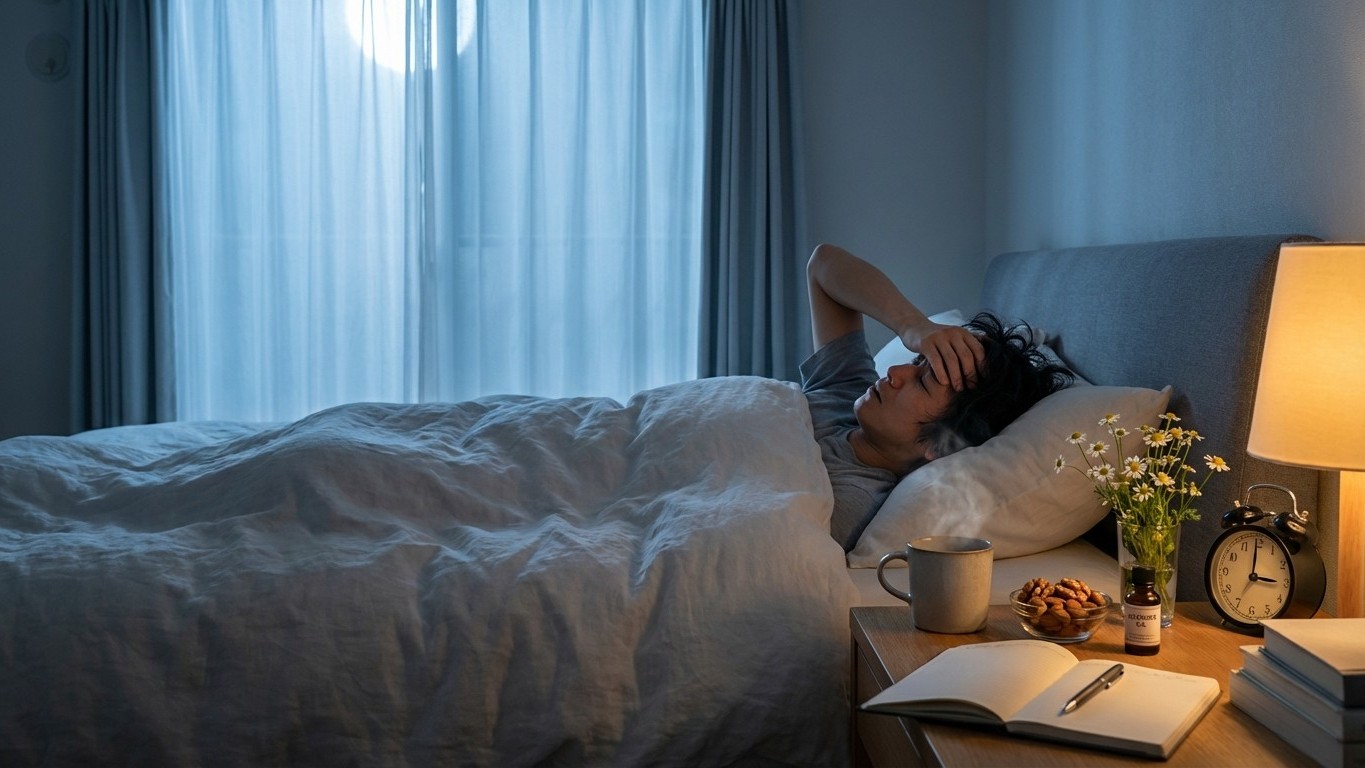
You’re lying in the dark, mind racing, clock ticking, and sleep feeling further away with every passing minute. The last thing you want is a long-term lifestyle overhaul, you want something that works tonight. The good news is that several natural sleep remedies that work fast do exist, and the evidence behind them is more solid than most people realise. The trick is knowing which ones to reach for first, and in what order.
Why your body resists sleep (and what fast-acting remedies actually target)
The most common reasons sleep doesn’t come easily
Before reaching for any remedy, it helps to understand what’s actually happening. Difficulty falling asleep usually stems from an overactive nervous system: cortisol levels that haven’t dropped properly by bedtime, racing thoughts that prevent the brain from downshifting, or a body temperature that hasn’t fallen enough to trigger drowsiness. Sometimes it’s simpler, too much light exposure in the evening, a late meal, or a single stressful event that’s wound you up tighter than usual.
Night-time wake-ups are a slightly different beast. If you’re regularly finding yourself awake at 3am, the causes can range from blood sugar fluctuations to anxiety patterns that surface during lighter sleep phases. For targeted advice on that specific problem, the article on natural remedies for waking up at 3am goes much deeper into what’s likely driving it.
What makes a natural remedy “fast-acting”?
A remedy earns the “fast” label if it can demonstrably influence your nervous system, body temperature, or stress hormones within 20 to 60 minutes, the typical window between deciding to go to bed and actually falling asleep. Herbal teas brewed and consumed 30 minutes before bed, breathing exercises performed in the moment, and certain supplements with a rapid absorption profile all meet this criterion. Anything that requires weeks of consistent use before you feel a difference belongs in a different category entirely.
The fast-acting natural remedies worth trying first
Herbal teas and plants with near-immediate effects
Chamomile is where most people start, and for reasonable cause. The dried flowers contain apigenin, a compound that binds to GABA receptors in the brain, the same receptors targeted by many anti-anxiety medications, though obviously at a much gentler scale. A strong cup brewed for 10 minutes, drunk about 30 to 40 minutes before bed, is the standard approach. The effect is mild but real: a softening of tension rather than a knockout punch.
Valerian root is a step up in potency. Clinical trials on its effects have produced mixed results overall, but the most consistent finding is a modest reduction in the time it takes to fall asleep. Valerian tea is an acquired taste (earthy is a polite description), which is why many people opt for capsules instead. If you do use it, allow 30 to 60 minutes before expecting any effect. The valerian question also comes up frequently in the broader guide to natural sleep remedies, which covers the full evidence base worth reading if you want to go deeper.
Passionflower is less discussed but genuinely interesting. Some small trials have found it comparable to low-dose sedative medication for mild insomnia, and its effect onset is reasonably quick when taken as a tea or tincture. Lemon balm, often blended with valerian or chamomile, adds a pleasant flavour and some evidence of its own for reducing restlessness.
Fast-acting natural supplements worth considering
Melatonin is the supplement most people know, and it’s important to understand what it actually does: it signals to the brain that it’s dark and time to sleep, rather than inducing sleep directly. This makes it most effective for people whose difficulty falling asleep is tied to a disrupted body clock (shift workers, frequent travellers, those who’ve stayed up too late on screens). A low dose taken 30 to 60 minutes before the desired sleep time is the approach supported by the bulk of the research. Higher doses don’t produce stronger effects and may actually disrupt sleep architecture.
Glycine is less well known but more interesting for straightforward sleep-onset difficulties. This amino acid lowers core body temperature, which is one of the key physiological triggers for sleep. Studies have found that taking glycine before bed reduced the time participants took to fall asleep and improved their perception of sleep quality by the following morning. It’s tasteless, dissolves easily in water, and works within about 30 minutes.
Magnesium glycinate, taken in the evening, supports GABA activity and muscle relaxation. It’s not the fastest option on this list, but for people whose sleep troubles are tied to physical tension or stress, it adds a layer of support that chamomile alone won’t provide.
Breathing techniques and body-based methods
If you need something that costs nothing and works within minutes, the physiological sigh is worth knowing about. It involves a double inhale through the nose (a short sniff followed immediately by a second, deeper one), then a long, slow exhale through the mouth. This manoeuvre deflates the small air sacs in the lungs that collapse during stress-related shallow breathing, and rapidly activates the parasympathetic nervous system. Even a few cycles can produce a noticeable shift in how tense you feel.
The 4-7-8 breathing pattern is another reliable option: inhale for 4 counts, hold for 7, exhale slowly for 8. The extended exhale is the operative part, it lengthens the outbreath relative to the inbreath, which is what drives the calming response. A body scan, moving your attention slowly from your feet upward while consciously relaxing each muscle group, works on a slightly longer timescale but is one of the most evidence-backed techniques for sleep onset, adapted from mindfulness-based cognitive therapy programmes used in NHS settings for chronic insomnia.
Food and drink timing
Tart cherry juice contains naturally occurring melatonin and tryptophan, and small studies have suggested that drinking it regularly in the evenings can improve sleep duration. A warm glass of milk isn’t just a cliché, the combination of tryptophan and calcium does support serotonin production, and the warmth itself triggers a slight drop in core body temperature as the body works to cool down, mimicking the natural pre-sleep thermal dip.
What to avoid is equally useful: caffeine consumed after 2pm can still be circulating in your system at midnight (its half-life in the body is around five to seven hours), and alcohol, while sedating at first, fragments sleep in the second half of the night.
Aromatherapy: what the evidence actually says
Lavender essential oil has the strongest evidence base in this category. Several controlled studies have found that inhaling lavender before or during sleep reduced anxiety scores and improved sleep quality ratings. A diffuser running for 30 minutes before bed, or a few drops on a pillow, is the practical route. Bergamot is another option with some supporting data for anxiety reduction. Roman chamomile, as a complementary oil rather than a tea, can also be used aromatically. The effects are unlikely to be dramatic on their own, but as part of a pre-sleep environment that signals calm, aromatherapy earns its place in the toolkit.
Timing, dosing, and combining approaches safely
When to take what before bed
Timing matters more than people realise. A reasonable sequence for someone struggling to fall asleep might look like this: dim the lights an hour before bed; begin diffusing lavender around the same time; drink a valerian or chamomile tea 30 to 40 minutes before you want to sleep; take glycine or magnesium when you get into bed; and use a breathing technique if your mind is still active once the lights are out. Nothing in that sequence conflicts with anything else, and each element reinforces the next.
Combining approaches without overdoing it
Layering two or three gentle approaches is sensible. Stacking six different supplements because you’ve read about all of them in the same evening is not. Start with one or two changes at a time so you can actually tell what’s helping. Herbal teas, breathing techniques, and aromatherapy can be combined freely. When adding supplements, introduce them one at a time over several nights.
Limitations and when to seek further help
Natural remedies that work fast are genuinely useful for occasional sleeplessness, travel disruption, or a stressful period at work. They are not a substitute for addressing chronic insomnia, which is defined as difficulties occurring three or more nights per week for three months or longer. For persistent sleep difficulties, Cognitive Behavioural Therapy for Insomnia (CBT-I) has the strongest evidence base of any treatment, including medication, and is increasingly available through NHS talking therapy services. If you’re dealing with recurring disruptions rather than the odd difficult night, the detailed overview at natural remedies for insomnia covers the symptom-by-symptom picture more fully.
A few safety notes worth keeping in mind: valerian may interact with sedative medications; melatonin is not recommended for children without medical supervision; and any herbal supplement should be discussed with your GP if you’re pregnant, breastfeeding, or taking prescription medication. This is not alarmism, most of these remedies are very safe for healthy adults, but the interactions do exist, and they’re worth knowing about. Always consult your GP if you’re unsure.
Quick reference: what to try first based on your situation
- Can’t fall asleep, mind racing: 4-7-8 breathing or physiological sigh, followed by chamomile or lemon balm tea
- Can’t fall asleep, physically tense: body scan technique, magnesium glycinate, lavender diffuser
- Waking up repeatedly: glycine before bed, tart cherry juice in the evening, and see how to stay asleep naturally for more specific strategies
- Jet lag or disrupted body clock: low-dose melatonin 30 minutes before target sleep time
- Occasional stress-related insomnia: valerian tea or capsule 45 minutes before bed, bergamot or lavender aromatically
Frequently asked questions
Which natural remedies act fastest for sleep?
Breathing techniques are the fastest, the physiological sigh can shift your nervous system within two to three minutes. Among supplements and teas, glycine and chamomile have relatively rapid onsets (20 to 30 minutes), while valerian typically needs 30 to 60 minutes. Aromatherapy works best when used as part of a longer wind-down routine rather than as an instant fix.
Which tea or plant works fastest for falling asleep?
Chamomile, brewed strongly and consumed 30 minutes before bed, is the most accessible and most studied option for a near-immediate calming effect. Passionflower and lemon balm are close competitors and may suit people who don’t respond well to chamomile. Valerian is potentially stronger but takes slightly longer to act and has a distinctive taste many people find off-putting.
How long before bed should you take a natural remedy for it to work?
The general rule is 30 to 60 minutes for most herbal teas and supplements, 60 to 90 minutes if you’re incorporating a full wind-down routine. Breathing exercises and body scans can be used immediately at bedtime, making them the most flexible option. Melatonin is best taken 30 to 60 minutes before your target sleep time, not when you’re already lying in bed wondering why you’re still awake.
Sleep is one of those areas where the simplest interventions are often the most effective, not because we’re easily fooled, but because the body already knows how to sleep, it just needs the right conditions to do so. The remedies above don’t force anything; they remove the obstacles. Try one or two tonight, and see what your body actually responds to.