
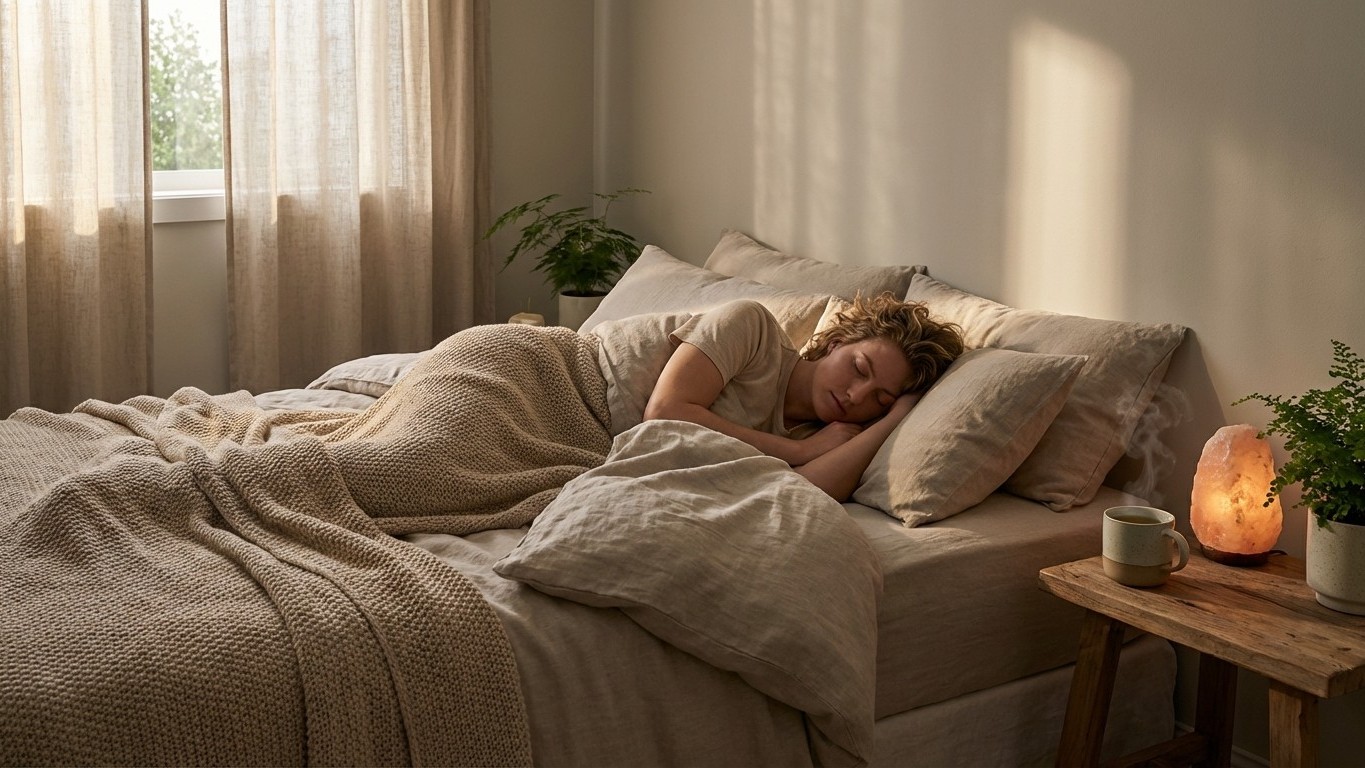
Falling asleep quickly, without medication: what “natural” really means
Typing how to fall asleep faster naturally into a search bar usually means one thing, you want practical steps that work with your biology rather than against it. “Natural” does not mean instant, and it does not mean ignoring persistent insomnia. It means adjusting light, timing, arousal, comfort, and habits so your brain recognises bedtime as safe and predictable.
In February 2026, we have strong sleep science on circadian rhythm, conditioned arousal, and behavioural sleep strategies. We also have long-standing traditional approaches like calming herbal infusions, with a mixed evidence base that tends to support mild benefits for some people. Below you will find 12 levers you can try, organised to be actionable. Each includes concrete examples, common mistakes, and a beginner-friendly way to start tonight.
Understand why you struggle to fall asleep
Common causes of difficulty falling asleep
Sleep onset is most often delayed by a small number of drivers. Many people have more than one at the same time.
- Circadian mismatch: your internal clock is later than your chosen bedtime, common in teens, shift workers, or after late-night screen exposure.
- High arousal: stress, anxiety, rumination, or feeling “wired” after an intense day.
- Conditioned wakefulness: your bed becomes associated with scrolling, working, worrying, or “trying” to sleep.
- Environmental friction: room too warm, too bright, too noisy, or uncomfortable.
- Evening stimulants: caffeine, nicotine, some pre-workouts, and late vigorous exercise for certain people.
- Alcohol-related disruption: it can make you drowsy initially but often fragments sleep later in the night.
- Medical contributors: pain, reflux, restless legs symptoms, breathing problems during sleep, medication side effects, perimenopause and menopause-related night symptoms.
Evidence-wise, behavioural and cognitive approaches are consistently supported for insomnia. Cognitive behavioural therapy for insomnia (CBT-I) is widely recommended in clinical guidance as a first-line treatment. If your problem is frequent and persistent, that context matters for what you try next.
How to identify your personal blockers
For three to five nights, track a simple “sleep onset snapshot” in your notes app or on paper:
- Lights out time and estimated time to fall asleep.
- Caffeine: what, how much, and latest time.
- Alcohol: yes or no, and timing.
- Evening screen time: last 60 minutes, mostly scrolling, work, TV, or gaming.
- Stress rating (0 to 10) and the main thought loop if present.
- Bedroom conditions: temperature, noise, light, and bedding comfort.
This is not about perfection. It is about spotting patterns, for example “sleep is worst when I eat late” or “it’s the nights after work emails that I lie awake”. Those patterns guide which levers will give you the biggest return.
12 natural levers to fall asleep faster
1) Set consistent bed and wake times
A steady wake time anchors your circadian rhythm. Keeping wake time within about an hour across the week often helps sleepiness arrive more predictably at night.
- Try tonight: choose a realistic wake time for the next 7 days, then set bedtime as a window rather than a strict target.
- Common mistake: going to bed early to “catch up” can backfire if you are not sleepy yet.
- Beginner adaptation: if your schedule is chaotic, stabilise wake time first, then gently bring bedtime earlier by 15 minutes every few nights.
If you want a structured week-long plan, the natural sleep routine page lays out a step-by-step approach.
2) Get bright natural light soon after waking
Morning light is a powerful cue for your body clock. It supports earlier melatonin timing in the evening and improves daytime alertness, which can increase sleep pressure at night.
- Try tonight: plan tomorrow morning, go outdoors for 10 to 20 minutes within the first hour of waking, longer if it is overcast.
- Common mistake: only getting daylight through a window, which is often far dimmer than being outside.
- Beginner adaptation: pair it with an existing habit, tea on the doorstep, a short walk, or commuting on foot for one stop.
3) Reduce evening blue-rich light from screens
Blue-rich light in the evening can delay melatonin and keep the brain in “day mode”. Research supports that bright light exposure in the evening can shift circadian timing later. The practical aim is not to fear screens, but to reduce intensity and duration close to bedtime.
- Try tonight: dim lights two hours before bed, and enable your device’s night mode.
- Common mistake: using night mode while keeping the screen at maximum brightness.
- Beginner adaptation: keep the habit but change the format, switch from short videos to an audiobook with the screen off.
For a broader framework, explore sleep hygiene tips natural, especially the light and wind-down sections.
4) Build a wind-down ritual (reading, meditation, warm bath)
Your brain learns by repetition. A calm pre-sleep routine lowers physiological arousal and helps your bed become a cue for sleep. A warm bath or shower taken 1 to 2 hours before bed can help some people by promoting a subsequent drop in core body temperature, a signal associated with sleep onset.
- Try tonight: choose one 15-minute activity, paper book, gentle stretching, or a guided meditation.
- Common mistake: “optimising” the ritual into a long checklist that becomes stressful.
- Beginner adaptation: keep it short and repeatable. Consistency beats complexity.
If you like precision, the best bedtime routine for adults resource offers a minute-by-minute template you can customise.
5) Use calming herbal teas (chamomile, limeflower, valerian)
Herbal infusions are a traditional tool for relaxation. Evidence varies by herb and product quality, and effects tend to be mild. Chamomile has some clinical research suggesting potential sleep benefits in certain groups, while valerian has mixed results across studies. Many people still find the ritual of a warm non-caffeinated drink helpful in signalling “day is done”.
- Try tonight: pick a caffeine-free infusion and drink it 60 to 90 minutes before bed, allowing time for a final toilet trip.
- Common mistake: taking herbal products alongside medications without checking interactions.
- Beginner adaptation: start with chamomile or limeflower if you are sensitive, and keep it as a ritual rather than expecting a sedative effect.
For a deeper guide to options and safety considerations, see natural sleep remedies.
6) Practise slow breathing or progressive muscle relaxation
Relaxation techniques reduce sympathetic activation, the “fight or flight” state that keeps you alert. Controlled breathing and progressive muscle relaxation (PMR) are widely used in behavioural sleep programmes and can be learned quickly.
- Try tonight: breathe in through your nose for 4 seconds, out for 6 seconds, for 5 minutes. Keep the exhale longer than the inhale.
- Common mistake: forcing deep breaths that make you lightheaded. Comfort matters more than depth.
- Beginner adaptation: do PMR only from jaw to shoulders, then stop. A short version is easier to repeat nightly.
7) Set the bedroom up for cool, quiet, and dark
A cooler room generally supports sleep onset for many people, as body temperature naturally dips at night. Ventilation, bedding choice, and light control are often the fastest environmental wins.
- Try tonight: air the room for 10 minutes, lower the thermostat if you can, and use a lightweight duvet with an extra layer nearby.
- Common mistake: overheating with heavy bedding and then waking repeatedly.
- Beginner adaptation: if you cannot change the room temperature, focus on breathable bedding and a cooler pillow.
Noise is personal. If unpredictable sounds wake you, consider a consistent background sound, such as a fan, rather than complete silence.
8) Make evening food work for sleep, not against it
Large, rich meals late at night can delay sleep through discomfort or reflux. On the other hand, going to bed hungry can keep you alert. A small, balanced snack can help if you are genuinely hungry.
- Try tonight: finish your main meal 2 to 3 hours before bed. If needed, have a light snack closer to bedtime.
- Snack ideas: yoghurt, a small bowl of oats, banana with nut butter, or wholegrain toast.
- Common mistake: using sugary snacks as a sleep aid, which may trigger swings in alertness.
- Beginner adaptation: change timing first, then composition. One variable at a time.
If reflux is part of your pattern, discuss it with your GP. Self-management is useful, but persistent symptoms deserve proper assessment.
9) Take a digital break 30 minutes before bed
This lever is related to blue light but not identical. The bigger issue for many people is cognitive stimulation, novelty, and emotional activation from messages and feeds. A 30-minute buffer often reduces racing thoughts.
- Try tonight: set a phone alarm labelled “digital off-ramp”, then put the phone on charge outside the bedroom if possible.
- Common mistake: “just one last check” that turns into 45 minutes.
- Beginner adaptation: if you must keep your phone nearby, switch it to Do Not Disturb and keep it face down.
10) Reduce stimulants and rethink alcohol
Caffeine can increase sleep latency and reduce sleep depth in sensitive people, and its effects can persist for hours. Nicotine is also stimulating. Alcohol can shorten the time to fall asleep for some, but it often worsens second-half sleep quality and can increase awakenings.
- Try tonight: set a personal caffeine cut-off, often early afternoon works better than late afternoon.
- Common mistake: forgetting caffeine sources like cola, energy drinks, strong tea, and some pain medications.
- Beginner adaptation: reduce by one step, swap the last caffeinated drink for decaf or herbal tea.
11) Lighten the mind load (journalling, scheduled worry time, rumination tools)
Racing thoughts are a top reason people struggle with how to fall asleep faster naturally. The goal is not to suppress thoughts, it is to change your relationship with them and reduce their urgency at night.
- Try tonight: do a 5-minute “brain dump” on paper. Write tasks, worries, and tomorrow’s first step for each.
- Another option: set a 10-Minute “worry appointment” earlier in the evening, then gently postpone worries at bedtime by reminding yourself you already gave them time.
- Common mistake: journalling in bed with bright light, turning it into a problem-solving session.
- Beginner adaptation: keep the notebook in the kitchen or living room. Bed stays for sleep and intimacy.
If anxiety is frequent and intrusive, structured support such as CBT-I or talking therapies can be very effective. Your GP can guide you to appropriate services.
12) Match interventions to your profile (age, stress, hormones)
Sleep needs and barriers change across life stages. Personalising your approach prevents frustration.
- High stress periods: prioritise lever 6 (relaxation) and lever 11 (mind load) before chasing supplements.
- Teens and young adults: circadian timing tends to run later, so morning light and consistent wake time are often the best starting points.
- Perimenopause and menopause: night sweats and temperature sensitivity can make lever 7 particularly impactful. Cooling bedding and a well-ventilated room often matter more than elaborate routines.
- Older adults: lighter, more fragmented sleep is common. Earlier daylight, gentle daytime activity, and reducing long late naps can help.
- Shift work: aim for consistent sleep anchors on workdays, and control light strategically. Consider professional advice for shift-work sleep strategies.
When basics are solid but sleep onset remains difficult, some people explore supplements like tryptophan or 5-HTP. This is a space where quality, interactions, and suitability vary, so use the supplement section within natural sleep remedies and discuss with a pharmacist or your GP, especially if you take antidepressants or other regular medicines.
Make it stick: practical integration tips
Change 2 to 3 levers at a time
Stacking all 12 in one week often fails. Pick the smallest set that targets your patterns from the snapshot you took earlier. My preference for most adults is:
- Fixed wake time (lever 1)
- Morning daylight (lever 2)
- A short wind-down ritual plus digital cut-off (levers 4 and 9)
Give your plan 10 to 14 nights. Sleep is not a switch, it is a rhythm, and your nervous system needs repetition to relearn safety at bedtime.
Use “if-then” rules for common setbacks
- If you cannot fall asleep after what feels like 20 to 30 minutes, then leave the bed and do something quiet in low light until sleepy, to reduce conditioned wakefulness.
- If you wake and start problem-solving, then write one line of the worry and one next action, then close the notebook.
- If you nap, then keep it earlier and brief, so it does not steal sleep pressure from bedtime.
Resources to explore next
- sleep hygiene tips natural for a full environment and habit checklist.
- best bedtime routine for adults if you want a plug-and-play schedule.
- natural sleep routine for a gentle 7-day build.
- natural sleep remedies for herbs, techniques, and the supplement landscape.
When to consult or adjust your approach
Signs you should seek medical advice
Self-help strategies are appropriate for many short-term sleep issues. It is sensible to talk to your GP if any of the following apply:
- Difficulty falling asleep most nights for more than three months, especially with daytime impairment.
- Loud snoring, choking or gasping in sleep, or excessive daytime sleepiness.
- Persistent low mood, panic symptoms, or severe anxiety that escalates at night.
- Restless legs symptoms, frequent night-time cramps, or unusual movements in sleep.
- Ongoing pain, reflux, or breathing problems affecting sleep.
- Regular reliance on alcohol, cannabis, or sedatives to sleep.
- Pregnancy, significant hormonal symptoms, or complex health conditions where guidance should be individualised.
Disclaimer: This article is for general information and does not provide medical advice. Consult your GP for personalised guidance, diagnosis, or treatment decisions.
FAQ: falling asleep faster naturally
What is the natural way to fall asleep fast?
The most reliable “natural” approach combines circadian support and de-arousal: get outdoor morning light, keep a stable wake time, dim lights and reduce screens in the evening, then use a short relaxation practice. If you do just one thing, stabilise wake time and add morning daylight for two weeks.
Which herbs or teas help you fall asleep faster naturally?
Common choices include chamomile, limeflower, and valerian, usually as a caffeine-free infusion. People often benefit as much from the calming ritual as from the herb itself. Evidence is mixed across herbal products, and interactions are possible, so check with a pharmacist or your GP if you take regular medication, are pregnant, or have chronic health conditions.
What are the most effective relaxation techniques to fall asleep?
Slow breathing with a longer exhale and progressive muscle relaxation are practical and well-established. Guided mindfulness can also help if you find it soothing rather than effortful. Keep it brief at first, five minutes is enough to build consistency.
How can I make my mind stop racing so I can fall asleep?
Shift the goal from “stop thoughts” to “reduce urgency”. A short brain dump and a next-step list, done outside the bedroom in low light, often lowers the sense that you must solve everything now. If rumination is persistent, CBT-I techniques and psychological support can be genuinely helpful.
Can adjusting the room environment make you fall asleep faster without medication?
Yes. Many people fall asleep faster in a cooler, darker, quieter space with comfortable bedding. Start with ventilation and light control, then refine temperature and noise. Environmental changes are often the simplest lever because they reduce friction without requiring willpower at 11 pm.
Keep a simple “tonight plan”
Choose three actions for the next seven nights: morning outdoor light, a 30-minute digital cut-off, and five minutes of slow breathing in bed. Write them on paper, not in your phone. If sleep is still regularly elusive after you have tried a steady routine, what would change if you treated the problem like a skill to retrain rather than a battle to win each night?