
I’ll research this topic thoroughly before writing the article.I now have all the information I need to write a comprehensive, well-sourced article. Let me compose it now.
A fish can suffocate while fully submerged in water. This isn’t a thought experiment or a trick question, it’s a documented Biological reality that reshapes how we think about oxygen, survival, and the hidden chemistry happening inside our own muscles every time we push ourselves through a hard workout. The parallel between a gasping carp at the surface of an algae-choked pond and the burning sensation in your thighs on the final sprint of a 5K is not merely poetic. It is, physiologically speaking, the same crisis playing out in different bodies.
Key takeaways
- Fish don’t extract oxygen from water molecules themselves—they need dissolved oxygen, which can mysteriously vanish from water
- Your muscles face an identical oxygen crisis during intense exercise, triggering the switch to inefficient anaerobic metabolism
- The crucian carp solves this by fermenting alcohol inside its muscles—a survival strategy humans never evolved
The Oxygen in Water Is Not the Oxygen You Think
While water itself is a compound made of hydrogen and oxygen (H₂O), the oxygen that fish need is not the oxygen bonded within water molecules, but rather oxygen that is dissolved in the water. This is a distinction most people never consider. Fish are not splitting H₂O like a school chemistry experiment, unlike terrestrial animals that use lungs, fish are equipped with gills, highly specialised organs tailored for extracting oxygen dissolved in water. The process begins when water enters the fish’s mouth, flows over the gills where oxygen extraction occurs, and exits via gill slits on the sides of the fish’s head.
Fish gills extract oxygen from water three to five times more efficiently than our lungs extract oxygen from air. This efficiency is necessary because water contains only about 1/30th the oxygen concentration of air. So when that dissolved oxygen disappears, through overcrowding, algal blooms, pollution, or rising temperatures — fish begin to suffocate as they are unable to extract the necessary oxygen from the water, leading to a state that could be likened to drowning. Scientists call this aquatic asphyxia, or simply hypoxia. When dissolved oxygen levels drop below 5 mg/L, any aquatic life present is put under extreme stress. If levels remain below 1–2 mg/L for longer than a few hours, it can result in fish death.
Temperature plays a significant role: colder water can hold more dissolved oxygen than warmer water. Salinity affects oxygen solubility too, freshwater can hold more dissolved oxygen compared to saltwater. This is why summer heatwaves trigger mass fish kills in rivers and shallow lakes, and why the problem is expected to worsen as global temperatures rise. The fish aren’t drowning in the conventional sense. They are choking on a medium that no longer contains enough of the molecule their cells depend upon.
What Happens Inside a Muscle When Oxygen Runs Out
Your muscles face an identical dilemma the moment exercise intensity outpaces your cardiovascular system’s ability to deliver oxygen. When we engage in hard physical effort, our bodies demand more oxygen than we can supply through breathing alone. This temporary shortfall is known as an “oxygen deficit”, the oxygen deficit occurs because our muscles are working harder than normal, and they need more oxygen to produce the energy necessary for exercise. The comparison to a fish in oxygen-depleted water is almost exact: the medium surrounding your muscle cells (blood) is still present, but it can no longer supply oxygen fast enough to meet demand.
Pushing your limits causes your muscles to rapidly deplete available oxygen and forces your body to switch from efficient aerobic energy production to less efficient anaerobic metabolism. This switch causes a temporary shortage of oxygen as the body taps into stored energy sources and accumulates an oxygen debt. The consequence is lactic acid. During high-intensity exercise when oxygen is not enough for energy needs, muscle cells use anaerobic respiration via glycolysis and produce lactic acid. That familiar deep burn you feel in your quads, your calves, your chest, that is the biochemical signature of local hypoxia.
The body does have a short-term buffer. Muscle also contains myoglobin, which binds oxygen with high affinity. As exercising muscles run out of oxygen, they use myoglobin reserves to keep aerobic metabolism going. Myoglobin is why slow-twitch muscle fibres appear reddish: type I fibres are mainly involved in aerobic activities and endurance exercise, containing ample amounts of mitochondria and utilising mostly oxidative phosphorylation, making them fatigue-resistant. They are myoglobin-rich, giving them a red appearance. Fast-twitch fibres, by contrast, are paler and far more susceptible to running out of oxygen quickly. Glycolytic muscle fibres show lower metabolic efficiency and greater oxygen extraction compared to oxidative fibres. The increased recruitment of fast-twitch fibres at high intensity has been reported to contribute to decreased muscle oxygenation, accompanied by increased blood lactate.
During exercise, the oxygen consumption rate in skeletal muscle can increase as much as 50-fold compared to resting conditions. The increased oxygen demand is partially compensated by increased blood flow in tissue microcirculation (10 to 25-fold), and the increase of oxygen extraction by the tissue. But beyond a certain threshold, compensation fails. The mismatch between oxygen demand and oxygen supply may lead to regional tissue hypoxia, and prolonged hypoxia can result in angiogenesis, capillary growth from pre-existing vasculature, an adaptive response that leads to a decrease of oxygen diffusion distances. This is, incidentally, one of the key mechanisms by which endurance training makes you fitter over time.
Paying Back the Oxygen Debt
That heavy, laboured breathing that continues well after you stop running has a precise scientific name: excess post-exercise oxygen consumption, or EPOC. The term “oxygen debt” means the extra volume of oxygen your body takes in after exercising to get itself back to its Pre-Exercise state. This recovery mechanism happens in a specific order to restore normal bodily functions, and oxygen is required to recover from lactic acid buildup effectively.
After strenuous exercise, the body must metabolise all of the lactic acid it has produced. Most lactic acid is converted back into pyruvate, which can enter the citric acid cycle. This process requires oxygen, and the amount of oxygen required to recover from strenuous exercise is equal to the oxygen debt. The liver plays a central role here too: the liver converts lactic acid back into pyruvate via gluconeogenesis, turning lactate back into usable glucose for future energy. It is a metabolic clean-up operation, and it explains why your recovery breathing is not random, it is purposeful, systematic, and oxygen-hungry.
Interestingly, the old view of lactate as purely a toxic waste product has been substantially revised. For much of the 20th century, lactate was largely considered a dead-end waste product of glycolysis due to hypoxia, the primary cause of the oxygen debt following exercise, a major cause of muscle fatigue, and a key factor in acidosis-induced tissue damage. Since the 1970s, a “lactate revolution” has occurred. Research now shows that lactate is not merely a waste product but also acts as a signalling molecule influencing various physiological processes, including promoting the activation of satellite cells involved in muscle repair and growth. Your muscles’ oxygen crisis, is also a growth signal.
Evolution’s Most Creative Oxygen Workaround
Some species have taken the problem of local oxygen depletion and solved it in ways that border on extraordinary. The crucian carp, a freshwater fish native to northern Europe, is the most hypoxia-tolerant vertebrate known to science. A few vertebrates have evolved mechanisms to handle anoxia, allowing them to overwinter in oxygen-deprived ice-covered ponds and shallow lakes. These include crucian carp and goldfish, which display the most extreme anoxia tolerance among teleosts, surviving without oxygen for up to 4–5 months, limited only by the exhaustion of large liver glycogen stores.
The biochemical adaptations to anoxia in crucian carp depend on the ability of their skeletal muscles to convert anaerobically produced lactic acid into ethanol, which can freely diffuse across the gills into the ambient water, thereby avoiding lactic acidosis. They are, in the most literal sense, brewing alcohol inside their muscles to stay alive, and then exhaling it through their gills. While this allows them to avoid high levels of lactic acid and acidosis, it is an energetically wasteful strategy, as it allows an energy-rich hydrocarbon like ethanol to be lost to the water. The body of a crucian carp overwintering under ice is running a continuous fermentation reaction, the same basic chemistry found in a brewery vat, just to keep its cells ticking over until spring.
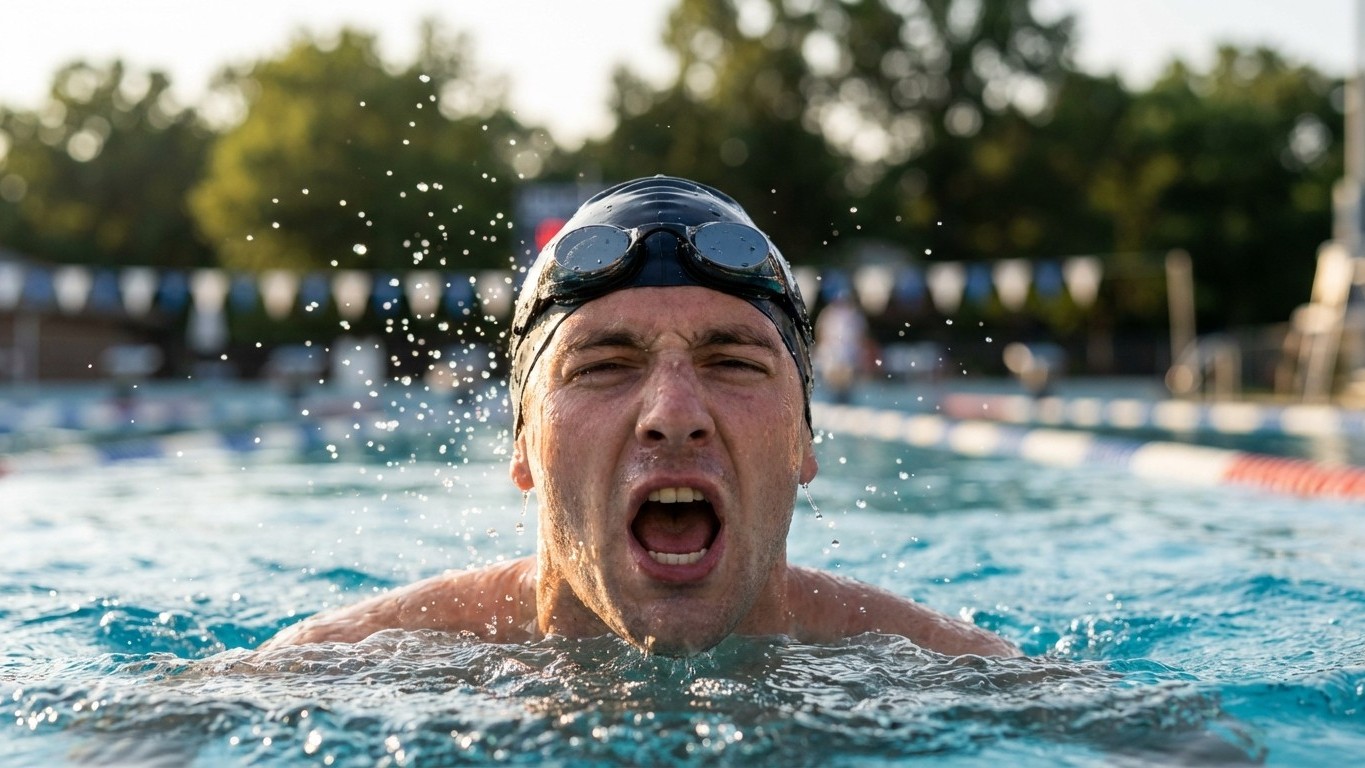
For us, there is no such evolutionary shortcut. Our muscles accumulate lactate, our pH drops, our fibres fatigue, and we slow down, or stop. But that limitation is also what makes training effective. Every session that pushes you into oxygen debt nudges your cardiovascular system to build more capillaries, your muscle cells to generate more mitochondria, and your body to handle the next oxygen crisis with greater composure. The fish gasps at the surface. You gasp on the treadmill. The crisis is shared; only the solution differs.
Please consult your GP before beginning any new exercise programme, particularly if you have cardiovascular or respiratory concerns.
Sources : nature.com | pmc.ncbi.nlm.nih.gov