
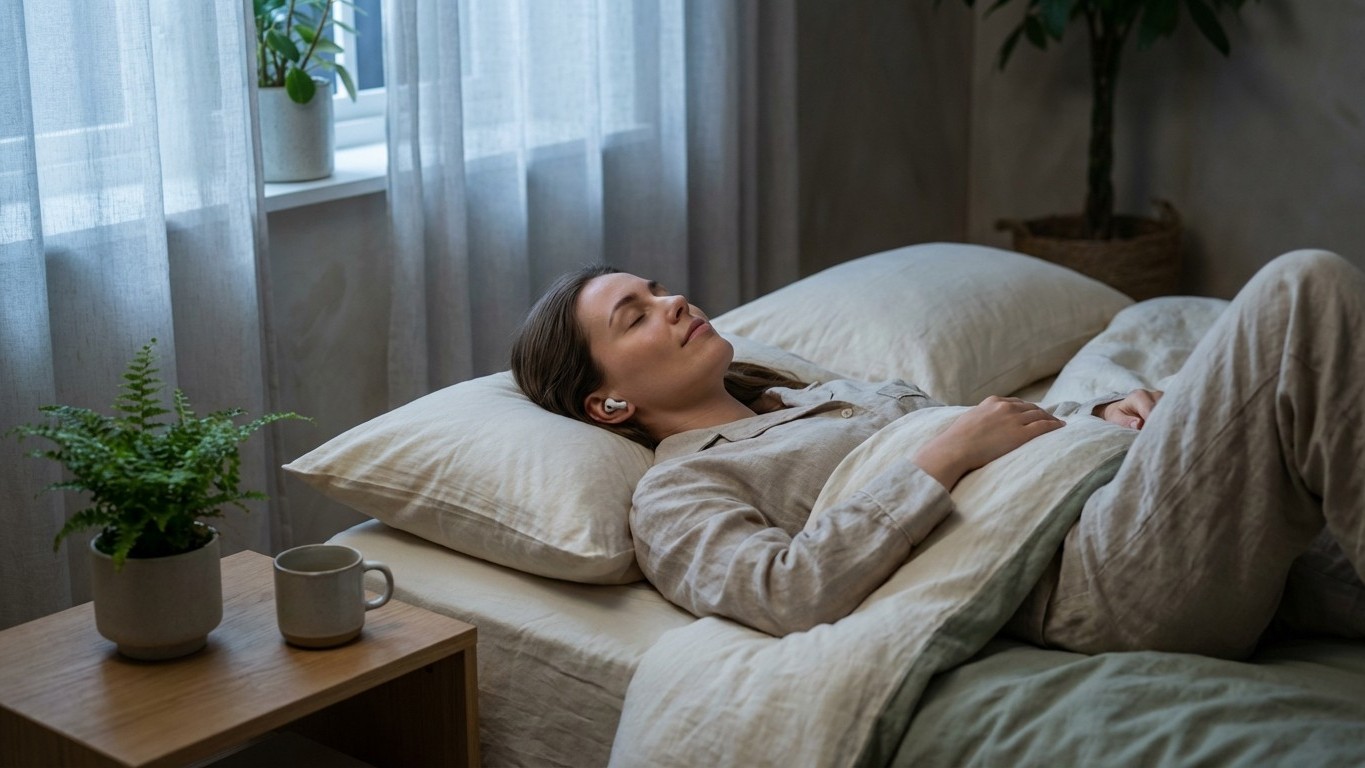
Lying awake at 2am, thoughts spinning, body restless, most of us know that particular kind of exhaustion. You’re tired enough to sleep but somehow too wound up to actually do it. Guided meditation for sleep natural approaches has quietly become one of the most effective tools for breaking that cycle, and the evidence behind it is genuinely compelling. Unlike sleeping tablets or even some herbal supplements, a well-chosen guided meditation session costs nothing, carries no withdrawal risk, and can start working within the first few evenings of practice.
What Is Natural Guided Meditation for Sleep?
Definition and core principles
Guided meditation is exactly what it sounds like: a narrator (live, recorded, or through an app) leads you through a structured mental practice designed to shift your nervous system from a state of alertness into one of deep rest. Your only job is to follow the voice. The instructions might ask you to breathe in a specific rhythm, visualise a quiet landscape, scan your body for tension, or simply notice thoughts without engaging them. The “guided” element removes the main obstacle most beginners face, the mind’s tendency to wander into tomorrow’s to-do list the moment you try to sit quietly.
The “natural” qualifier matters here, and it’s worth unpacking. A natural approach to guided sleep meditation deliberately avoids synthetic soundscapes, electronic binaural beats layered with artificial ambience, or sessions that rely on pharmaceutical-sounding claims about brainwave manipulation. The focus is on the voice, the breath, authentic sounds (birdsong, rain, ocean waves recorded in real environments), and evidence-based techniques drawn from mindfulness and somatic practices. Think of it as the difference between a walk in an actual forest and a candle that smells vaguely of pine.
How it differs from standard relaxation content
A standard “relaxation playlist” might simply layer ambient music under a soft voice saying vague things about clouds and peace. Authentic guided meditation for sleep natural practice goes further: it uses specific psychological mechanisms, including focused attention, body awareness, and cognitive defusion (the ability to observe thoughts without being pulled into them), to genuinely downregulate the stress response. Research published in JAMA Internal Medicine found that mindfulness meditation produced measurable improvements in sleep quality among adults with moderate sleep disturbance, outperforming sleep hygiene education alone. That’s a meaningful distinction.
The Sleep Benefits : What the Science Actually Shows
Sleep researchers have become increasingly interested in mind-body techniques over the past decade, partly because of the limitations of long-term sleep medication use and partly because the mechanisms are now better understood. When you’re stressed or anxious, your sympathetic nervous system (the “fight or flight” branch) stays activated. Cortisol and adrenaline keep your brain alert. Guided meditation activates the parasympathetic system, the one responsible for rest, digestion, and cellular repair, by slowing breathing, reducing heart rate, and lowering the muscle tension that keeps so many people rigidly awake.
A 2015 randomised controlled trial published in JAMA Internal Medicine (Blacks et al.) demonstrated that participants who completed a mindfulness awareness programme reported significantly less insomnia, fatigue, and depression compared to a control group receiving sleep hygiene education. More recent systematic reviews have pointed to reductions in sleep onset latency (the time it takes to fall asleep) and improvements in sleep continuity among regular meditators. The effects are modest compared to acute medication but, crucially, they compound over time rather than diminishing.
There’s also the question of night-time anxiety, which is a different beast from daytime worry. The combination of darkness, quiet, and physical stillness can actually amplify anxious thoughts. Breathing exercises for sleep anxiety work partly through the same parasympathetic pathway, and pairing them with guided meditation creates a layered approach that many people find far more effective than either technique alone.
How to Choose a Natural Guided Meditation That Actually Works for You
Criteria for genuine natural sessions
With thousands of meditation recordings available across apps, YouTube, and streaming platforms, the quality range is enormous. A few concrete criteria help separate the genuinely useful from the aesthetically pleasant but ineffective. First, look for sessions led by practitioners with grounding in established methodologies: Mindfulness-Based Stress Reduction (MBSR), Mindfulness-Based Cognitive Therapy (MBCT), or yoga nidra. The narrator doesn’t need a medical qualification, but they should have a traceable training background.
Second, pay attention to the sonic environment. Natural recordings (actual rain, genuine ocean waves, real birdsong) have a quality that synthetic loops lack, a slight unpredictability that the nervous system responds to differently. Completely silent sessions work well too, particularly for body scan practices. What tends to undermine sleep-specific sessions is music with strong rhythmic elements or uplifting major-key melodies, which are activating rather than settling.
Third, consider your specific issue. Trouble falling asleep calls for different content than middle-of-the-night waking. Anxiety-driven sleeplessness responds well to cognitive defusion techniques and breath focus; physical restlessness benefits from progressive muscle relaxation for sleep incorporated into the guided session.
Format considerations: apps, audio, video, and live sessions
Apps such as Calm, Headspace, Insight Timer, and others offer structured sleep programmes, and Insight Timer in particular hosts a large library of free content from independent teachers. Audio-only formats (podcast episodes, downloadable MP3s) have a practical advantage over video: you don’t need a screen, which means you can practise in the dark with your phone face-down. Screens emit blue light that interferes with melatonin production, so a session that requires you to watch something is working against itself.
Live online sessions through platforms like Zoom have become popular since 2020 and offer something recorded content cannot: real-time responsiveness. A teacher can adjust the pace, check in with participants, and hold space for questions. For beginners who find it hard to commit to a solo practice, this accountability element can make a real difference.
Choosing your technique: body scan, visualisation, or nature sounds
Body scan meditation, systematically bringing awareness from the crown of the head down to the soles of the feet, noticing sensation without trying to change it — is particularly well-suited to sleep because it anchors attention in the body rather than in thought. Visualisation (imagining a peaceful scene in sensory detail) works beautifully for people with strong visual imaginations. For those who find silence oppressive, sessions that incorporate nature soundscapes (rain on leaves, a gentle stream) can act as a gentle anchor for wandering attention. The “right” approach is simply the one that helps your particular mind settle.
A Practical Guide: Starting and Building Your Evening Practice
Setting up your environment
The space matters more than most people expect. A room temperature between 16 and 18 degrees Celsius supports sleep physiology. Dim the lights at least 30 minutes before you begin. If you use a phone for audio, enabling night mode or red-spectrum lighting settings reduces blue light exposure. Comfortable bedding, loose clothing, and removing clutter from your immediate visual field all contribute to a physical environment that supports the psychological work the meditation is doing.
A simple session structure you can follow tonight
Begin lying down or in a comfortable seated position. Spend the first two minutes simply noticing your breath without trying to control it. Then follow the guided instructions, whether that’s a body scan, a breathing pattern, or a visualisation. If your mind wanders (it will), the practice is simply to notice that it has wandered and return, without self-criticism. A 15 to 20 minute session is a reasonable starting point; some sleep-specific recordings run to 45 minutes, which is fine if you fall asleep mid-session. That’s not failure. That’s success.
For the broader framework within which this kind of practice sits, the overview at relaxation techniques for sleep naturally covers the full landscape of evidence-based approaches and explains how different techniques interact.
Frequency, duration, and building the habit
Consistency beats intensity here. A 15-minute session every evening for three weeks will produce more noticeable sleep improvements than an occasional hour-long session when you’re desperate. Research on habit formation suggests that attaching a new behaviour to an existing anchor (in this case, getting into bed or brushing your teeth) accelerates automaticity. After four to six weeks of regular practice, many people report that the transition into relaxation begins even before the session starts, the mind begins to associate the ritual with rest.
One question that comes up often: do you need to do it every single night? Probably not forever, but in the early weeks, regularity matters. Think of it like building any physical capacity, consistency during the learning phase is what creates the neural pathways you’ll later draw on automatically.
Precautions, Common Mistakes, and When to Seek Further Help
Guided meditation is safe for most adults, but a small number of people, particularly those with a history of trauma, dissociation, or certain mental health conditions — find that inward-focused practices can be destabilising rather than calming. If you notice increased distress during or after sessions, stop and consult your GP or a qualified mental health professional. This is not a reason to avoid meditation, but it is a reason to approach it with appropriate support.
The most common mistake beginners make is treating the practice as something they need to “perform correctly.” There is no correct meditation. Thoughts during meditation are not evidence that you’re doing it wrong, they’re the normal activity of a human brain. The instruction to “empty your mind” is a widespread mischaracterisation of what meditation actually involves.
For a comprehensive view of how guided meditation fits alongside other approaches, including herbal remedies, sleep hygiene adjustments, and lifestyle changes, the natural sleep remedies guide offers an evidence-based overview of the full toolkit available to anyone who wants to improve their sleep without medication.
Where to Find Reliable Guided Sleep Meditations
Insight Timer offers thousands of free recordings filtered by technique, duration, and teacher. The UCLA Mindful Awareness Research Centre provides free guided meditations on their website, created by researchers with academic grounding. NHS-endorsed resources increasingly include mindfulness components, and the Every Mind Matters section of the NHS website includes sleep-specific tools. For structured programmes, MBSR courses are available online through several UK universities and the Mindfulness Network.
The question worth sitting with, as you begin this practice, is not “will this work?” (the evidence suggests it will, given consistent effort), but rather: which version of natural guided meditation fits your particular rhythms, your particular restless mind? That’s a question only a few evenings of honest experimentation can answer, and there are far worse ways to spend those hours than quietly exploring your own capacity for stillness.
Please consult your GP if you have persistent sleep difficulties, as these can sometimes indicate an underlying health condition that warrants professional assessment.