
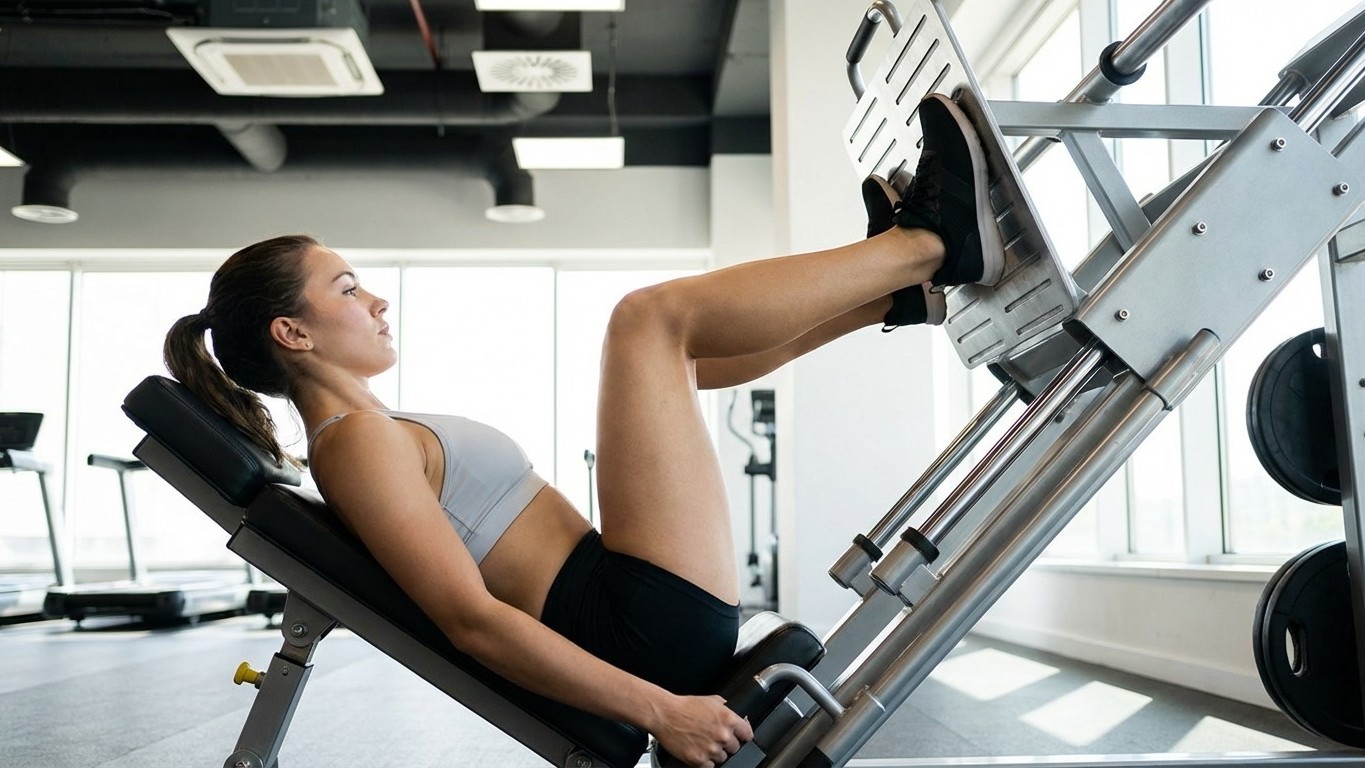
Flat feet on the leg press platform is one of the most common errors in any gym, and it quietly loads your lumbar spine in a way that most people don’t feel until weeks or months later. The moment your heels sit flush against the footplate and your knees travel past a certain depth, your pelvis tilts posteriorly, your lower back rounds, and the pad beneath you becomes largely decorative. Your discs, particularly those at L4-L5 and L5-S1, are now absorbing shear forces they were never designed to handle under load.
Key takeaways
- What happens to your pelvis the moment your heels sit flat on the footplate
- Why hip flexor tightness forces your lower back to compensate under load
- The three-second foot position change that transforms leg press safety
Why your pelvis is the real problem
The leg press looks deceptively safe. You’re seated, supported, pushing weight away from your body. The risk seems low. But the spine doesn’t particularly care about how you feel during the movement; it responds to mechanical forces, and those forces are shaped almost entirely by hip and pelvic position.
When you place your feet flat and low on the footplate, you’re asking your hips to flex deeply, often beyond 90 degrees as the carriage descends. Most people simply don’t have the hip flexor length or posterior chain mobility to maintain a neutral pelvis at that range. The pelvis tips backward, the lumbar curve flattens or reverses, and the lower back lifts off the pad. This position is called posterior pelvic tilt under load, and it converts what should be a quadriceps exercise into an unintentional stress test for the intervertebral discs of the lumbar spine.
The discs themselves are hydraulic structures. Under neutral spinal load, pressure distributes relatively evenly. But in a flexed lumbar position under axial load, that pressure concentrates at the posterior annulus, the outer fibrous ring of the disc. Over time, repeated loading in this position can contribute to annular tears and, in predisposed individuals, disc herniation. A 2019 review published in the Journal of Orthopaedic & Sports Physical Therapy confirmed that posterior pelvic tilt during loaded hip flexion is a consistent predictor of elevated lumbar disc pressure.
The foot position fix that most coaches skip
Raising your feet higher on the platform is the single most effective adjustment you can make, and it takes about three seconds. A higher foot position reduces the demand on hip flexion to reach the same depth, allowing the pelvis to stay neutral and the back to remain in contact with the pad. Think of it as giving your hips a head start.
The width matters too. A narrower stance with feet flat tends to internally rotate the femurs and further restrict hip mobility, compounding the pelvic tilt. Moving feet to roughly shoulder-width apart, with a slight toe-out angle of 20 to 30 degrees, opens the hip joint and allows the ball of the femoral head to clear properly as you descend. It’s a small postural change with a disproportionately large effect on lumbar safety.
Depth is the third variable, and this is where gym culture complicates things. The belief that deeper always means better is persistent. For the leg press, though, depth is only an asset if your pelvis stays neutral throughout the full range. The moment your lower back peels off the pad, you’ve gone past your functional range, regardless of what the weight or the mirror suggests. A useful cue: place one hand flat between your lower back and the pad before you begin. If you can feel daylight during the descent, the range needs to come in.
What tight hip flexors actually do to your technique
Shortened hip flexors, a common consequence of prolonged sitting, physically pull the pelvis into anterior tilt at rest, but paradoxically restrict the hip’s ability to flex freely without compensating at the lower back. When you then load a deep hip flexion movement like the leg press, the body finds the range of motion it needs by borrowing from the lumbar spine. The result is that familiar lower-back rounding, and the pad becomes a place you start, not a place you stay.
Addressing this off the machine pays dividends. A consistent hip flexor stretching routine, particularly targeting the iliopsoas and rectus femoris, can meaningfully improve the range available at the hip before pelvic compensation kicks in. A daily 60 to 90-second low lunge hold on each side, performed over several weeks, has been shown in mobility research to reduce passive hip flexor tension. This isn’t a quick fix; it’s a structural change that makes the gym safer over time.
It’s also worth looking at glute activation. Weak or inhibited glutes fail to stabilise the pelvis during loaded movements, leaving the lumbar extensors to pick up the slack. Incorporating glute bridges or clamshells as a brief warm-up before leg press sessions can prime the posterior chain and reduce the likelihood of the pelvis dropping into that problematic tilt under load.
Reading the signs your back is giving you
Lower back discomfort that appears specifically during or after leg press sets, rather than after squats or deadlifts, is a fairly specific signal. If the ache centres around the sacral area or the lower lumbar region and resolves within hours of finishing, it likely reflects the accumulated stress of repeated pelvic tilt under load rather than acute injury. Persistent pain, pain radiating down one leg, or any neurological symptoms like tingling or numbness warrant a prompt conversation with your GP or a musculoskeletal physiotherapist, not an adjustment of foot position.
One angle worth considering: the leg press is often recommended to people rehabilitating knee injuries precisely because it appears to offload the spine. That assumption holds only when technique is sound. A poorly executed leg press can, in some cases, deliver more lumbar stress than a well-executed bodyweight squat. The machine doesn’t make the movement safe. Your mechanics do.
This article is for informational purposes only. Please consult your GP or a qualified physiotherapist for advice specific to your health and training needs.