
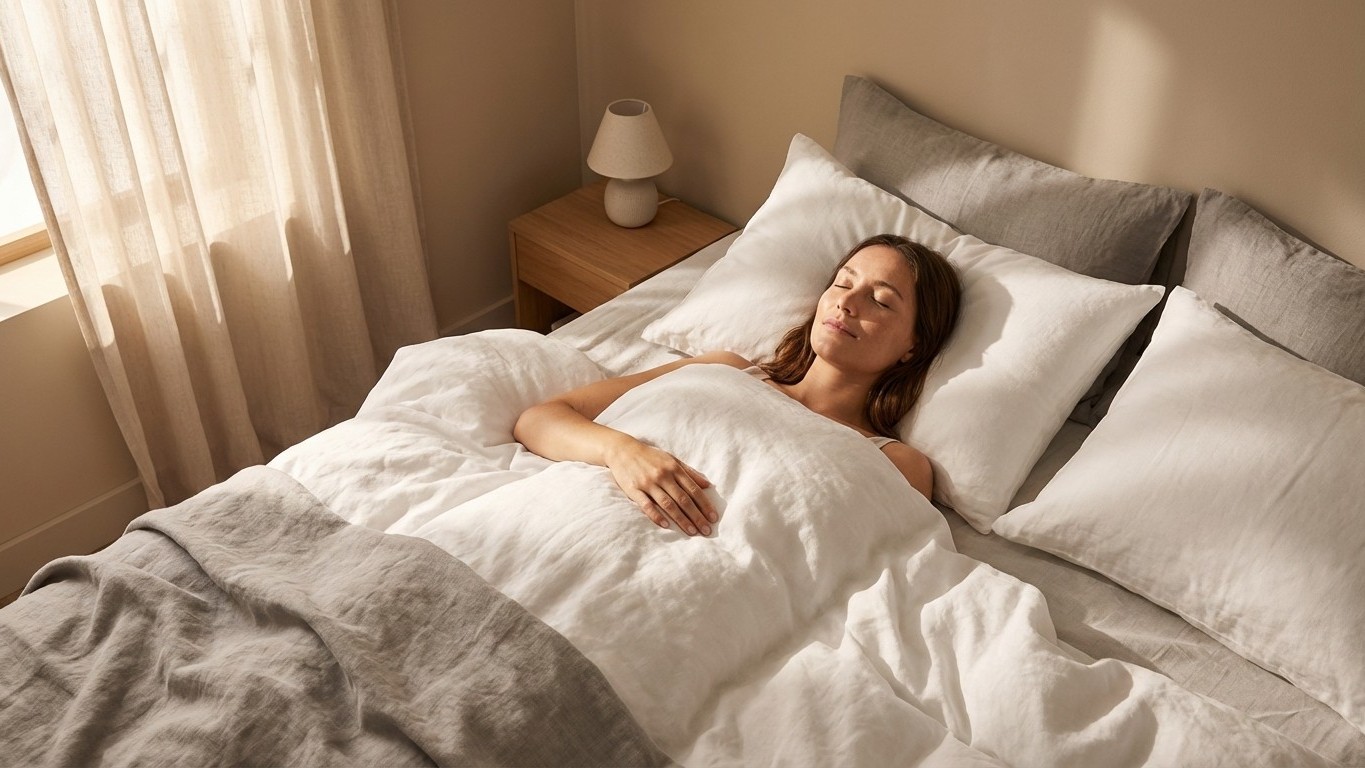
Lying in bed, eyes closed, mind still racing through tomorrow’s meeting or replaying an awkward conversation from three days ago, sound familiar? The body scan meditation for sleep is one of the most effective tools you can use right there, in your own bed, without any equipment, app, or prior experience. This guide gives you a complete, ready-to-use script, along with the science behind why it works and honest advice on making it a sustainable evening habit.
What Is Body Scan Meditation for Sleep?
Defining the Body Scan
The body scan is a mindfulness practice where you systematically move your attention through different parts of your body, from feet to head (or head to feet), noticing sensations without trying to change them. No visualisations of peaceful beaches required. No mantra. Just a quiet, deliberate tour of your own physical experience, anchoring your awareness in the present moment rather than letting it drift into the mental noise of the day.
Originating from Jon Kabat-Zinn’s Mindfulness-Based Stress Reduction (MBSR) programme developed in the late 1970s, the body scan has since been studied in its own right as a sleep aid. The beauty of it, especially when you’re lying in bed, is that it requires no particular posture, no cushion, no silence, just your breath and a willingness to pay attention.
Why Use It Specifically for Falling Asleep?
Most people struggle to sleep because their nervous system hasn’t received the message that the day is over. The brain stays in problem-solving mode, and the body holds onto the physical tension accumulated since morning. The body scan addresses both of these at once. By directing attention inward and moving it slowly through the body, you interrupt the loop of rumination while also signalling to the parasympathetic nervous system, the “rest and digest” branch, that it’s safe to slow down.
There’s something almost paradoxical about it: you’re not trying to sleep, you’re simply observing. And often, that absence of effort is precisely what allows sleep to arrive.
The Evidence Behind the Body Scan
What Research Actually Shows
Mindfulness-based interventions, of which the body scan is a central component, have been studied in relation to insomnia with encouraging results. Research published in peer-reviewed journals has found that MBSR programmes can reduce the time it takes to fall asleep, decrease the number of night-time awakenings, and improve overall sleep quality. The mechanisms involved include reduced cortisol levels, lower heart rate variability linked to anxiety, and a measurable decrease in what researchers call “pre-sleep cognitive arousal”, the technical term for the mind refusing to shut up at bedtime.
One aspect that makes the body scan stand out is its effect on rumination. Chronic nighttime rumination is one of the primary drivers of insomnia. By giving the mind a concrete, sequential task, move attention here, now here, now here, the body scan effectively occupies the same mental bandwidth that rumination would otherwise hijack.
How It Compares to Progressive Muscle Relaxation
The body scan and progressive muscle relaxation for sleep are often confused, and understandably so, both involve moving attention through the body. The key difference is action versus awareness. Progressive muscle relaxation (PMR) asks you to actively tense and release muscle groups, creating physical contrast that triggers relaxation. The body scan asks only that you notice what’s already there.
For someone who carries a lot of physical tension in their muscles, PMR may produce faster initial results. For someone whose main issue is mental restlessness or anxiety-driven wakefulness, the body scan tends to be more effective. Many people find that combining both, a brief PMR session followed by a body scan, gives them the best of each approach. You can explore how these methods overlap in this guide to relaxation techniques for sleep naturally.
The Body Scan Sleep Script: Step by Step
Setting Up (Even from Bed)
You don’t need to prepare much. Lie on your back if that’s comfortable, arms resting loosely at your sides, legs uncrossed. If back-sleeping isn’t your preference, any position where you feel reasonably comfortable works. Dim the lights or turn them off entirely. If you have a partner who’s already asleep, you can read through this script beforehand and carry it from memory, even a rough version works.
Phones off, or on aeroplane mode. The goal is to remove any anticipation of interruption, because that anticipation alone keeps the nervous system on alert.
The Full Body Scan Script for Sleep
Begin by taking three slow breaths. Inhale through the nose for a count of four, exhale through the mouth for a count of six. Let your body settle into the mattress. Feel the weight of your limbs. There’s nowhere to go, nothing to do.
Bring your attention to the soles of your feet. Notice any sensations, warmth, coolness, tingling, pressure from the sheets. Don’t try to relax them; simply notice. Spend about thirty seconds here, breathing normally. Let the awareness expand to include your heels, your ankles, the tops of your feet.
Slowly move your attention up to your lower legs, calves, shins. Notice any tension or heaviness. If you find tension, breathe towards it gently: imagine your breath travelling down to that spot on the inhale, and carrying a little of the tension away on the exhale. Continue to your knees, noticing the backs of the knees, often a place where warmth collects.
Your thighs now. The large muscles here are often unexpectedly tight after a day of sitting. Simply notice. Then the hips and pelvis, a region where many people hold stress without realising it. Let the weight of your hips sink into the mattress.
Move attention to the lower back. If there’s discomfort, acknowledge it without judgement, discomfort noticed is discomfort that no longer needs to shout for your attention. Continue up through the middle back, the shoulder blades, feeling the mattress or pillow beneath you as a support, something holding you.
Your abdomen rises and falls with each breath. Spend a moment simply watching this movement from the inside. Then the chest, the ribcage expanding slightly with each inhale. No need to control the breath, let it breathe you.
Bring your attention to your hands. Fingertips, palms, the backs of the hands. Your forearms, elbows, upper arms. The shoulders, this is where many people carry the most obvious tension. Breathe here. Let the shoulders fall a little heavier, a little further from your ears.
Your neck, the throat, the jaw. If your jaw is clenched, allow it to soften, teeth slightly apart, tongue resting gently at the bottom of the mouth. Your cheeks, the area around your eyes. Let the forehead smooth. The scalp, the top of the head.
Now hold the whole body in awareness at once. A complete, weighted, breathing presence. Let go of any deliberate attention and simply exist here, in this body, in this bed. Sleep, if it comes, is welcome.
Short Version (10 Minutes) vs Long Version (20-30 Minutes)
The script above takes roughly 20 to 25 minutes when done slowly. If you need something faster, perhaps you’re very tired and want just a gentle anchor, you can compress it significantly. Move through the body in five broad zones: feet and lower legs, thighs and hips, torso and back, arms and shoulders, then face and head. Spend one to two minutes on each zone, three slow breaths per area. The whole thing takes under ten minutes and still delivers a meaningful shift in nervous system tone.
For chronic insomnia or high anxiety levels in the evening, the longer version is worth the investment. Longer, slower practice gives the parasympathetic nervous system more time to fully take over.
Making This a Sustainable Evening Practice
Does It Need to Be Every Night?
Consistency matters more than frequency in most mindfulness research. Doing a body scan five nights out of seven will serve you better than sporadic hour-long sessions on weekends. The brain benefits from routine: when the body scan becomes a reliable signal that sleep is coming, it begins to trigger the associated relaxation response more quickly over time. Think of it as training a reflex rather than performing a technique.
If you find evenings chaotic, even ten minutes of intentional body awareness before turning out the light counts. Pair it with something you already do, teeth brushed, phone put away, then body scan. The habit stacking approach tends to stick.
What If You Fall Asleep Mid-Script?
Good. That’s the point. There’s no failure mode here, drifting off during a body scan is not interrupting the practice, it is the practice working. If you’re using a recorded guide and wake up to find it still playing, simply turn it off and go back to sleep. If you’re using this written script from memory and lose your place somewhere around the knees, let it go. Your attention wandering and returning is itself a mindfulness exercise.
For anyone who finds that breathing exercises for sleep anxiety help to calm an overactive mind before starting the body scan, layering the two approaches can be very effective. A few minutes of slow, controlled breathing before beginning the physical scan gives the mind an initial anchor.
Frequently Asked Questions
How is body scan different from yoga nidra? Yoga nidra, sometimes called “yogic sleep,” follows a similar structure but typically includes visualisation, intention-setting, and a specific guided journey between waking and sleeping states. The body scan is simpler and more flexible, no teacher or recording is strictly necessary. Both are effective for sleep; yoga nidra tends to appeal to people who enjoy more structured guidance and narrative, while the body scan suits those who prefer a quieter, more self-directed practice.
Can the body scan be combined with other natural approaches? Absolutely. The body scan sits comfortably within a broader sleep hygiene routine. Magnesium, valerian root, or other natural sleep remedies address the physiological side of sleep, while the body scan works on the psychological. They don’t interfere with each other. Some people find a warm bath followed by a body scan, perhaps with a drop of lavender on the pillow, creates a powerful winding-down sequence that their body learns to associate with sleep. Consult your GP if you’re considering supplements, particularly if you’re on any medication.
Is it safe to do every night without risk? The body scan is gentle, non-pharmacological, and carries no known risks for healthy adults. It’s a form of mindful self-observation, not a physiological intervention. The only caveat worth mentioning is for individuals processing trauma: body-based mindfulness practices can occasionally surface difficult sensations or memories. If that happens, please speak with a mental health professional who can tailor the approach safely.
Finding Audio Resources and Apps
Several free resources exist if you’d prefer to be guided rather than working from memory. The UCLA Mindful Awareness Research Center offers free audio downloads of body scan meditations on their website, recorded in clear, calm voices and available in varying lengths. The Insight Timer app has hundreds of free guided body scans contributed by teachers worldwide, filtering by duration lets you find exactly the length you need on a given evening. NHS-endorsed apps like Headspace have also included sleep-specific body scan tracks in their free tiers, though the full libraries require a subscription.
Recorded audio has one advantage worth noting: you don’t have to hold the script in memory, which frees your mind completely from any effortful engagement. That said, working from memory, even imperfectly, trains a kind of self-sufficiency that pays off on nights when your phone is charging across the room and you simply need to sleep.
The question of which sleep technique works best for you is, in the end, a personal one, your body’s responses are data worth paying attention to. The body scan is a good starting point not because it’s the most complex or the most ancient, but because it asks so little and offers so much. Perhaps the most surprising thing about it is how quickly it can shift from feeling like an effort to feeling like a homecoming.