
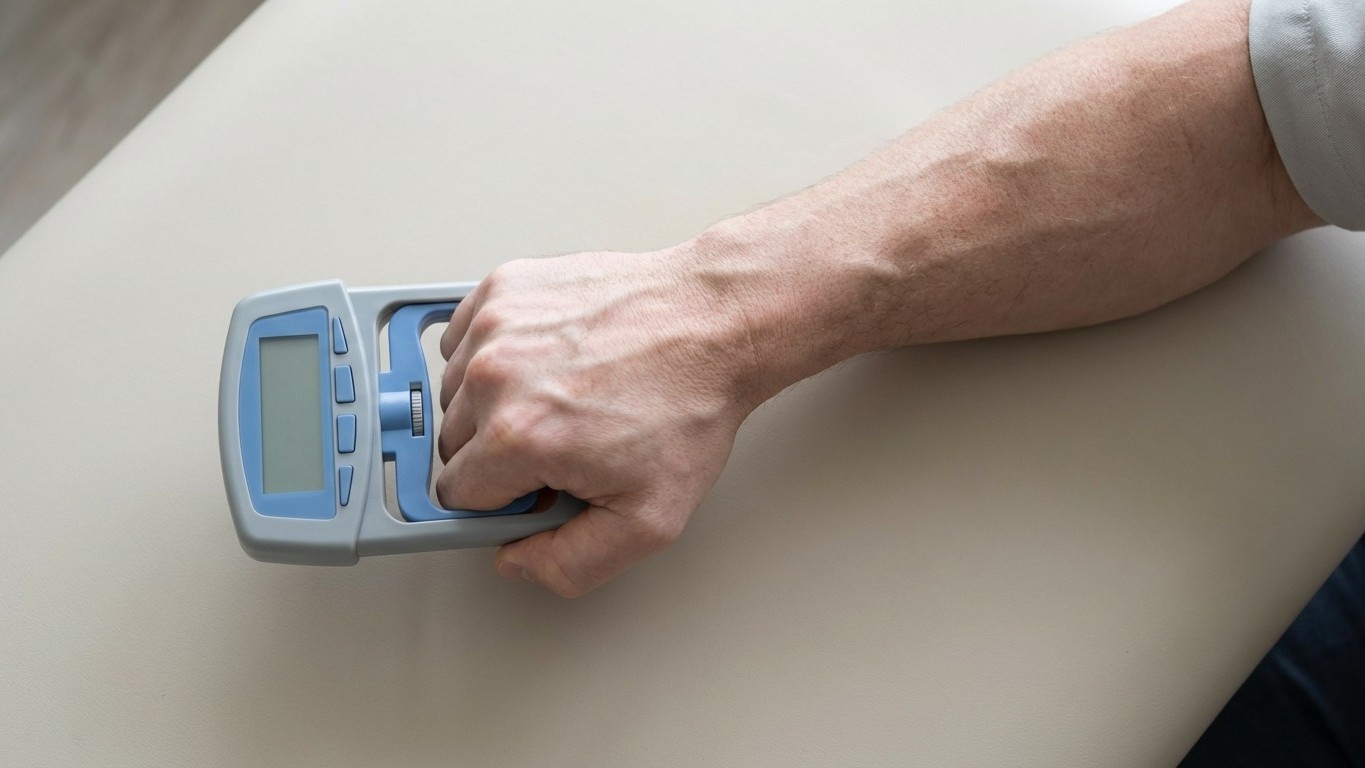
Your handshake might reveal more about your future health than a resting heart rate, a cholesterol panel, or even a GP appointment. A long-running study tracking grip strength over 26 years has identified a specific threshold below which the risk of dying prematurely doubles, and the findings are quietly reshaping how some clinicians think about muscular Fitness as a vital sign.
Key takeaways
- Researchers tracked grip strength over 26 years and discovered a precise threshold where mortality risk suddenly doubles
- Grip strength decline over time matters as much as a single measurement—the trajectory tells the real story
- This simple two-second test may become as routine as blood pressure checks for adults over 40
What the research actually found
The study, which followed thousands of adults over nearly three decades, measured grip strength repeatedly using a handheld dynamometer, a simple device that records how hard you can squeeze. The data revealed something that researchers had suspected for years but struggled to quantify with this level of precision: grip strength is not merely a proxy for upper body fitness, it reflects the overall integrity of your musculoskeletal system, your nervous system, and your metabolic health simultaneously.
The critical threshold identified sat around 26 kilograms of force for men and approximately 16 kilograms for women, though these figures vary slightly across different publications depending on age group and population studied. Below those values, mortality risk from all causes, including cardiovascular disease and cancer, was found to double compared to those with moderate or high grip strength. To put that in perspective: falling below this threshold carried a comparable risk elevation to smoking in some analyses. That comparison tends to stop people in their tracks.
One detail that rarely gets mentioned in the headlines: grip strength decline, not just a single low reading, was strongly predictive. Adults whose scores dropped steadily over successive measurements fared worse than those who maintained consistent (even moderate) strength. The trajectory matters as much as the number.
Why grip strength is such a powerful predictor
Grip strength works as a kind of biological summary. When you squeeze a dynamometer, you’re recruiting motor neurons, contracting skeletal muscle fibres, drawing on stored glycogen, and coordinating signals from your central nervous system. All of that, happening in two seconds, gives researchers a surprisingly clean window into systemic health.
Skeletal muscle, which makes up roughly 30 to 40 percent of body weight in a healthy adult, is an endocrine organ, not just a mechanical one. It produces and releases proteins called myokines that regulate inflammation, insulin sensitivity, and immune function. When muscle mass and quality decline, so does this hormonal output. The downstream effects touch virtually every organ system, which is why weak grip correlates with outcomes as varied as hip fracture, cognitive decline, and heart failure.
There’s also a circulatory logic to it. Strong forearm and hand muscles demand a well-functioning cardiovascular system to deliver oxygen and remove waste products efficiently. A weak grip can signal that this system is already compromised, often silently, before symptoms emerge. Grip strength essentially surfaces what’s happening deeper in the body before more obvious markers catch up.
What this means for everyday life
The obvious question is whether improving grip strength Actually reduces mortality risk, or whether it merely correlates with other healthy behaviours. The honest answer is: probably both. People who exercise regularly, maintain a varied diet, sleep adequately, and manage stress tend to have stronger grip. So some of the signal is confounded by lifestyle. But there is reasonable evidence suggesting that progressive resistance training, which increases grip strength as a direct consequence, also independently improves cardiovascular health and metabolic markers.
Testing your own grip is easier than you’d think. Many GP surgeries and physiotherapy clinics have dynamometers, and some gyms do too. A simple, rough-and-ready alternative is the dead hang: hanging from a pull-up bar with both hands for as long as you can sustain it. Sixty seconds is often cited as a reasonable benchmark for adults under 60, though your age, sex, and body weight all affect what’s reasonable for you.
If you do want to work on grip, the good news is that it responds relatively quickly to targeted training. Farmer’s carries (walking while Holding heavy weights at your sides) are particularly effective. So are dead lifts, rock climbing, and even something as low-barrier as carrying shopping bags without assistance. The hands and forearms adapt to load, and the benefits ripple outwards into broader muscle health.
It’s worth being clear: a single low grip reading is not a diagnosis of anything. Many temporary factors suppress grip, including fatigue, nerve compression, arthritis flare-ups, and even dehydration. If you’re concerned about yours, the right step is to speak with your GP, who can assess it in the context of your full health picture.
A shift in how we measure fitness
For decades, cardiovascular fitness dominated the conversation. VO2 max, resting heart rate, blood pressure, these were the metrics that mattered. Muscle Strength was treated as cosmetic at best, or the concern of athletes and elderly patients at worst. This study, alongside a growing body of similar longitudinal research, is nudging that consensus.
Some sports medicine physicians now advocate for grip strength to be measured routinely in adults over 40, the same way blood pressure is checked at a standard health review. Whether that becomes NHS practice is another matter entirely, healthcare systems move slowly, and a dynamometer test competes with a long list of other priorities in a ten-minute appointment. But the case for including it is getting harder to dismiss.
What strikes me most about this research is not the threshold itself, but the time horizon: 26 years of data. That’s not a snapshot. That’s a life unfolding, with grip strength quietly narrating it from one decade to the next. The question it leaves hanging is whether the hands are merely recording the story, or whether, with the right attention, we can change how it ends.
This article is for informational purposes only. Please consult your GP for personalised medical advice.