
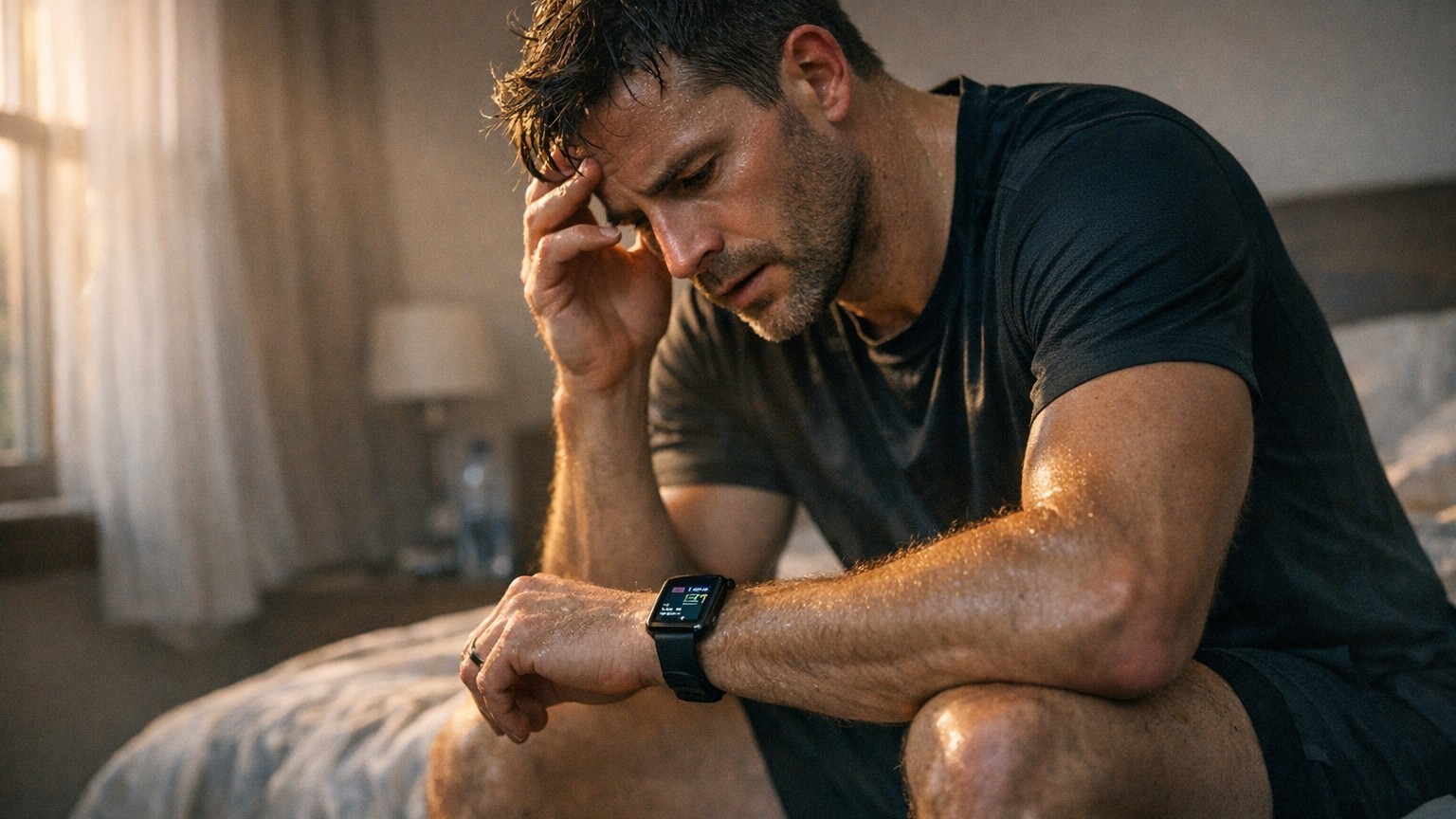
Sleep deprivation after hard training doesn’t just leave you feeling groggy the next morning. It actively dismantles the physiological processes that make exercise worthwhile in the first place. For anyone logging consistent sessions at the gym or on the track and wondering why progress has plateaued, the answer is often hiding in those six hours, or fewer, they’re spending in bed.
Key takeaways
- A coach’s recovery data check exposes why your progress has plateaued
- Your muscles aren’t growing during the workout—they’re growing during deep sleep, and you’re cutting that window short
- High-intensity training on chronic sleep debt creates a compounding physiological deficit your body can’t recover from
What actually happens to your muscles when sleep is cut short
The bulk of muscle repair and growth happens during sleep, not during the workout itself. Training creates microscopic tears in muscle fibres; sleep is when the body stitches them back together, stronger than before. This process is tightly linked to the secretion of human growth hormone (HGH), which the pituitary gland releases primarily during slow-wave (deep) sleep. Cut that sleep short, and you truncate the very window in which HGH is doing its most productive work.
Research published in journals tracking sleep and athletic performance has consistently shown that sleeping fewer than seven hours per night is associated with reduced muscle protein synthesis and elevated cortisol levels. Cortisol, the body’s primary stress hormone, is catabolic, it breaks tissue down rather than building it up. So the biological picture is almost perversely counterproductive: train hard, sleep poorly, and cortisol rises while anabolic hormones fall. You end up in a biochemical environment that is actively hostile to the gains you worked for.
There’s a glycogen angle too, which tends to get overlooked. Muscles store glycogen as their primary fuel for intense exercise. Poor sleep impairs how efficiently the body replenishes these glycogen stores after a session. The result is that your next workout begins from a depleted baseline, you’re not just tired, you’re structurally under-fuelled.
The recovery check that reframes everything
When a coach or sports scientist runs a proper recovery assessment, they’re not just asking whether you feel rested. They’re looking at resting heart rate variability (HRV), perceived exertion scores, grip strength, and sometimes even reaction time. HRV in particular has become a widely used proxy for how well the nervous system has recovered. A low HRV reading on the morning after a hard session often correlates directly with poor sleep quality or duration the night before.
That moment of having your recovery data laid out in front of you tends to be clarifying in a way that vague advice never is. Seeing that your HRV is consistently suppressed after nights under six hours, while recovering well after seven or more, removes the ambiguity. The numbers make the connection impossible to ignore. Many athletes who have been through this process describe it as the point where they stopped treating sleep as optional and started treating it as training infrastructure.
One finding that surprises most people in this context: the timing of the short sleep matters as much as the total. A 2019 study from the journal Sleep found that sleeping between 10pm and 4am, a six-hour window, still produced worse recovery outcomes than sleeping the same six hours later in the night, partly because early night sleep contains a higher proportion of deep slow-wave sleep. going to bed at midnight and waking at 6am costs you less than going to bed at 10pm and rising at 4am, assuming the total hours are identical. Counterintuitive, but the architecture of sleep matters, not just the clock hours.
Why high-intensity training makes sleep debt more damaging
Low-intensity activity, a gentle walk, a relaxed swim, places modest demands on recovery systems. The body can absorb those sessions even on imperfect sleep without much consequence. High-intensity training is a different matter entirely. Intervals, heavy resistance work, and high-volume sessions create a significant physiological debt that requires deep, sustained sleep to clear. Running those sessions on chronically short sleep is a bit like repeatedly overdrafting a bank account and making only partial repayments. The deficit compounds.
The immune system is another casualty that rarely features in gym conversations about recovery. Intense exercise temporarily suppresses immune function, a well-documented phenomenon sometimes called the “open window” theory, during which the body is more vulnerable to infection. Sleep is one of the primary mechanisms through which immune function is restored. Athletes who are sleeping under six hours regularly are navigating this open window for longer than necessary, which is one reason why overtrained athletes so often end up with persistent colds and minor infections at inconvenient moments.
There is also a neuromuscular dimension. The coordination and motor patterns that make skilled movement efficient are consolidated during REM sleep. Short-changing REM, which tends to be concentrated in the final one to two hours of a sleep period — degrades the precision of those patterns. Sprint mechanics, lifting technique, sport-specific skills: all of these are subtly less sharp after a string of short nights, even if you feel awake enough to train.
Building sleep as seriously as you build training load
The practical shift is treating sleep like a training variable with its own periodisation logic. On heavy training days or in high-volume training blocks, sleep needs go up, not stay constant. Most sports medicine guidance now points to seven to nine hours as the target range for people in regular intense training, with some elite athletes deliberately targeting nine hours during peak training phases.
Consistent sleep and wake times matter more than most people realise, because they anchor the circadian rhythm that governs when HGH is released and when cortisol naturally drops. Shifting your schedule by two or three hours on weekends, the so-called “social jetlag” pattern, disrupts this rhythm meaningfully. A stable schedule, even at social cost, tends to produce measurably better recovery markers within two to three weeks.
One often-overlooked strategy is the strategic nap. A 20-minute nap taken between 1pm and 3pm has been shown in multiple studies to partially offset the HRV and performance deficits caused by a short previous night, without disrupting subsequent night-time sleep if kept under 30 minutes. It’s a practical tool, not a luxury, and for anyone whose schedule makes long nights difficult, it may be the most accessible lever available.
This article is for informational purposes only. Please consult your GP or a qualified sports medicine professional for personalised advice about your training and recovery.