
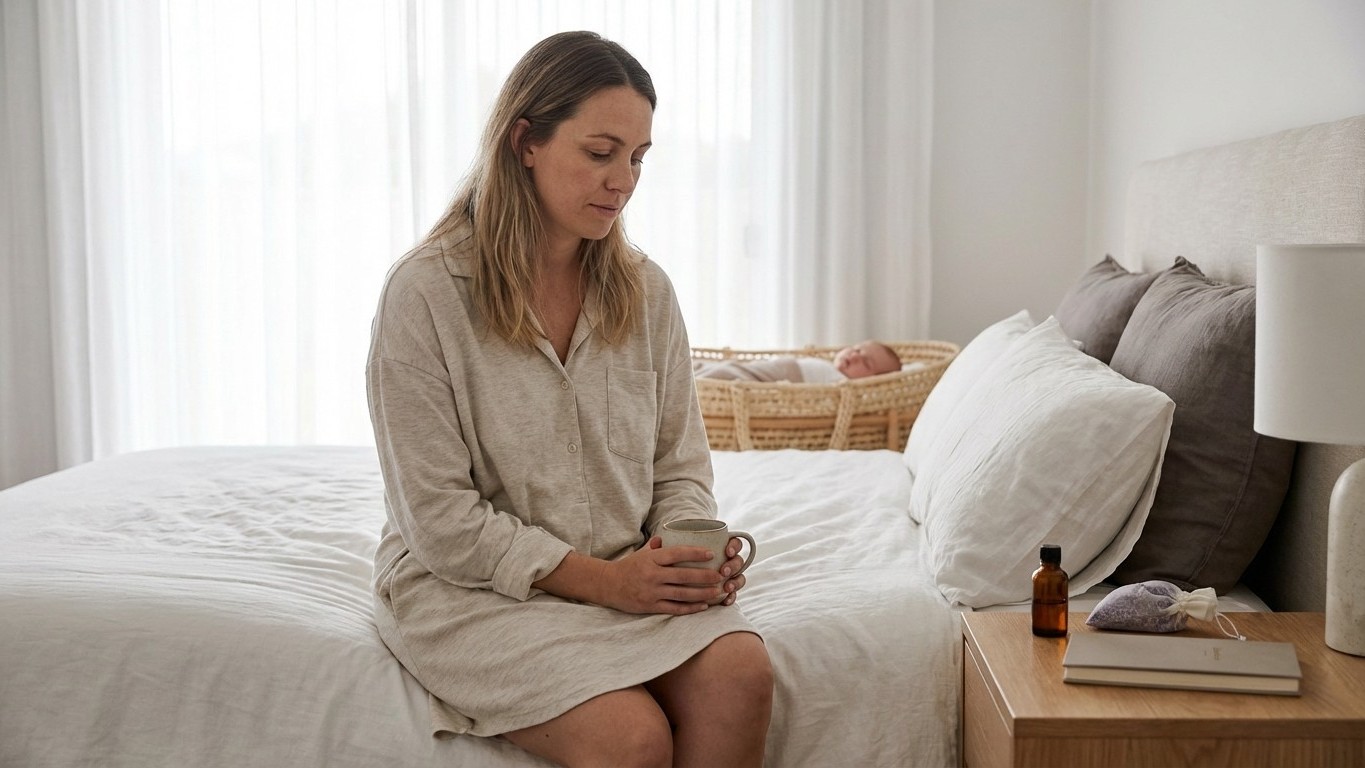
The first weeks after giving birth can feel like a paradox that no one quite prepares you for: you are exhausted beyond anything you have previously experienced, yet sleep refuses to come. Or it comes in jagged, shallow fragments that leave you more depleted each morning. Postpartum insomnia is not simply tiredness, it is a physiological and psychological disruption that affects a significant proportion of new mothers, often peaking in the early weeks after delivery and persisting well into the fourth trimester. The good news is that there are natural sleep remedies that are both effective and appropriate for this particular season of life, provided you know which ones to reach for and which to avoid.
Understanding Postpartum Insomnia and Fragmented Sleep
Why Sleep Becomes So Disrupted After Birth
Childbirth triggers a cascade of hormonal changes that would challenge anyone’s sleep. Oestrogen and progesterone levels, which had been elevated throughout pregnancy, drop sharply in the days following delivery. Prolactin rises to support milk production, and cortisol, the stress hormone, often remains elevated as the body and mind adapt to a radically new set of demands. The result is a nervous system that is simultaneously wound up and worn out.
Beyond hormones, there is the circadian rhythm disruption that comes from feeding a newborn around the clock. Human sleep architecture relies on consolidated periods of rest to move through the stages of light sleep, deep sleep, and REM sleep. When these cycles are interrupted every two to three hours, the restorative work of sleep, memory consolidation, immune regulation, emotional processing — simply cannot complete itself. This is not a personal failing; it is biology under duress.
The Difference Between Postpartum Insomnia and Simple Fatigue
Many new mothers assume that difficulty sleeping is just exhaustion dressed up differently. There is an important distinction, though. Simple fatigue means you want to sleep and, given the opportunity, you can. Postpartum insomnia is when the opportunity arrives, your baby is settled, your partner has taken a shift, and yet your mind races, your body stays tense, and sleep will not come. Some women describe lying awake with anxiety about the baby even when they know all is well. Others wake spontaneously in the early hours and cannot drift back off.
This kind of hyperarousal pattern is closely linked to postpartum anxiety, which is distinct from the more widely discussed postnatal depression. If your sleeplessness feels accompanied by persistent worry, intrusive thoughts, or a sense that something terrible is about to happen, please do speak to your GP or midwife. Natural remedies can support sleep, but they work best alongside professional support when anxiety is the primary driver.
Risks and Precautions Specific to the Postpartum Period
What Can Be Problematic in Some Natural Approaches
The postpartum period demands a more careful eye than most when it comes to natural remedies. “Natural” does not automatically mean safe, and this is doubly true when you are recovering from childbirth and potentially breastfeeding. Some herbal preparations pass into breast milk; others may interact with medications commonly used after delivery, including iron supplements or medications for blood pressure. Valerian root, for example, while widely used for sleep, has insufficient safety data for breastfeeding women and is generally best avoided during this period. St John’s Wort carries well-documented interactions with various medications and is not recommended postpartum.
High-dose melatonin supplements are another area where caution is warranted. While low-dose melatonin (0.5mg) has been studied in some contexts, the hormonal sensitivity of the postpartum period means that introducing exogenous melatonin without guidance is not advisable, particularly during breastfeeding.
Particular Considerations: Breastfeeding, Baby Blues, and Postpartum Complications
If you are breastfeeding, the principle is straightforward: anything you consume has the potential to reach your baby via breast milk, though the quantity and effect vary enormously between substances. Herbs such as chamomile and lavender used as teas or in aromatherapy are generally considered low-risk at normal amounts, but the evidence base for many herbal remedies in lactating women remains thin simply because this group is rarely included in clinical trials. When in doubt, less is more.
Baby blues, the emotional fragility and tearfulness affecting up to 80% of new mothers in the first fortnight — typically resolves on its own. Postpartum depression, however, is a medical condition that natural sleep remedies cannot treat. If low mood persists beyond two weeks, or feels severe, please do not rely on chamomile tea and breathing exercises alone. Your GP is your first port of call.
Natural Remedies That Are Compatible: What to Choose and Why
Safe Herbal Teas After Pregnancy
Chamomile tea is probably the most evidence-adjacent option for new mothers. It contains apigenin, a compound that binds to GABA receptors in the brain and has mild sedative properties. Drunk as a warm infusion in the evening, chamomile poses very low risk during breastfeeding at normal culinary amounts, and many mothers find the ritual of a warm drink before bed as calming as the herb itself. Lemon balm (melissa officinalis) is another gentle option, with some small studies suggesting it may reduce anxiety and improve sleep quality, though large-scale trials remain limited.
Passionflower is sometimes recommended for sleep and anxiety, but the evidence for its safety during breastfeeding is insufficient, so it is better left aside for now. Similarly, hops, often found in sleep blends, lack adequate breastfeeding safety data. If you are browsing ready-made sleep teas, reading the full ingredient list matters more than the word “natural” on the front of the packet.
Natural Supplements That Are Documented and Compatible
Magnesium is one of the better-supported options here. Many women enter the postpartum period already depleted in magnesium, pregnancy is demanding on mineral stores, and low magnesium is associated with poorer sleep quality and increased anxiety. Magnesium glycinate, in particular, is well tolerated and gentle on the digestive system. It is worth discussing supplementation with your GP or health visitor, but this is one of the more pragmatic options for postpartum sleep support.
Glycine, an amino acid found naturally in bone broth and some protein foods, has shown promise in small studies for improving sleep quality and reducing daytime fatigue. It is considered safe during breastfeeding at dietary amounts, though supplement doses should be discussed with a healthcare provider. L-theanine, found in green tea, has mild anxiolytic properties and is generally well tolerated, though again, professional guidance is wise before adding new supplements postpartum.
Relaxation Techniques Adapted to New Motherhood
Progressive muscle relaxation, systematically tensing and releasing muscle groups from feet to face — can be done lying in bed in under ten minutes and asks nothing of you except the willingness to be still. Research consistently shows it reduces physiological arousal, which is exactly the hyperarousal pattern driving much postpartum insomnia. Box breathing (inhaling for four counts, holding for four, exhaling for four, holding for four) is another technique that takes no equipment, no cost, and no childcare to practise.
Yoga nidra, sometimes called “non-sleep deep rest”, is a guided body-scan meditation that some researchers suggest can produce restorative states similar to light sleep. Free audio recordings are widely available, and even a 20-minute session while your baby sleeps can offer meaningful recovery. The body does not always need a full night’s sleep if it receives quality rest in other forms, this is not wishful thinking, it is physiology.
Sleep Environment and Postpartum Sleep Hygiene
The standard sleep hygiene advice, fixed wake times, no screens before bed, cool dark room, requires some creative adaptation when you have a newborn. A more flexible framework helps: rather than a fixed bedtime, focus on a wind-down signal. This might be dimming the lights in the room after a certain feed, making your herbal tea, or putting on the same sleep playlist. These cues train your nervous system to associate a sequence of actions with the transition towards sleep.
Keeping the bedroom as dark as possible during night feeds, using a low red-light lamp rather than overhead lighting, helps protect your melatonin levels even when you are awake. It is a small adjustment that many mothers find genuinely useful once they try it.
Building a Gentle Evening Routine After Birth
A Simple Routine Compatible With Your Baby’s Rhythm
Perfection is not the goal here, adaptability is. A realistic evening routine for a new mother might look something like this: after the last feed of the evening, dim the lights and make a cup of chamomile or lemon balm tea. Spend five minutes doing box breathing or a body scan. Keep your phone in another room if at all possible. When you lie down, do a brief progressive relaxation through your shoulders and jaw, where most of us hold tension without realising it. If sleep does not arrive within twenty minutes, do not lie there watching the ceiling. Get up, sit quietly in dim light, and try again when you feel drowsy.
The aim is to break the learned association between your bed and wakefulness, one of the hallmarks of chronic insomnia, before it becomes entrenched.
Managing Frequent Night Wakings
Working With Your Baby’s Sleep Cycles, Not Against Them
Newborns cycle through sleep roughly every 45 to 60 minutes, spending a much higher proportion of their time in REM sleep than adults do. Night wakings are not a problem to be solved; they are developmental biology. What you can do is shift your own relationship with them. Rather than dreading each waking as a disruption, some sleep researchers suggest treating them as natural breaks, similar, in a way, to the polyphasic sleep patterns of pre-industrial humans, who often slept in two distinct blocks with a quiet wakeful period in between.
Micro-Naps and Strategies for Rest Despite Everything
The advice to “sleep when the baby sleeps” is both sensible and maddening in equal measure, because the household rarely cooperates. That said, a 20-minute nap in the early afternoon, set an alarm to avoid falling into deep sleep, can meaningfully reduce sleep debt without interfering with the ability to sleep later. If genuine sleep feels impossible, even lying down with eyes closed and doing a body scan counts as rest. Your brain does valuable recovery work even in these lighter states.
Frequently Asked Questions and Real Experiences
FAQ: Common Questions About Postpartum Sleep
Which herbal teas are safe after birth? Chamomile and lemon balm at normal amounts are widely considered low-risk, including during breastfeeding. Always check the full ingredient list of any blended tea and discuss with your midwife or GP if you are unsure.
Which natural remedies should be avoided when breastfeeding? Valerian, St John’s Wort, high-dose melatonin, passionflower, and hops are best avoided during breastfeeding due to insufficient safety data or known risks. When browsing herbal sleep products, treat the ingredient list as more informative than the marketing.
Are natural sleep supplements compatible with breastfeeding? Magnesium glycinate is among the better-tolerated options, and glycine at dietary amounts is generally considered safe. That said, any supplementation worth taking is worth discussing with a healthcare professional first, your GP or health visitor can give personalised guidance based on your specific situation.
How do you manage sleep when your baby wakes frequently? Short naps, wind-down rituals before each sleep window, relaxation techniques, and adjusting your sleep environment for quick re-entry into sleep (dark room, no phones, minimal stimulation) all help. The goal is maximising the quality of every sleep opportunity, however brief.
What Other Mothers Have Found Helpful
Many mothers who have navigated postpartum insomnia describe the same turning point: stopping the fight. One mother of twins described spending the first eight weeks lying rigid in bed during every precious gap, convinced she would soon crash out, and instead lying awake for the entire stretch. It was only when she started using those windows for a body-scan practice, with no expectation of sleep, that sleep began to arrive. Another found that a magnesium supplement recommended by her GP, combined with a consistent wind-down sequence, made the difference between two-hour and four-hour stretches of consolidated sleep — a change she described as transformative.
These are individual experiences, of course, not prescriptions. But they point to something the evidence supports: the combination of a calm nervous system, a supportive environment, and appropriate nutritional foundations gives sleep the best possible conditions to return on its own terms.
Sleep deprivation in early motherhood is one of the most under-discussed public health challenges there is. While you navigate this period, you might find it helpful to know that many of the same principles covered here apply across different life stages, from perimenopause to older adulthood. If you are curious about how natural approaches shift across a lifetime, the guides on natural sleep remedies for menopause and natural sleep remedies for menopause offer a broader perspective. For those managing hormonal sleep disruption alongside night sweats, the natural sleep remedies for perimenopause night sweats page covers adjustments specific to that experience.
Right now, though, the question worth sitting with is this: are you treating postpartum sleeplessness as a problem requiring a solution, or as a signal from your body asking for gentleness and support? The remedies that tend to work best are rarely the most dramatic ones. They are the consistent, low-stakes habits that slowly rebuild the conditions your nervous system needs to do what it already knows how to do.
Always consult your GP, midwife, or health visitor before starting any new supplement or herbal remedy during the postpartum period, particularly if you are breastfeeding or managing any health condition.