
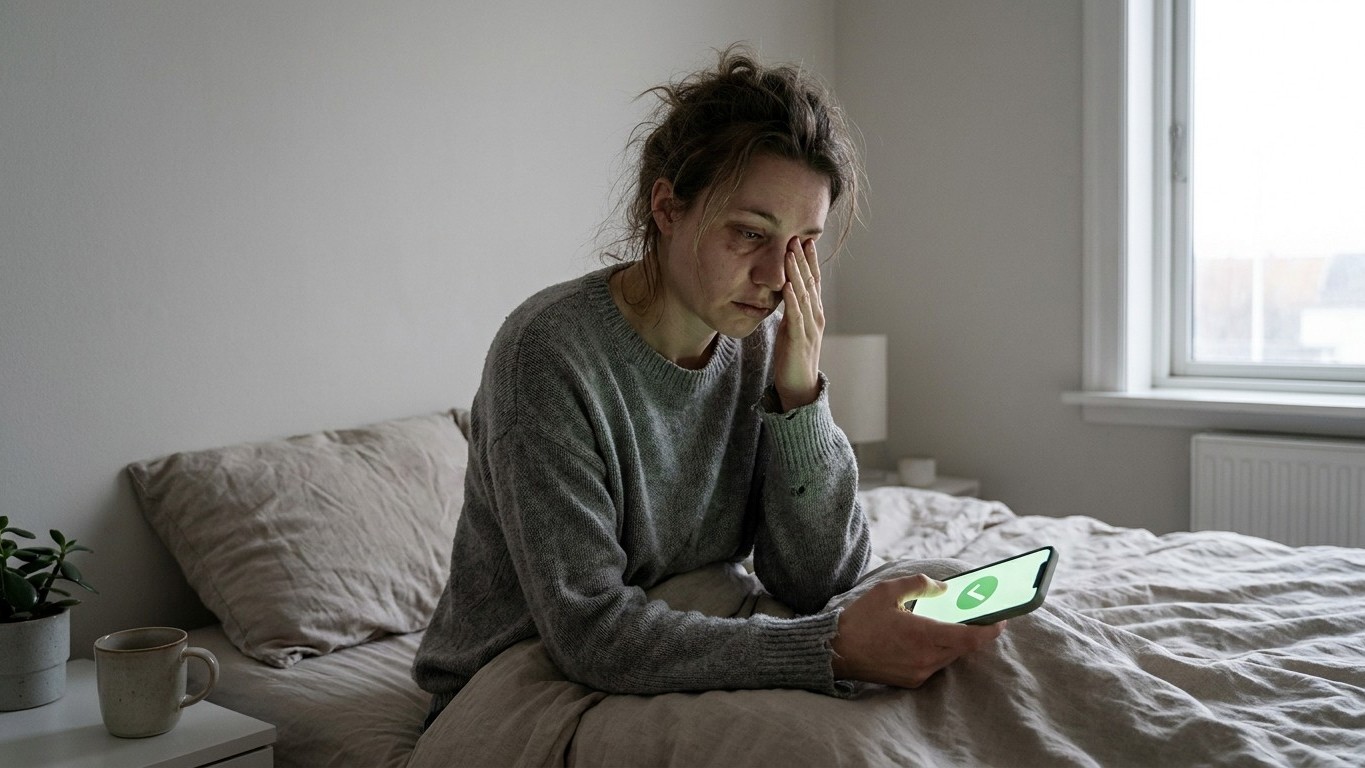
Eight hours on the tracker, a green “good sleep” badge, and yet the tiredness never lifted. That’s the paradox many people taking a sleeping tablet after late work sessions eventually run into: the numbers say rest happened, but the body disagrees. The explanation lies not in how long you were unconscious, but in what your brain was actually doing during those hours, and increasingly, the research on benzodiazepines and Z-drugs backs up that gut feeling.
Key takeaways
- Your sleep tracker can’t see which sleep stages you’re actually in—and that’s where the real restoration happens
- Sleeping pills silently reshuffle your brain’s sleep architecture, trading deep repair sleep for light, superficial sleep
- Tolerance builds in days, not weeks, turning an occasional aid into a nightly habit before you notice
Why the same number of hours stopped feeling the same
A sleep tracker measures movement, heart rate and sometimes oxygen levels to estimate how much time you spent asleep. It cannot see which stage of sleep you were actually in, and that distinction turns out to matter enormously. Deep, slow-wave sleep is when the brain clears metabolic waste and consolidates memory; REM sleep is tied to emotional processing and learning. Sleeping tablets, particularly benzodiazepines, are well known to reshuffle this architecture rather than simply extending it. A systematic review of benzodiazepine studies found that these drugs confirm an increase in stage 2 of NREM sleep and a decrease in time of stages 3 and 4 of NREM sleep with a reduction in time of REM sleep during the nocturnal sleep. In practice, that means more time in light sleep and less in the stages that actually do the repair work, even though the total duration on a wearable device might look flawless.
The same review notes that this shift can bring a specific kind of false reassurance: the increase in stage 2 of NREM sleep may lead to a subjective improvement of sleep quality with no awakenings. You feel like you slept through, because in a sense you did, just not through the stages that leave you cognitively sharp the next day. Researchers behind a 2025 study on chronic sedative-hypnotic use in older adults with insomnia described broadly the same pattern, noting that prolonged sedative-hypnotic use in both adults with and without insomnia disorder has been shown to be detrimental to sleep quality by disrupting sleep architecture, including a reduction in time spent in deep sleep and REM sleep while increasing duration in N2 sleep. Zopiclone, one of the most commonly prescribed Z-drugs in the UK, comes with a similar caveat straight from primary care guidance: although these medications can make you fall asleep faster, they do not produce natural, restorative sleep.
What repeated use after late nights actually does
Taking a tablet occasionally after a stressful late session is different from building it into a routine, and this is where the trajectory tends to sneak up on people. Tolerance to sleeping tablets can build within days rather than weeks; one clinical resource for patients notes that it can take as little time as just a few days for tolerance to develop, which means the dose that once knocked you out at 11pm after a deadline gradually stops working as well, tempting some people to reach for it more often or in higher amounts. Dependence follows a similar timeline for a subset of users, and some people can become dependent on sleeping tablets, experiencing withdrawal symptoms if stopped suddenly.
This isn’t scaremongering, it’s the reason UK prescribing guidance is so cautious. Back in 2004, NICE issued guidance to physicians about these risks and advised against use for over 4 weeks, and only for severe insomnia, and that caution still shapes how GPs prescribe today. Most GPs will only offer a short course, and patient guidance is explicit that doctors generally advise taking sleeping tablets for no more than two weeks at a time to prevent dependence, and sometimes they may suggest taking them only two or three nights a week rather than nightly. The pattern described in the title, a tablet after every late session, is precisely the kind of drift that turns an occasional aid into a nightly habit without anyone quite deciding it should.
There’s also a wider body of research that goes beyond architecture and dependence into longer-term health signals. One widely cited review of hypnotic drugs summed up the concern bluntly: the most important risks of hypnotics include excess mortality, infections, cancer, depression, automobile crashes, falls, other accidents, and hypnotic-withdrawal insomnia. That doesn’t mean every pill taken occasionally carries these risks in equal measure, but it does explain why sleep specialists keep steering people back toward non-drug options wherever possible.
What tends to work better than a nightly tablet
The irony is that the problem triggering the late-night tablet, an overstimulated brain after hours of screens and deadlines, responds far better to timing and behaviour changes than to sedation. Cognitive behavioural therapy for insomnia (commonly shortened to CBT-I) is the approach the NHS and most sleep clinics recommend first, because it addresses the racing mind and disrupted sleep-wake associations that late working sessions create, rather than just forcing unconsciousness. Alongside that, a few practical adjustments make a genuine difference for people whose insomnia is tied to overwork rather than a diagnosed sleep disorder:
- Building in a genuine wind-down window, ideally 60 to 90 minutes screen-light and task-free, before attempting sleep
- Keeping wake-up time consistent even after a late night, since this anchors the body clock more than a lie-in does
- Getting outside light exposure early in the day, which supports the natural melatonin release that a scrolling session at midnight actively suppresses
None of this means sleeping tablets are never appropriate. For genuinely short, defined periods of severe insomnia, under medical supervision, they remain a legitimate tool. But the tracker badge that says “eight hours, well done” was never built to detect the difference between sleep that restores you and sleep that merely switches you off. If a pattern of nightly tablets after work has crept in, that’s worth raising with a GP rather than working around alone, since the fix usually isn’t a stronger dose but a different approach to the hours before bed entirely. This article is not a substitute for medical advice, and anyone relying on sleeping tablets regularly should speak to their GP about the safest way forward.
Sources : clinicaltrials.gov | thebalance.clinic