
Introduction
Evening anxiety has a particular flavour. The day quietens down, distractions fade, and the mind finally has space to replay conversations, scan tomorrow’s to do list, or worry about sleep itself. If you regularly lie down Feeling wired, tense, or stuck in rumination, Breathing exercises for sleep anxiety can be a practical, drug free way to settle your system before bed. They are simple, portable, and you can start tonight.
This article focuses on three beginner friendly protocols that are commonly used for evening calm: 4-7-8 breathing, paced breathing (often called cardiac coherence), and mindful diaphragmatic breathing. Each is explained step by step, with tips for people whose thoughts spiral at lights out.
Why evening anxiety disrupts sleep
Understanding the link between anxiety and trouble falling asleep
Sleep onset is not something you force. It tends to happen when your body shifts into a quieter physiological state: lower arousal, slower breathing, reduced muscle tone, and a mind that is not scanning for threats. Evening anxiety pushes in the opposite direction.
From a physiology perspective, anxiety is often associated with heightened sympathetic nervous system activity (the alert, mobilising side of the autonomic nervous system). That can show up as faster breathing, a tighter chest, a clenched jaw, or a “restless” heart rhythm. When this pattern continues at bedtime, your brain may interpret it as a signal to stay vigilant rather than drift off.
There is also a cognitive loop. If you have had a few rough nights, the bed itself can become a cue for worry. People start monitoring sensations, clock watching, or thinking “I must sleep now”, which increases arousal. Breathing practice helps most when it is treated as a pre sleep skill, not a test you have to pass.
Common signs of night time anxiety
- Racing thoughts or replaying the day as soon as your head hits the pillow
- Physical tension, including tight shoulders, clenched stomach, or shallow breathing
- A sense of dread about tomorrow, or a need to “solve” problems at bedtime
- Feeling tired but wired, yawning while your body still feels on guard
- Frequent checking of the time, or tracking how long it is taking to fall asleep
- Waking at night with a jolt, then struggling to settle again
If anxiety is severe, persistent, or linked to panic symptoms, it is worth discussing with your GP. Breathing exercises can support sleep, but they are not a substitute for personalised medical care.
How breathing can ease evening anxiety
Immediate effects of slow, deep breathing
Breathing is one of the few body functions you can control voluntarily, and it has fast feedback effects. When you slow the breath and soften the exhale, many people notice a quick drop in perceived tension, a settling in the chest, and a clearer sense that the body is safe enough to rest.
Research on paced breathing suggests it can Influence heart rate variability (HRV), a marker associated with autonomic regulation, in many people. In practical terms, slow, steady breathing can nudge the body towards a calmer state, which is exactly what you want at bedtime. Evidence varies by protocol and person, but paced breathing is widely used in behavioural and relaxation approaches for stress reduction.
Why breathing influences the nervous system and sleep
Think of your breath as a dial between “revved up” and “ready to recover”. Longer exhales and slower overall breathing tend to activate pathways linked with parasympathetic activity (often described as rest and digest). When you practise this consistently, your evening Routine becomes a cue for downshifting.
Breathing also helps in a more psychological way: it gives your attention a single, repeatable task. For people prone to rumination, that matters. You are not trying to banish thoughts. You are choosing a rhythm that makes thoughts less sticky.
3 easy breathing protocols for evening anxiety
Pick one protocol to start with for a week. Rotating between all three in the same night can become another form of “trying hard”, which often backfires for sleep. If you feel light headed, stop, return to normal breathing, and try a gentler pace next time.
1. 4-7-8 breathing: calming the mind and relaxing the body
4-7-8 breathing is a structured pattern with a relatively long exhale. Many people find it helpful when their mind is noisy, because counting anchors attention. It can feel surprisingly powerful, so keep the first sessions short.
Best for: rumination at lights out, sudden spikes of worry, difficulty “switching off”.
How to do it, step by step:
- Sit or lie down comfortably. Unclench your jaw and let your tongue rest gently behind the top teeth if that feels natural.
- Exhale slowly through your mouth, as if fogging a mirror, until your lungs feel comfortably empty.
- Close your mouth and inhale quietly through your nose for a count of 4.
- Hold the breath for a count of 7, without straining.
- Exhale through your mouth for a count of 8, slow and steady.
- That is 1 round. Start with 4 rounds, then stop and return to natural breathing.
Practical tips for beginners:
- If a 7 count hold feels stressful, shorten it. A gentler version (for example 4-4-6) can still be calming.
- Keep the breath quiet. No gasping. If you hear yourself sucking air in, slow down.
- Let the shoulders stay heavy. Many people lift them unconsciously during the inhale.
- If counting makes you more alert, switch to a soft mental cue like “in… hold… out…”.
When to use it: try it once as you get into bed, or earlier in your wind down. If you tend to fall asleep quickly but wake anxious at 3 am, this pattern can also help you resettle, as long as it does not become a performance task.
2. Cardiac coherence (paced breathing): reduce stress in 5 minutes
Cardiac coherence is often used as a simple paced breathing method, commonly around six breaths per minute. The idea is not “deep breathing at all costs”, but smooth, even breathing that you can sustain comfortably. Many people like this protocol because it is predictable, short, and easy to repeat nightly.
Best for: daily stress that carries into the evening, a sense of being on edge, difficulty settling after screens or work messages.
How to do it, step by step:
- Set a gentle timer for 5 minutes. If you prefer not to use your phone at night, a simple clock or offline timer works well.
- Inhale through your nose for 5 seconds.
- Exhale through your nose (or softly through the mouth) for 5 seconds.
- Continue for 5 minutes, keeping the breath smooth rather than forceful.
Make it more effective for sleep anxiety:
- Place one hand on your lower ribs or upper abdomen. Aim for a subtle expansion there, not a dramatic belly push.
- Soften the exhale slightly, as though you are letting air out rather than pushing it out.
- If your mind wanders, return to the timing without judgement. Wandering is normal.
How quickly might you feel it? Some people feel calmer within a few minutes, others notice benefits after practising once or twice daily for a couple of weeks. Studies on slow breathing and HRV often measure immediate physiological Changes, but the felt sense of calm is individual and can depend on overall stress load, caffeine intake, and sleep debt.
3. Mindful diaphragmatic breathing (abdominal breathing)
Mindful diaphragmatic breathing is less about counts and more about sensation. For evening anxiety, this can be a relief, you are not trying to hit numbers, you are practising a calmer breathing pattern and pairing it with a steady, compassionate attention.
Best for: people who dislike breath holds or strict counting, tension in the chest, feeling emotionally “tight”.
How to do it, step by step:
- Lie on your back with a pillow under your knees, or lie on your side with a pillow between the knees. Comfort matters.
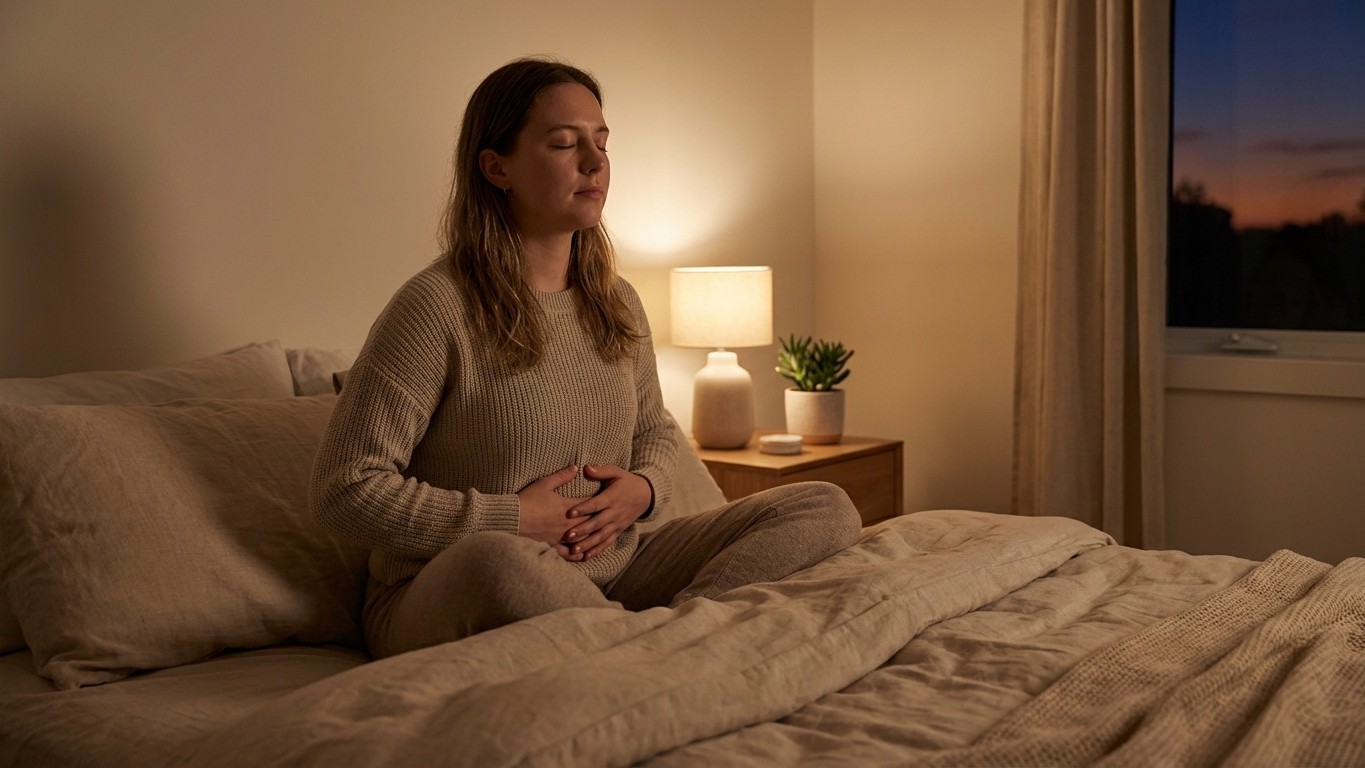
- Place one hand on your upper chest and the other on your abdomen, just below the ribs.
- Breathe in through your nose. Aim for the lower hand to rise more than the top hand.
- Exhale slowly, letting the abdomen fall. Keep the throat relaxed.
- Continue for 3 to 10 minutes. If you want structure, try a slightly longer exhale than inhale, for example inhale for 4, exhale for 6, without strain.
- When thoughts appear, note them briefly (for example “planning”, “worrying”, “remembering”) and return to the feeling of the breath.
Troubleshooting common issues:
- If you feel you cannot “belly breathe”, do not force it. Focus on expanding the lower ribs sideways, like an umbrella opening.
- If you start yawning or sighing, that can be a normal sign of downshifting. Let it happen.
- If mindful attention ramps up anxiety, keep your eyes open and focus on a neutral object, or switch to paced breathing for a few nights.
Practical tips to integrate these exercises into your evening routine
When and how often to practise
Timing makes a difference. If you start breathing exercises only when you are already panicking about not sleeping, the body can interpret the practice as another emergency measure. I prefer a two step approach for most people:
- Early wind down (30 to 90 minutes before bed): 5 minutes of paced breathing to lower baseline arousal.
- At lights out: 4 rounds of 4-7-8, or 3 to 10 minutes of mindful diaphragmatic breathing.
Frequency matters more than intensity. A brief daily practice tends to teach your nervous system what “settling” feels like. If evenings are very anxious, consider adding a short session earlier in the day, such as mid afternoon, to reduce overall load.
Classic Mistakes to Avoid
- Breathing too deeply or too fast, which can cause tingling, light headedness, or a feeling of air hunger
- Forcing the breath into the belly aggressively, leading to more tension
- Turning the exercise into a sleep test, which increases performance pressure
- Practising only in bed, so the bed becomes associated with “work” rather than rest
- Trying three methods back to back, which can keep the brain in problem solving mode
If you notice that any breathing method consistently makes you feel worse, pause it and discuss it with a clinician, especially if you have a history of panic attacks or respiratory conditions.
Frequently asked questions about breathing and evening anxiety
Which breathing exercises are most effective for anxiety before sleep?
Effectiveness is individual, but a helpful rule is: choose the method you can do gently and consistently. People who like structure often do well with paced breathing or 4-7-8. Those who feel stressed by counting often prefer mindful diaphragmatic breathing with a slightly longer exhale. If your anxiety includes physical agitation, paced breathing for 5 minutes earlier in the evening can be a good starting point, then a shorter practice in bed.
How long do you need to practise breathing to notice sleep benefits?
Some people feel a noticeable calming effect within a single session, particularly if they were breathing shallowly and quickly beforehand. Sleep improvements may take longer because sleep is influenced by many factors, including stress level, light exposure, alcohol, caffeine, and irregular schedules.
A realistic plan is to practise one protocol most nights for 2 weeks and note changes in:
- How long it takes to feel calmer at bedtime
- The intensity of rumination
- How often you wake and how quickly you resettle
Can breathing really replace sleeping tablets for night time anxiety?
Breathing can be a strong tool, but it is not a like for like replacement for medication, and it is not appropriate to make that swap without medical guidance. If you are using prescribed sleep or anxiety medication, speak with your GP before making changes. In many cases, breathing exercises are best viewed as a foundation skill that can reduce reliance on emergency coping strategies and support longer term sleep habits.
Combining breathing with other natural techniques
Breathing works well alongside other non drug approaches. If you want a broader menu, see relaxation techniques for sleep naturally. For people who carry tension in the body, pairing breathing with progressive muscle relaxation for sleep can be particularly soothing.
If your anxiety is driven by persistent mental chatter, a structured audio practice can help you stay with a calmer focus. The guide guided meditation for sleep natural explains how to choose a style that supports sleep rather than stimulating more thought.
Complementary resources and recommendations to go further
Breathing exercises are one part of a wider approach to stress related insomnia. If you are building a full evening routine, it can help to look at light exposure, stimulant timing, alcohol, bedroom temperature, and pre bed decompression habits. The hub page natural sleep remedies covers a range of options beyond breathing, including routines and other relaxation methods.
My practical recommendation for February 2026 is to keep your plan simple and measurable. Choose one breathing protocol, pick a consistent time, and decide what “success” means, calmer body, fewer spiralling thoughts, or easier return to sleep after waking. That keeps the focus on regulation rather than perfect sleep.
Medical note: This article is for general information and wellbeing support, not medical advice. If you have ongoing insomnia, significant anxiety, panic symptoms, or you are considering changing any medication, consult your GP for personalised guidance. What would you like to improve first tonight, the racing thoughts, the tight chest, or the urge to check the clock?